
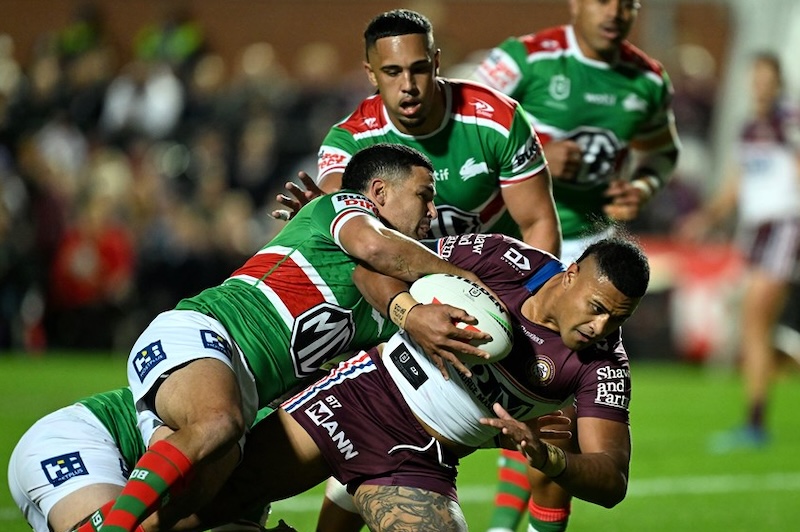
The biggest game in Australian sport right now isn’t being played on any field. It’s the fight for NRL broadcast rights between Nine Entertainment and Foxtel. Michael Pascoe says Nine could lose whatever the outcome.
It’s a devilish position for any CEO to be: lose the NRL broadcast rights for the next seven years and smash the company, pay too much for the broadcast rights and smash the company.
That’s the risk facing Nine Entertainment’s Max Stanton. The odds of a third outcome – paying only enough and not too much – just got longer with the AFR reporting Foxtel is bidding to buy all the broadcast and streaming and cut Nine out completely.
It’s a battle of the financially weakening local C-suite against a Ukrainian/Russian/Anglo-American billionaire.
The rights are presently shared by Foxtel and Nine until the end of next season. Foxtel’s reported pitch would replace Nine’s free-to-air component bringing both Seven and Ten on board, Seven broadcasting Sunday and Monday matches while Ten takes Thursday and Friday nights.
What Nine wants
Nine itself would like all the rights to boost its Stan streaming platform which would in turn be a massive blow to Foxtel.
One way or the other, the AFR’s Zoe Samios reckons the bidding war will deliver Rugby League (and Racing NSW) chief Peter V’landys his $4 billion rights goal, a billion more than Nine was thought to be offering and double the existing agreement.
Talk about inflation.
It’s always tempting to see conspiracy in local media games but this fight is international. It’s three decades since the Packer v Murdoch “Super League” war. Now there’s no Packer involved in Nine and Murdoch has just a 6 per cent stake and one board seat on Foxtel’s owner, London-headquartered DAZN, less than the Saudi government’s 10 per cent and both percentages irrelevant given billionaire Len Blavatnik’s majority holding through his Access Industries.
Blavatnik is Ukrainian born, Russian raised and a citizen of both the US and UK. He made his fortune buying into newly-privatised Russian commodities in the 1990s. Forbes estimates his worth at more than $50 billion.
The final quarter?
Nine Entertainment’s market capitalisation is $1.44 billion, struggling to hold at 91 cents a share, down a couple as the Foxtel bid news broke. It is trading at a price/earnings ratio of 1.57, which means the market doesn’t have much optimism about its future. It compares with an average PE ratio for the ASX 200 of about 20.
So it’s deep pockets versus near-empty pockets as Nine just paid $850 million to buy an outside advertising company – billboards.
Thanks to the government’s anti-siphoning rules, live sport remains free-to-air TV’s bedrock. Having it at the wrong price though is poisonous, as Seven’s slide towards oblivion demonstrates.
And with the company dominated by non-journalists, it’s those expensive newsrooms that would be back in the frontline of cost cutting.
Should the Nine board and management get the equation wrong, the result could be fatal.
There’s no printers ink at the top of Nine and little to show for the alleged synergy that was supposed to come from Nine’s takeover of Fairfax. A demerger would leave a cheap newspaper stable and a cheaper broadcasting arm up for grabs.
Heck, never mind about demerging.
The importance of the rugby league contract to the company’s existence might explain the duchessing of Peter V’landy’s interests beyond television.
Gambling ads furphy
Nine has been trying to make NRL be to the SMH what AFL is to The Age, elevating multiple NRL stories daily on the homepage above its politics, world, business and opinion sections.
Another hare potentially set running by a $4 billion broadcast deal, if the Federal Government had any ticker, is burying the “sport needs it” excuse for gambling advertising.
Neither of the major local football codes face meaningful international competition for talent.
The average AFL player on more than half a million a year and the average NRL player on $400K+ are paid that much because the money is there to pay them. If it wasn’t, the games would go on regardless of the athletes (and CEOs) being paid a bit less.
And please don’t try the old lie of “it’s for the kiddies”. Any government serious about encouraging children’s sport would pick up the insurance bill and stop the massive subsidisation of the very rich business operations that are the AFL and NRL.