
Whistleblowers get the blunt end of the stick in Australia. They do great public good but suffer for protection. Rex Patrick reports on KPMG and the live Neometals case.
Rules are important
Germans love rules. It’s what makes them good at engineering and manufacturing.
I spent a lot of time in Germany in the first decade of this century and grew a healthily respect for their love of rules. When I asked “what is it about rules”, the response was aways the same; rules bring certainty and also make summer holidays in southern Europe (where the Germans get a rest from their own rules) so much more enjoyable.
Christian Reiche is a German who came to Australia in 2023 under a visa scheme for people who have an ‘internationally recognised record of exceptional and outstanding achievement in their field of expertise’; in his case a waste and recycling subject matter expert in battery materials and recycling.
Christian was employed as Head of Recycling with an Australian battery technology company, Neometals, which had entered a joint venture with SMS, a German company, to commercialise the Australian technology. Chirstian was also appointed as the managing director of the joint venture, Primobius.
Blowing the whistle
Between February and April 2024, Christian ‘blew the whistle’ to his bosses at Neometals on a number of improper things he’d observed. Rules were being broken.
The reported conduct included intellectual property theft by a supplier (who was working with an SMS appointee on the joint venture advisory board), conflicts of interest that were a risk to both Neometals and the joint venture, and forgery of a management signature on a significant purchase order acceptance.
After his disclosures were ignored, in July 2024 Christian formally re-raised them by way of a letter and explicitly stated that the letter was a disclosure for the purpose of the whistleblower provisions of the Corporations Act. He followed up his July letter with inquiries as to the progress of investigations as per the company’s whistleblower policy.
Following the letter, on 26 July 2024, Christian’s delegation to approve purchases was reduced from $100K to $25K, he was excluded from a 6 August 2024 leadership event, was denied a time-in-lieu claim on 21 August 2024 and given a redundancy notice the following day. His employment was terminated on 4 September 2024.
KPMG whistleblowing
In May 2024, about the same time Christian was blowing the whistle at Neometals, another person was blowing the whistle at KPMG on audit independence failures, misuse of confidential client information and the corruption of ASX and audit tender processes.
That whistleblower was ignored by KPMG and only came to prominence after an adjournment speech by Labor Senator Deb O’Neill in the Senate on 24 March this year.
That speech has led to the Parliamentary Joint Committee on Corporations and Financial Services, which Senator O’Neill chairs, turning its focus on KPMG and ASIC. It has led to Andrew Yates resigning and there’s more to come.
No independent investigation of the substance of the concerns was commenced by KPMG. Adverse action was taken against the whistleblower, which the company characterised as a workplace grievance –
KPMG did not believe the person had blown the whistle.
And that takes us back to Christian.
Federal Court proceedings
Christian took Neometals to Court to deal with adverse actions taken against him as a whistleblower.
He lost, both in the Federal Court and the Full Federal Court, where the Government kicked in to pay his legal fees.
The Courts did so on the basis that Neometals did not believe Christian had made a disclosure qualifying for protection and any belief or suspicion their executives may have had was not the reason or part of the reason for the adverse conduct that followed, including his redundancy.
The Courts decided that a company doesn’t have to objectively assess, they only have to subjectively assess, that a disclosure was made and that the whistleblowing aligns with one of the disclosures that the Corporation Act qualifies for protection.
The problem with the law
This is hugely problematic, giving companies heaps of wiggle room to avoid liability for terminating a whistleblower.
The Courts also determined that the fact of the whistleblowing had to be a substantial or an operative factor in the adverse conduct before compensation could be awarded.
The substantial or operative factor approach is normally used to balance out the competing interests between employee and employer in a workplace dispute, not for the case of a whistleblower who openly expose themselves to significant personal and financial risk to play a critical role in the early detection and remedying or corporate misconduct.
Tasmanian MP and former whistleblower Andrew Wilkie expressed his dismay over Christian’s loss in the Parliament last month.
… this whistleblower was witness to serious misconduct, he spoke up, he thought he had the protection of the relevant part of the Corporations Act, but, because the management didn’t regard him as a whistleblower, he was not protected by the whistleblower protections.
The Courts got it wrong when they sought to interpret the law.
That’s an arrogant thing for me to say – the Courts core business is to work out what the Parliament meant by the words in the statute. But I can say it in this instance because I was personally involved in negotiating the exact law in question.
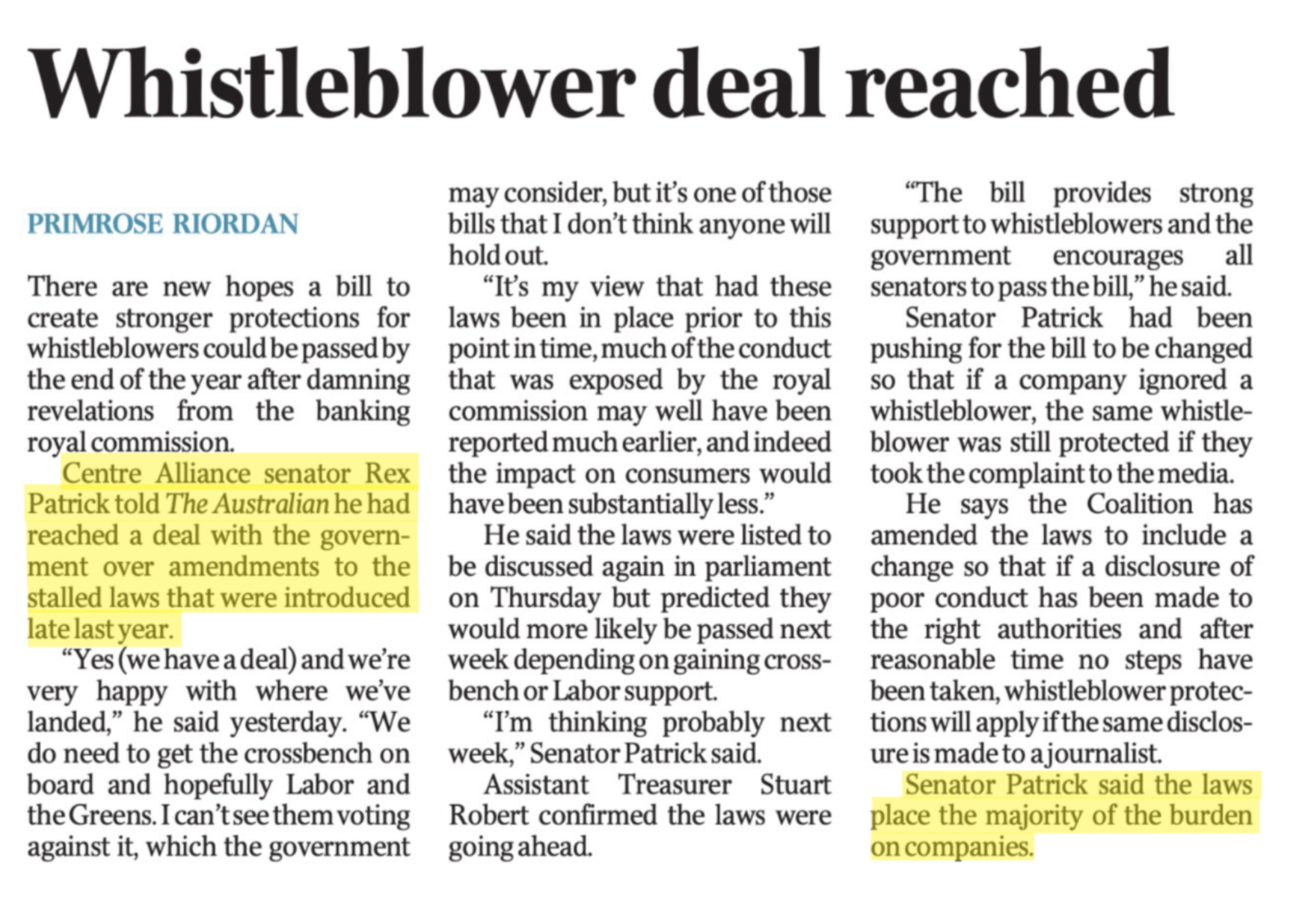
The Australian – 22 September 2018
Former Senator Nick Xenophon got a commitment from the Liberal Government in 2014 to enhance whistleblower protections. I took over from Nick Xenophon in the Senate and so also took over responsibility for ensuing the Government met its commitments to him.
When the Treasury Laws Amendment (Enhancing Whistleblower Protections) Bill 2018 was introduced into the Parliament the Senate’s Economics Committee examined the Bill and I sat on the Inquiry. I issued a dissenting report into the Bill entitled, “Perfect is the enemy of the good, but this ain’t even good”.
Recommendation 7 of my dissenting report dealt with the provisions that the Courts were dealing with in Christian’s case. It stated:
Belief or suspicion requirement in s1317AD(1)(b)&(c)must be removed and replaced with a more general test that does not hinge on state of mind.
I further recommended:
There must be no doubt in the statue’s language … none, nil, zilch! Without this we will end up seeing poorly resourced whistleblowers battling it out in the courts against highly resourced companies over the meaning and intent. If lawyers and judges are needed to sort out the interpretation, we haven’t done our job properly.
This Bill has to be amended so that there is no doubt as to a corporation’s responsibility to encourage and facilitate whistleblowers, to protect them, and in the event they fail in this duty then they will have to properly compensate them.
The dissenting report became the basis for negotiations between me and then Minister for Revenue and Financial Services Kelly, O’Dyer. These negotiations saw the Bill amended to address my concerns. So, I know the Court found an answer in the legislation that was different to what Kelly O’Dwyer and I intended and the Parliament ultimately agreed to.
High Court appeal
Christian honoured conduct rules himself and blew the whistle when he saw conduct rules being broken. He did so, with the confidence only a German could, thinking the rules Parliament had made would protect him as a whistle-blower.
His employment was terminated and, when he took the matter to the independent umpires, the umpires have misinterpreted the rules Parliament made.
Christian has appealed the umpires’ interpretation to the High Court. The Whistleblower Justice Fund, through its supporters, have kicked in $25K to fund his special leave application.
Let’s hope the High Court elects to hear the matter. It can’t be that companies can claim “we didn’t realise” as they kick a whistleblower out the door.
Whistleblower out. Cricket Australia investigates ‘contracts-for-mates’ affair