Australia’s Future Fund and other large funds could soon be defending themselves as opponents of the Gaza genocide consider court action. Andrew Gardiner with the story.
A recent landmark New Zealand High Court ruling has compelled that country’s fund to properly address human rights issues and Geneva Convention breaches before investing in conflict areas.
The NZ ruling has activists abuzz about its implications here, with the Australia Palestine Advocacy Network (APAN) and the Australian Centre for International Justice (ACIJ) known to be exploring legal options “to ensure our sovereign wealth fund and all other investment funds are adhering to their human rights due diligence obligations”.
A court case in The Hague on Australia’s selling weapons parts directly to Israel would have to be brought by another country, but Nicaragua began a not-dissimilar, as-yet-unresolved case against Germany in 2024.
MWM understands there are at least two avenues for a legal challenge to the Future Fund’s selective use of Environmental, Social and Governance (ESG) factors in determining where it will invest, and to Australia’s sales of F-35 and other parts to Israel.
One is in The Hague,
where ACIJ’s Rawan Arraf says “Australia could face proceedings before judicial bodies (like) the International Court of Justice (ICJ)”, alongside the much-watched genocide case against Israel.
Future Fund’s reputation at stake
According to Arraf, the fund’s investments “expose Australia to serious reputational consequences — including damage to its credibility within the UN system — and undermine its standing as a state that claims to uphold international law and human rights.”
“Reputational consequences” were at the heart of the NZ ruling, but Australia’s Future Fund Act (2006) fails to mention these words, meaning there’s no precedent for something similar here. Instead, activists have zeroed in on Section 18 of the act, which gives Treasurer Jim Chalmers and Finance Minister Katy Gallagher “Investment Mandate” powers over the fund.
As Ministers of the Crown, both are bound by Australia’s obligations under the various international treaties and conventions we’re a part of. “The (Future Fund) Board has explicit investment exclusions for activities banned through international conventions and treaties ratified by Australia”, the Finance Department points out.
Australia has also signed up to treaties and conventions which outlaw:
- Genocide (a UN-backed investigation concluded Israel is committing genocide in Gaza);
- Starvation of civilians (the International Criminal Court (ICC) has issued warrants for Israel’s PM Netanyahu and former Defence Minister Gallant over just such offences);
- Illegal settlements (the ICJ ruled that Israel’s West Bank settlement policies violate international law by “transferring parts of its own civilian population into the territory it occupies”);
- Racial Discrimination (the ICJ “found multiple and serious violations by Israel towards Palestinians in the (West Bank), including, for the first time, finding Israel responsible for apartheid”).
Looking the other way
On face value, readers would be assuming Chalmers and Gallagher had long since required the Future Fund to divest its close to $300m from companies enabling these crimes and much more. Yet it seems a blind eye is being turned, under the watchful gaze of Australia’s all-powerful Zionist lobby.
“The Future Fund pulled its money out of places like China, Russia and Myanmar in recent years, but it looks like someone was pressured not to follow suit in the Middle East, where Gaza’s death toll alone has hit six figures”, one senior activist said.
MWM approached the Future Fund and two relevant government departments for comment.
Australia likes to think of itself as a good global citizen, but it’s becoming increasingly hard to maintain that image while its Future Fund is full-speed ahead on war profiteering.
The fund’s ambivalence in the face of Middle East carnage came into sharper focus when it took serial offender Elbit Systems off a banned investment list six months before the Gaza invasion.
Double standards
One example is Elbit, which stands condemned for its part in bloody moments like the 2024 attack on a World Central Kitchen aid convoy in Gaza, which killed seven aid workers, including Australian Zomi Frankcom. But this didn’t stop the Future Fund, which upped its Elbit investments fivefold that same year.
As sovereign wealth and pension funds in Norway, Sweden and the Netherlands divest from the companies enabling genocide, our Future Fund seems not to want to know about it. That is, unless the international pariah is a country like Russia, which the fund announced it was divesting from just four days after the invasion of Ukraine.
How do they get away with such double standards? The answer lies in the fine print, where exclusions specifically mandated by the government around various war crimes are mysteriously watered down by the time they appear in the fund’s much-touted investment policies.
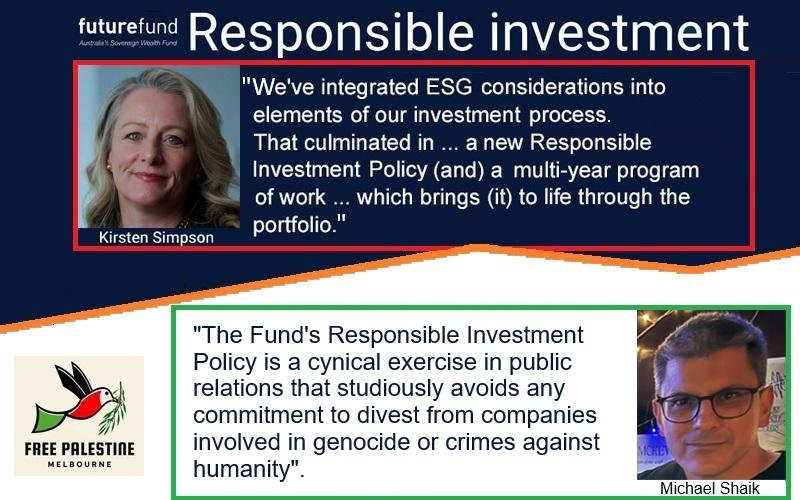
Image collage by author
Asserting its ‘independence’ from the government, the fund applies a narrow set of investment exclusion rules, allowing offenders like Elbit to slip through the cracks.
Historically, the fund has excluded only companies producing cluster munitions, landmines, chemical and biological weapons, although its Responsible Investment director, Kirsten Simpson, has pledged to make changes one day as part of a “multi-year program”.
Until those “multiple years” pass and we see real change, however, the ACIJ has no hesitation in calling the Responsible Investment Policy framework “astonishingly inadequate”.
In lieu of meaningful change by the fund itself, one solution could be changes to the Future Fund Act, which Michael Shaik from Free Palestine Melbourne (FPM) sees as
urgently needed to bring Future Fund investments into line with our international obligations.
Drawing the line
Cue Red Lines 2.0, a legislative package addressing (among other things) the fund’s investment practices, coming soon, thanks to a pair of independent Senators.
Activists say it will need strong support from human rights groups, crossbenchers, Greens and (if they’re lucky) major party sympathisers before it can be referred to Senate Inquiries, in turn triggering the kind of public scrutiny required to bring change.
As for its actual passage into law, Red Lines 2.0 faces steep odds after an earlier version was blocked by the major parties. Meanwhile, Nicaragua has formally threatened court action in The Hague against three countries – the UK, the Netherlands and Canada – over their weapons parts sales to Israel.
FPM and other activist organisations know the long odds they face combating the behemoth that is the Zionist lobby, and – court challenges aside – continue to plug away with grassroots activism.
“We understand that there is a lot of work to be done, but we are in this for the long haul, building workplace and community links around divestment and making the government’s current support for Israel untenable”, Shaik told MWM.
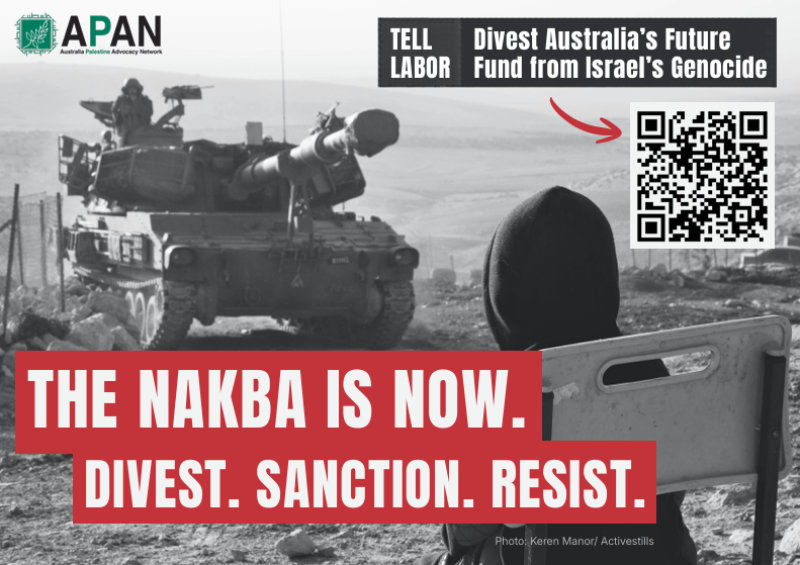
For its part, APAN launched its “the Nakba is now” campaign on Friday, marking the anniversary of a mass displacement and dispossession of Palestinians after Israel’s establishment in 1948. Protesters marched in cities across Australia to mark the Nakba, which APAN has made a centrepiece in its campaign to divest the Future Fund.
“The 1948 Nakba (meaning ‘catastrophe’ in Arabic) massacred tens of thousands and wiped 530 villages off the map”, APAN campaigns lead Molly Coburn pointed out. “It continues to this day, and we’re all paying for it”.