
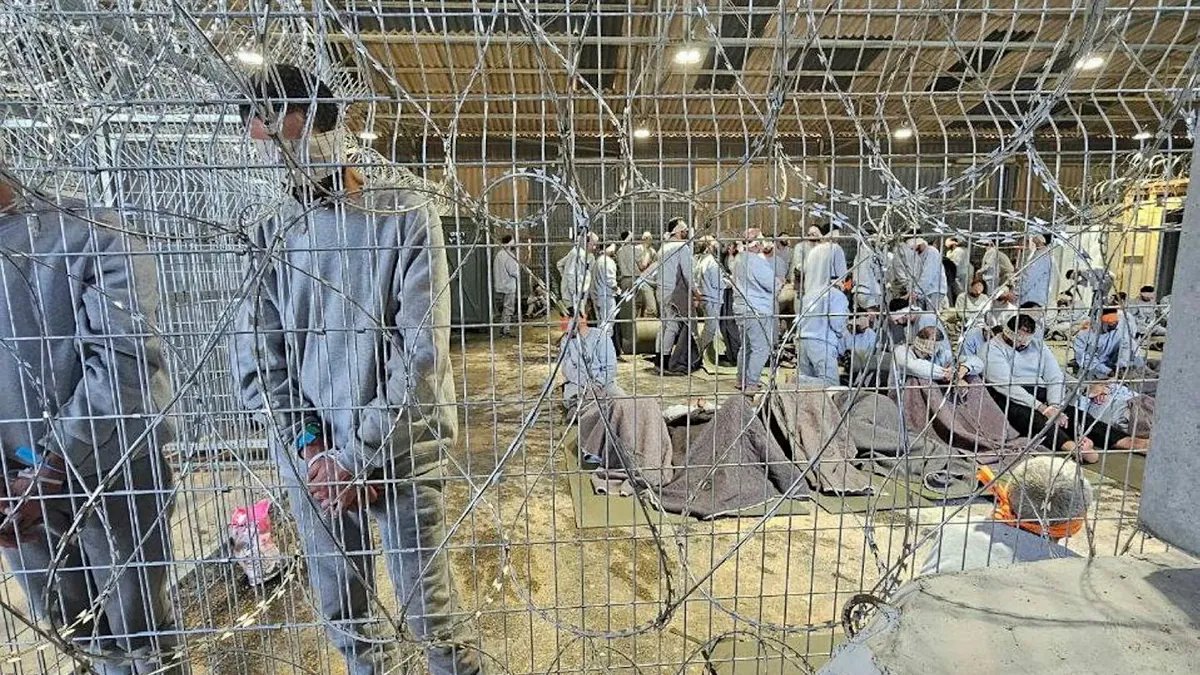
A report titled ‘Another Genocide Behind Walls’ was published this week, bearing witness to unspeakable atrocities committed by IDF soldiers. Andrew Brown reports.
Warning: This story contains graphic descriptions of violence.
A report published just days ago by Euro-Med Human Rights Monitor documents testimony from a Palestinian woman detained at Sde Teiman who was filmed being raped by two Israeli soldiers over two days. She knows the footage exists because when it was over, her captors hung her by her wrists during interrogation and showed it to her.
They told her they would publish it unless she cooperated.
That footage is somewhere. It may have been copied, shared, archived, or passed through servers. It may have moved through intelligence channels that include partners of Australia. It has not been produced, accounted for, or publicly demanded by a single Australian minister or a single editor of a major Australian newspaper.
We will come back to that.
The report is titled “Another Genocide Behind Walls.” The publisher is a Geneva-based independent human rights organisation. It covers what happened inside Israeli prisons and detention centres from October 2023 to October 2025. It runs to dozens of pages of documented testimony, legal analysis, and findings that Euro-Med describes as constituting
a de facto state policy of sexual violence used as a tool of subjugation and destruction.
It was available to every journalist and politician in Australia the day it was released, but do not expect to hear about it from them.
It will not lead the evening news. It will not appear on the front page of the Sydney Morning Herald or The Australian. No minister will be asked about it at a doorstop. No shadow minister will demand a response. It will be categorised, quietly and efficiently, as the kind of story that does not get run by the kind of people who have decided, without ever saying so publicly, that some victims do not generate the coverage others do.
It will be buried not through censorship but through the more respectable mechanism of collective editorial silence, which in this country has proven just as effective.
That is why you are reading it here.

Loading…

 Reload document
  Open in new tab
 Raped by a dog
His name is not in the report. He is 43 years old. He was held for a year without charge. Before that year, he had a life, a family, a name people used when they needed him. This is what he told investigators about what a single day of interrogation meant inside that facility:
“They tied me naked to a metal bed… then a soldier raped me. I felt severe pain in my anus and screamed, but every time I screamed, I was beaten… The soldier left after ejaculating inside me. I was left in a humiliating position… I was bleeding. Later, they brought a dog… the dog raped me… I was raped at least twice more that day.”
That is one day. He was held for a year.
A second man describes watching someone he knew be gang raped by soldiers taking turns over more than forty minutes while others watched. When it was over, they brought the man back to the group, broken, so the rest of them would understand what they were and what could be done to them.
A Palestinian woman at Sde Teiman was bound naked to a metal table, raped by two Israeli soldiers over two days, left shackled and bleeding through the night between. She told investigators she had wished for death. The report is named for what she called her experience.
Then there is this. A man detained at Sde Teiman describes hearing dogs barking in the area where detainees were held in metal cages. He describes what two soldiers did next:
“They forced me to lie down, and a dog climbed on top of me and tried to insert its penis into me. At first, I did not understand what was happening, but then I realised that I was being raped. I was completely naked, with no clothes on. I felt the dog’s fluids on my body. I tried to resist, but I was handcuffed, and the space was so small that I could not move. Two of them were holding me down tightly. This went on for three to four minutes.”
Two of them were holding him down.
That detail destroys every defence available. This is not a soldier losing control in the chaos of war. Two people made a decision, took positions, and held a handcuffed man still while an animal was used on his body. That act requires organisation. It requires the absolute certainty of impunity,
and impunity at that scale is not something individual soldiers manufacture for themselves.
It is institutional. It is policy. It comes from above, which is what the report states. It finds these practices were carried out as part of a policy supported by senior civilian and military leaders.
No accountability, just complicity
In March of this year, the Israeli military announced it was dropping charges against five soldiers accused of gang-raping a Palestinian detainee at Sde Teiman. It dropped those charges despite CCTV footage showing soldiers surrounding the detainee as he was pinned against a wall.
Charges dropped. Footage in evidence. This is not a justice system failing. This is a justice system doing its job, which is to protect the men inside it.
When footage of those five soldiers was leaked to the Israeli public by the country’s own military advocate general, a two-star general named Yifat Tomer-Yerushalmi, she was arrested, charged with obstruction of justice and fraud, and forced to resign.
The woman who released evidence of a crime was prosecuted. The men who committed it held a press conference outside the Supreme Court and described themselves as victims of an unfair trial.
Right-wing organisations staged public demonstrations in their support. Benjamin Netanyahu looked at CCTV footage of soldiers sexually assaulting a Palestinian detainee and described the leak of that footage as, in his own words, the most serious public relations attack against Israel to date.
Not the rape. The footage of the rape.
These men did not disappear quietly. They became a cause. They became symbols. They were embraced by a political movement that understood exactly what they had done and celebrated them for it.
“Most moral army in the world”
This is the army that Israeli government spokespeople, and more than a few Australian politicians, have described in public as the most moral army in the world.
This is the only democracy in the Middle East. These are the phrases repeated in our parliament, in our press galleries, and on our opinion pages for decades, offered as a reason to extend trust, supply weapons, share intelligence, and look the other way when the evidence becomes inconvenient.
A handcuffed man in a cage too small to move. Two soldiers holding him down. An animal used on his body for three to four minutes.
The most moral army in the world.
Now consider who we are supposed to be.
Spitting on the Anzac tradition
Australia has built a national identity on the proposition that how you treat the person who cannot defend themselves is the truest measure of your character. We do not just believe this in the abstract. We have consecrated it. The Anzac tradition does not rest on victory or military glory. It rests on captivity, on what it means to watch a man be broken in a place no one can reach, and to carry that witness for the rest of your life.
We gather every April to honour that. We teach it to children as the irreducible thing that separates us from the worst of what human beings do to each other.
The men and women in these testimonies were handcuffed in spaces too small to move and raped by animals while soldiers held them down. They were filmed and threatened with publication.
They were destroyed in front of other prisoners so the terror would multiply.
They were held without charge, without lawyers, without Red Cross access, in facilities that Australia’s ally maintains and that Australia’s government has consistently refused to condemn in any language that costs anything.
If those were Australian prisoners, the Foreign Minister would not need to be asked twice. We would have named it at the United Nations, recalled our ambassador, and cancelled every arms arrangement before the bodies were cold. We know this because we have done exactly that for other prisoners in other places when the politics allowed it.
The politics do not allow it here. Albanese, Wong, and Marles have decided, quietly and without ever saying so directly, that they do not.
Albanese has spoken of being troubled by civilian casualties. Wong has called for humanitarian access. Neither of them has said the word rape in this context. Neither has named Sde Teiman.
Neither has demanded that the footage be produced and accounted for.
That footage. Still somewhere. Still undemanded by the government that calls itself our moral voice in the region.
What this masthead is demanding is simple, and it is on the record.
Table the report!
The Euro-Med Human Rights Monitor report “Another Genocide Behind Walls” must be tabled formally in both chambers of the Australian parliament.
Not quoted in a speech. Not summarised in a press release. Tabled, as a document of this legislature, so that it cannot be managed into a ministerial inbox and forgotten.
Once tabled, Albanese, Wong, and Marles must respond on the Senate floor, in person, under their names. The question is not complicated. It is the same question the footage demands.
What do you know, when did you know it, and what are you going to do?
The editors of this country’s major mastheads who have had these findings and run diplomatic process stories instead owe their readers a public explanation. That too should be on the record.
The 43-year-old man whose name is not in the report is out of that facility now. When investigators asked about his condition, he told them he was in very poor physical and mental health. That is a man reaching for language to describe something language was not made to carry. He found it anyway. He sat in front of investigators, in whatever state he was in after a year in that place, and he said what was done to him.
He did his part and bore witness.
The question is whether this country will do ours.
Middle East carnage continues to line the pockets of superfunds