

Australian industry super funds are investing in companies involved in the Gaza genocide, and unions are not demanding they stop. Andrew Gardiner reports.
Protected by rules putting a member’s “best financial interests” over ethical, environmental or social considerations, the vast majority of Australia’s industry superfunds are all-systems-go on pouring money into projects connected to the decimation of Gaza, dispossession in the West Bank, and bombing Israel’s neighbours.
An MWM investigation has confirmed that just two of Australia’s 20 industry super funds are making modest changes to their investment portfolios. The other 18 remain invested in Israel’s war machine, with Australian Super alone funding corporations like Elbit Systems (drones), ICL Group (white phosphorus) and Palantir (AI/software for weapons systems).
This, even as the IDF is again using the banned white phosphorus in Lebanon, in which Australian super is invested.
The two funds which did divest – Vision Super and HESTA – still have some money tied up in Israeli projects in Gaza and the West Bank. “HESTA and Vision divested from Israeli banks (but) they still have money in companies listed on a UN database as operating from Israel’s illegal settlements”, Molly Coburn from the Australia Palestine Advocacy Network (APAN) told MWM.
White phosphorus, blood-red money. Australian Super profiting from genocide
Activist Jill Sparrow says even those modest changes could be quietly reversed “as soon as we look away”. “Divestment isn’t set and forget (and)
there’s a lot of money to be made in dropping bombs,
“so super funds could be sorely tempted”, she said.
If you’re in a union-partner industry super fund and have a problem with genocide, chances are you’re out of luck on the socially-conscious investments front. Unions routinely route members’ super into partner funds with little regard to the social or environmental impact when it’s invested.
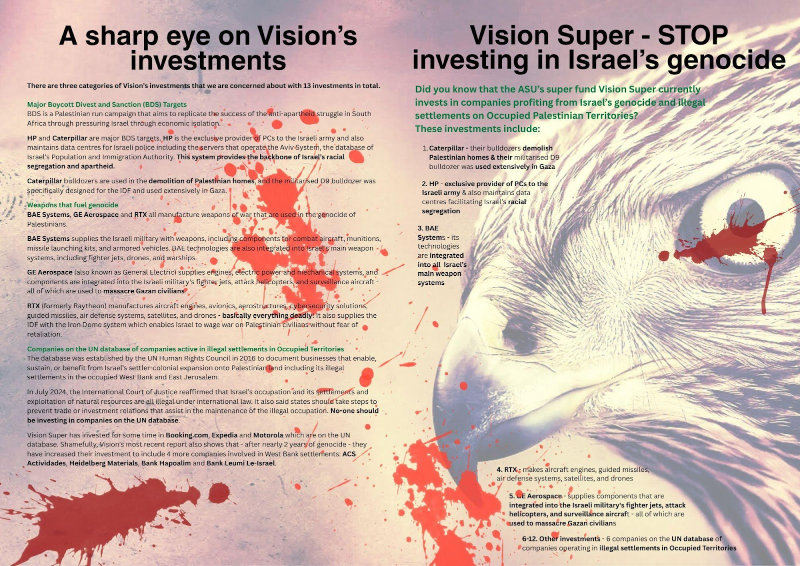
Australian Services Union (ASU) members took matters into their own hands on super fund divestment. IMAGE: ASU for Palestine.
Ethics ignored
Under 2005 rule changes, union members can transfer their super to retail super funds, Australian Ethical and Future Group, which shun companies whose work enables the carnage in Gaza. These funds show it can be done, so why have industry super funds not done it?
Instead, unions aligned with the Labor Party, under pressure from Zionist lobbyists, are content to send members’ money to super funds that aid the Israeli war effort, funding what the UN calls “a moral stain on us all”.
Like so many other ACTU affiliates, the United Workers Union (UWU), with 151,000 members, talks a good game on Israel’s actions in Gaza, but hasn’t put its members’ super where its mouth is. MWM’s efforts to ascertain how much the union had done to lobby its super funds – HostPlus, Australian Super and HESTA – yielded nothing.
What we learned from UWU members is that in early 2024, a rank-and-file motion including divestment was passed at the council level in various states before being “soft-blocked” by union officials, who reportedly sat on it. Later that year, a more formal “Boycott, Divestment and Sanctions” (BDS) motion, requiring real action compelling divestment by the super funds, was defeated.
“Social issues are bread and butter issues, and funding war is a dead end. Our leadership – who are on the boards of HESTA and Australian Super – (need) to stop hiding behind ‘fiduciary duties’ to fund death and destruction”, UWU delegate (early childhood education) Nicki Toupin told MWM.
Fidiciary duties
Fiduciary duty doesn’t just provide cover for unions putting the bottom line first. “In the interests of members”, it’s cited time and again by super funds whenever there’s pressure to divest.
Buttressing their argument is case law precedent, which will raise the hackles of Australian republicans: Cowan v Scargill, a UK decision dating back to the Thatcher years (1985), helped redefine a member’s “best interests” as “best financial interests” (emphasis added). 2021 changes to fiduciary duty here in Australia reflect that new emphasis.
How do you define “best financial interests”? Wouldn’t a stable Middle East be good for the world’s economy, providing investment opportunities for our super funds that don’t involve genocide?
“Egregious war crimes, crimes against humanity and devastating environmental impacts mean you can argue that the financial interests of super fund members are undermined by investments that support the Israeli military”, Claire Parfitt, Senior Lecturer in Political Economy at Sydney University, told MWM.
It seems our super funds, and their investment managers, are ignoring these arguments in the quest for a quick return, their investment in the Israeli war machine rendering Middle East instability something of a self-fulfilling prophecy.
There are, of course, equal and opposite rules against super funds investing in projects “maintaining the situation created by Israel’s illegal presence in the occupied Palestinian territory”. But some rules, it seems, are more equal than others; successive Australian governments barely lift a finger to enforce international court rulings, human rights obligations and social considerations (ESG), which might trouble the bottom line.
To quote a famous movie line, “a foul is not a foul unless the ref blows his whistle”. The failure to enforce international and ethical obligations means super funds can go on hiding behind “fiduciary duty”; at least 18 of our 20 industry funds are doing just that.
From Vietnam war to Gaza genocide. Where have all the unions gone?