
Australia does not suffer from a lack of empathy. It suffers from selective empathy. And nowhere is that clearer than in the way our political and media class decide who is allowed to mourn. Andrew Brown with the story.
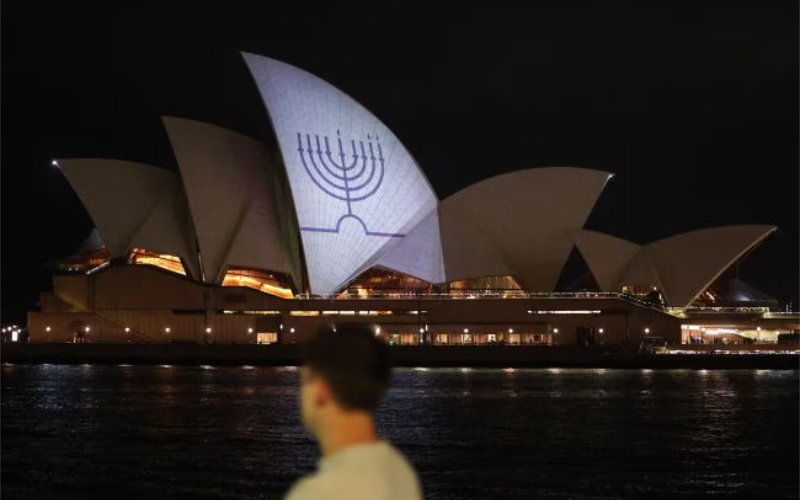
Thursday night at the Opera House was a masterclass in performative sorrow. Premiers, the opposition leader and the prime minister lined up, kippahs in place, voices lowered, faces solemn. Cameras rolled. Statements were delivered. Condolences stacked neatly on top of one another. This was not an isolated moment. It was the latest act in a month-long production of national grief.
Vigils. Ceremonies. Bondi Beach gatherings. Flags lowered. Monuments illuminated. Front pages flooded. Four or five pages a day. Every day. For weeks.
The fifteen deaths were tragic. No argument there. But tragedy alone does not explain the scale, intensity and unanimity of the response. What explains it is something far less noble.
A rigid hierarchy of grief that decides whose suffering is sacred and whose is negotiable.
Roughly ninety thousand Jewish Australians received uninterrupted national mourning. Meanwhile, between seven hundred and fifty thousand and eight hundred thousand Aboriginal Australians are told they do not even have the right to mourn publicly on the day that marks the beginning of their dispossession.
When Aboriginal Australians say January 26 is not a birthday but a funeral date, invasion, mass death, cultural destruction, they are told to stop whining and start celebrating. When they ask for a day of mourning instead of fireworks, they are branded divisive. Un-Australian. Trouble makers.
Their grief is treated not as grief but as a political irritant.
This hostility is not spontaneous. It is cultivated. And it is amplified relentlessly by News Corp Australia, which has perfected the art of sanctifying some pain while ridiculing others. Jewish mourning is framed as a moral obligation. Aboriginal mourning is framed as an attack on the nation.
Ask a simple question. Do we fly Aboriginal flags at half mast on January 26? Do our leaders line up wearing Aboriginal symbols to apologise for genocide? Do we dim national monuments for the tens of thousands killed and the millions dispossessed over generations?
The answer is no. Always no.
But we will lower flags for a foreign nation. We will light up monuments for another country. We will bend Australian national symbolism into elaborate shapes of solidarity abroad while denying it at home.
The hypocrisy deepens when we move from symbolism to power.
Aboriginal Australians are not a special interest group. They are the custodians of this continent for seventy to eighty thousand years. After decades of consultation, they issued the Uluru Statement from the Heart. The request was modest by any democratic standard. A Voice to Parliament. A permanent advisory body so they could speak about laws that govern their lives. Not a veto. Not supremacy. Just a voice.
Australia said no.
The population rejected it at referendum. Loudly. Decisively. Aboriginal Australians were told their history could be acknowledged symbolically but never structurally. Their voice would remain optional.
Then, without a vote, without a referendum, without even asking the public, the government appointed a special envoy for Jewish Australians.
We were not consulted. We were informed.
That envoy now shapes policy across universities, visas, funding and law. Institutions comply instantly. Policies are rewritten. Speech boundaries tighten. Laws are amended at speed. Political leaders fall into line without hesitation.
Protection is automatic.
This is not an argument against protecting Jewish Australians. They deserve safety and dignity like anyone else. What is being exposed is the double standard. One community must survive a referendum to be heard,
another receives institutional power by ministerial decree.
And then there is the question no one in politics or media dares to address honestly. Many of the people Australia has wrapped in national mourning openly identify first with Israel. Dual allegiance is not hidden. It is asserted. Yet Australia lowers flags and performs national grief for that foreign nation while denying its own First Nations even a single day of mourning.
This is what Aboriginal Australians see.
They see leaders don religious symbols for others while refusing even symbolic recognition for them. They see weeks of wall-to-wall grief coverage while deaths in custody barely rate a paragraph. They see laws passed overnight to combat one form of racism while their own is endlessly debated, diluted or dismissed.
They see a country that knows exactly how to mourn, yet chooses not to when the dead are theirs.
This is not unity. It is hierarchy. It is moral cowardice dressed up as compassion. And it is enforced daily by a political class addicted to optics and a media class that decides whose pain counts.
Australia does not lack empathy. It lacks honesty.
Until this country applies the same standards of grief, symbolism and institutional respect to Aboriginal Australia that it so effortlessly grants to others, every speech about unity is hollow.
And most Australians, if they are honest, already know it.