
The Bondi Royal Commission started its public hearings this week, and the mainstream media is lapping up the antisemitism narrative while ignoring other Jewish voices. Stephanie Tran reports.
The first block of public hearings for the Royal Commission into Antisemitism and Social Cohesion began this week, focusing on the prevalence and key drivers of antisemitism in Australia.
Questions about representation and balance have already emerged, with critics arguing that the hearings are dominated by established, pro-Israel Jewish organisations, while progressive and non-Zionist voices remain marginal.
A number of peak Jewish bodies giving evidence, including the Executive Council of Australian Jewry, New South Wales Jewish Board of Deputies, Jewish Community Council of Victoria, Zionist Federation of Australia, National Council of Jewish Women of Australia, Australia/Israel & Jewish Affairs Council and the Dor Foundation, are being represented by the same barristers and solicitors, Arnold Bloch Leibler.
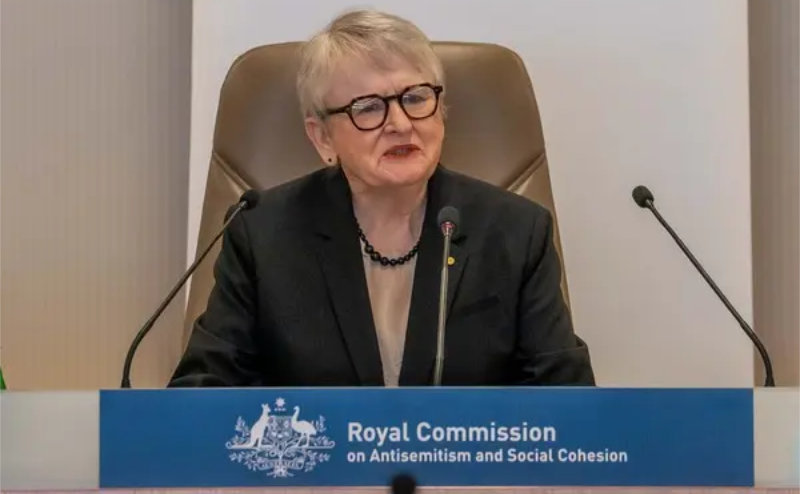
In her opening remarks on Monday, Royal Commissioner Virginia Bell said she was “satisfied that these organisations represent the majority of Australian Jews”.
The hearings will also include evidence from senior community figures, with counsel assisting Zelie Heger noting that they will provide a “bird’s-eye overview” of antisemitism in Australia.
They include Australia’s Special Envoy to Combat Antisemitism, Jillian Segal and Jeremy Leibler, partner at Arnold Bloch Leibler and president of the Zionist Federation of Australia.
Conflating Jewish identity with Israel
Peter Wertheim, co-CEO of the Executive Council of Australian Jewry, told the Royal Commission on Tuesday that the pro-Palestine protests in the wake of October 7 were “shocking” and called the “endless repetition of the genocide charge” an attempt to “re-stigmatise Jews collectively”.
Bell granted limited leave to the Jewish Council of Australia to examine expert witnesses on the IHRA definition and survey data relating to antisemitic attitudes, describing it as representing “a distinct but much smaller section of the Jewish community”.
That characterisation has been contested by some Jewish academics and advocates, who argue that the Jewish community is far more politically and ideologically diverse.
Antony Loewenstein, an independent journalist, film-maker and author of The Palestine Laboratory, and an advisory committee member of the Jewish Council of Australia, said it was “highly questionable” whether the organisations appearing before the commission reflect the breadth of Jewish opinion in Australia.
“The Australian Jewish community is culturally, politically and religiously diverse, and
it’s highly questionable if the most pro-Netanyahu, pro-Israel lobby groups represent the majority of Jews in the country..
Loewenstein criticised the tendency among these organisations to conflate Jewish identity with the actions of the Israeli state.
“Conflating Israel and Judaism, pursued by the so-called mainstream Jewish groups in Australia, is both historically inaccurate and dangerous, tying Jews to the actions of a genocidal Jewish state.”
Professor Linda Briskman, the Margaret Whitlam Chair of Social Work at Western Sydney University and also on the advisory committee of the Jewish Council of Australia, said her research into Jewish Australians critical of Israeli government policies pointed to a different picture from that presented by peak bodies.
Briskman co-authored Not in Our Name: Jewish Australians Speak Out, a report examining the experiences of Australian Jews who oppose Israeli policies and practices in the Occupied Palestinian Territories.
“What we’ve found is that opposition to Israel’s actions is grounded not in the rejection of Jewish identity but in deeply held ethical commitments rooted in Jewish traditions of justice,” she said.
She added that Jews expressing dissenting views often face “significant personal and social consequences”, and said that
antisemitism should be addressed alongside other forms of racism.
“We should be concerned about all forms of racism,” she said. “Racism against Jewish people shouldn’t be treated as the exception. We know that Islamophobia has risen greatly since October 7, but that doesn’t get nearly as much publicity or attention.”
Jewish Council of Australia
The Jewish Council of Australia, which represents Jewish Australians and supports Palestinian rights while opposing antisemitism and racism, was granted leave on Friday to cross-examine expert witnesses on the IHRA definition and data relating to antisemitism.
In a letter to supporters, executive director Sarah Schwartz said the group was seeking to raise funds to cover legal representation at the hearing.
“Pro-Israel legacy organisations, who receive significant public funding, have already formed a conglomerate and briefed a large team of barristers and lawyers,” she wrote.
Schwartz said the balance of representation would shape how the hearings are understood publicly, telling MWM,
If the only Jewish groups represented in these hearings are Israel-aligned, it will have a significant impact on the narrative.
“Having us in the room will be the single most effective way we can ensure these hearings are not exploited to pursue a right-wing agenda and demonise Palestinians, Muslims, immigrants and those speaking out against Israel’s genocide.”
IHRA definition
The hearings will scrutinise the use of the International Holocaust Remembrance Alliance (IHRA) definition of antisemitism.
In opening remarks, Bell acknowledged divisions within the Jewish community over the definition, noting concerns that it could be used to suppress criticism of Israel.
“The Jewish community is not monolithic, and there exist divisions of view amongst them about matters that include the politics of the Middle East,” she said. “I’m conscious that some Jews and other members of the Australian community believe that the IHRA working definition of antisemitism can be weaponised in order to suppress criticism of Israel.”
However, Bell defended its use, arguing that conduct must be assessed in context.
“I consider that some of the criticisms of the IHRA definition proceed on a misconception,” she said. “The examples of conduct under that working definition that may constitute antisemitism are just that. In every case, the question of whether the conduct is to be assessed as antisemitic is considered in its overall context.
“I expect the application of the IHRA definition will be fleshed out in the course of the evidence of witnesses in this first block of hearings by witnesses who have appropriate expertise.”
“When anti-Zionism becomes antisemitism”
Counsel assisting the Royal Commission, Richard Lancaster SC, said a key task for the inquiry “is to identify when anti-Zionism becomes antisemitism”.
He described Zionism as “the belief in the Jewish people’s right to self-determination in their ancestral and biblical homeland of Israel”, which he said is a “core value” for many Australian Jews.
Lancaster said that some examples within the IHRA definition suggest that, depending on context, “it could be antisemitic to deny that right to self-determination,” attribute collective responsibility to Jews for the actions of the Israeli state, or express hatred on the basis of perceived loyalty to Israel.
“A further aspect of this is that current Australian political and social commentary undoubtedly displays many instances of very strongly expressed criticism of the polarising actions of Israel’s current government,” he added, stating that expert witnesses would be asked to help distinguish between legitimate political criticism and antisemitic rhetoric.
“One of the experts to be called is Dr Dave Rich, who is the director of policy at the Community Security Trust in London, as research fellow at the London Center for the Study of Contemporary Antisemitism,” Lancaster said.
Rich is a “is a leading expert on left-wing antisemitism”. He has rejected the UN’s finding that Israel has committed a genocide in Gaza, stating that UN’s finding “has put the final nail in the coffin of Israel’s reputation, but it is as shoddy and partisan as every other attempt to pin the genocide label onto the Jewish State”.
In March, Rich delivered a keynote at a conference launching a new national approach to addressing antisemitism in Australian schools, developed by UNESCO and implemented by the Office of the Special Envoy on Combating Antisemitism.