
The Women Deliver conference in Melbourne exposed the global decline in humanitarian aid amid escalating conflict. Aleta Moriarty was there.
Women Deliver is the largest gathering of women leaders, rights advocates and activists anywhere in the world, bringing together 6,000 people from 189 countries.
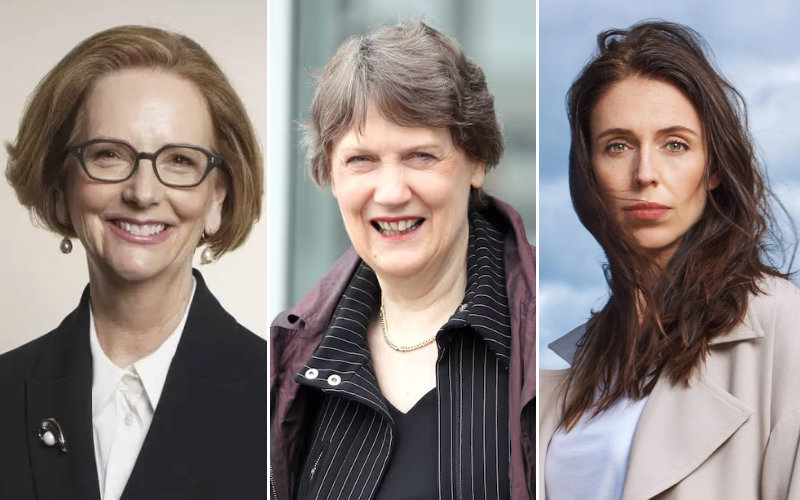
Alongside the activists were former leaders Julia Gillard, Jacinda Ardern, Helen Clarke and Justin Trudeau, who confronted the defining crises of our time: a world at war, the global rise of authoritarianism, the unchecked power of corporations, and the systematic erosion of the multilateral system.
Out of it came the Melbourne Declaration for Gender Equality, a global commitment to rebalance power, resources and accountability for girls, women and gender-diverse people.
A world at war
Conflict was front and centre, with representatives from almost all conflict-affected regions and countries, including Myanmar, Palestine, Lebanon, and Afghanistan.
According to the Uppsala Conflict Data Program (UCDP), 61 active state-based conflicts were recorded in 2024, the highest number since records began in 1946. The International Committee of the Red Cross puts the total number of armed conflicts at 130, double the figure of fifteen years ago. The Armed Conflict Location and Event Data Project (ACLED) estimates
one in eight people worldwide is now exposed to conflict.
The burden falls disproportionately on women and girls. UN Women reports that in 2024, approximately 676 million women and girls, 17% of the global female population, lived within 50 kilometres of active conflict zones, the highest share since the 1990s.
Sexual violence remains one of the most systematic features of contemporary warfare. During the Bosnian War, rape was widely used as a weapon. Women were systematically detained, forcibly impregnated, and held captive until they gave birth, denied abortion by design, their bodies conscripted as instruments of ethnic cleansing. The erasure of a people, all delivered through the bodies of women.
The UN Secretary-General’s 2025 Report on Conflict-Related Sexual Violence documented an 87% increase in cases since 2022, widely acknowledged as a significant undercount, given the stigma, fear of reprisal and restricted humanitarian access that prevent reporting.
In the Democratic Republic of Congo alone, 38,000 cases were reported by service providers in North Kivu in the first months of 2025. In Sudan, UN Women reported a 288% increase in demand for lifesaving support following rape and sexual violence in April 2025.
These are not mere statistics; they are women, each one a universe of relationships and possibilities,
unmade by atrocity and crime.
“(We need) a little reflection of what is happening and what it does, conflict. What conflict does to an actual human being, right? said Afghan woman and refugee Zohra Mousavi from Bridge to Safety.
“We always forget about that, we forget about the lives of people. We talk about numbers. It becomes just incredibly difficult to then narrow it down to remember that we’re talking about humans.”
A flood of people
Conflict uproots lives on a vast scale. UNHCR recorded more than 123 million forcibly displaced people in 2024, approximately one in every 67 people on Earth.
Among the most acute situations is Cox’s Bazar in Bangladesh, a country where the average income is around $2000 a month. It is the world’s largest refugee camp, home to around 1.3 million stateless Rohingya refugees, approximately three times the population of Canberra, with more than 75% of them women and children.
The camp is one of the most desperate and densely populated places on earth, with 47,000 people crammed per square kilometre and residents living in bamboo and tarpaulin shelters, acutely vulnerable to landslides, flooding, fires and cyclones.
“Rohingya refugees in Bangladesh…are living in such horrible conditions. I was there last year. Six thousand five hundred learning centres have shut. When I went, there were children roaming around in every single street trying to look for things to do when they should be at school, said Noor Azizah, survivor of the ongoing Rohingya genocide and co-executive director of the Rohingya Women’s Collaborative Network.
“We need funding to make sure our people are not just surviving. They need food. People are living on seven dollars a month now… And because people are not able to live with these short stipends, women are looking for jobs in really dangerous jobs, you know, leaving the camps, young children are doing sex work.”
Candy over human aid
At the very moment need has surged, the humanitarian system has been eviscerated. The withholding of support itself becomes a weapon, as deliberate and as deadly as any other. In addition, broader aid cuts have systemically targeted programming that supports women, whether this be for sexual and reproductive health or to support women’s rights.
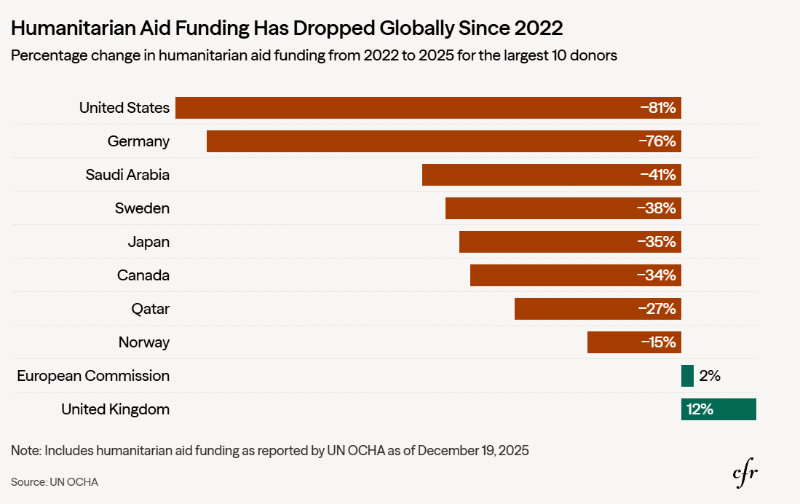
Between 2024 and 2025, more than 30% of global humanitarian funding disappeared, driven primarily by cuts to USAID, but triggering wider contraction from other major donors, including Germany and Sweden.
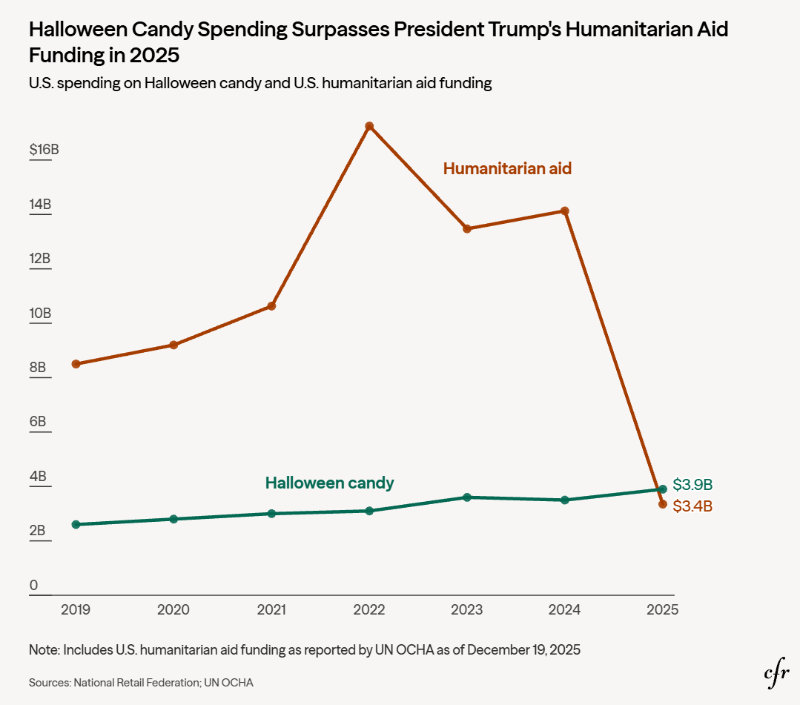
The Council on Foreign Relations reported that total humanitarian funding had dropped to 2016 levels, with agencies now forced to
cut food from the hungry to preserve dwindling resources for the starving.
Data from the Council on Foreign Relations starkly demonstrate this.
A paper published in The Lancet forecast that global aid cuts could result in between 9.4 and 22.6 million additional deaths by 2030. This is comparable to the number of deaths attributed to COVID-19, yet receives a fraction of the attention.
“This erosion of multilateralism is not part of efficiency, it is part of militarisation, it is not a reform or a merger, it is an attack and all of it must be resisted,” said Kate Gilmore, former United Nations Deputy High Commissioner for Human Rights, adding, “The most critical impacts of the deliberate dismantlement are being borne by ‘we the peoples….
(this) death march is not austerity, it is atrocity.
The obscenity of the richest man in the world, holding a chainsaw, celebrating these cuts that have led children to die or enter sex work, should plague all our minds. According to Forbes, Elon Musk’s net worth reached $800 billion in February 2026, exceeding the GDP of Sweden, Norway and Singapore. In 2025 alone, he added approximately $194 billion to his personal wealth.
Australia’s aid declining
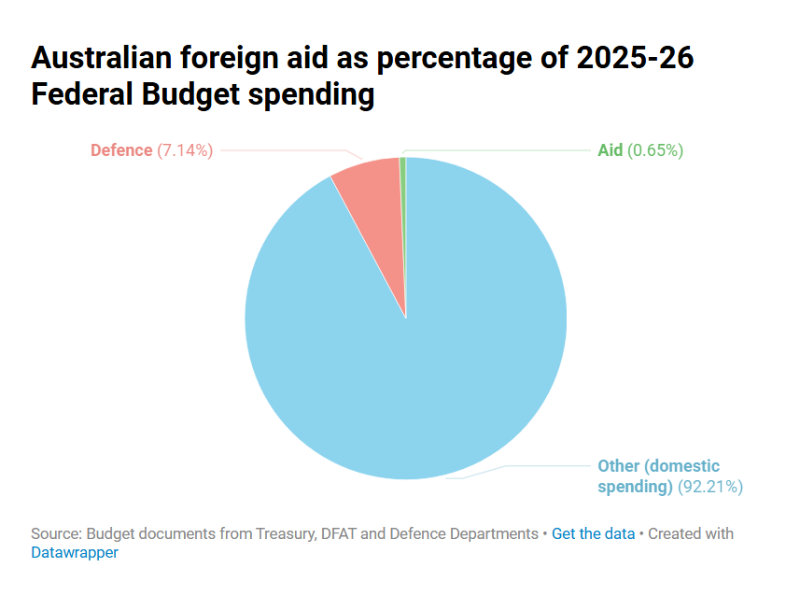
Australia’s aid budget tells a story of quiet retreat. While nominal figures appear to be rising, the aid budget is going backwards once adjusted for inflation or measured against Gross National Income.
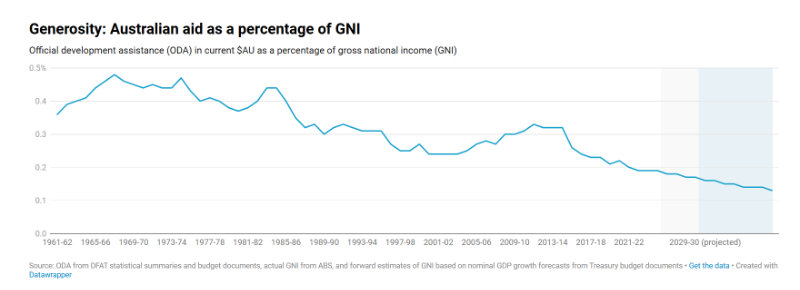
In 2025–26, aid represented just 0.63% of the federal budget, small by international standards, and it keeps falling.
Australians grossly overestimate our aid contributions. A 2015 survey found that 19% of Australians believed aid made up at least 5% of the federal budget, around 8 times more than the actual figure of 0.63%.
Attacks on humanitarian aid workers
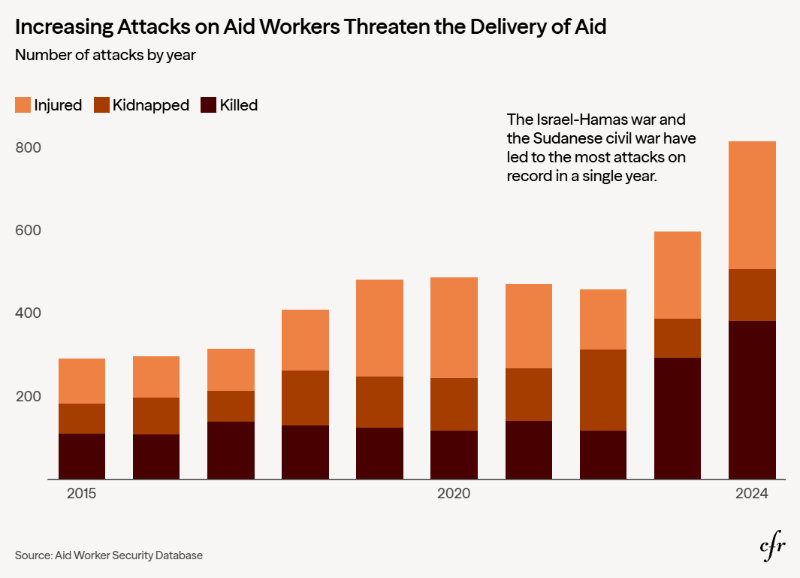
It hasn’t just been humanitarian funding that has been targeted, but the frontline humanitarian workers themselves, in numbers we have simply never seen before.
The last two years have been the deadliest consecutive years for humanitarian workers ever recorded. In 2024 alone, a record 383 aid workers were killed, more than double the annual average of the previous decade, driven primarily by the war in Gaza and the civil war in Sudan, which together accounted for the majority of deaths.
The Red Cross and Red Crescent Movement lost 38 staff and volunteers in 2024 alone, while 289 UN personnel were killed in Gaza, the largest loss of UN staff in any single crisis in history. Likewise, among them was Australia’s very own Zomi Frankcom, struck by an Israeli drone while delivering food for World Central Kitchen in clearly marked vehicles. We still await the results of the official investigation.
Whitewash! What’s the scam with the Binskin Inquiry into the murder of Zomi Frankcom?
“We are in the midst of a complete breakdown of the international system, said Agnes Callamard, Secretary General of Amnesty International. “In the past, we warned of the imminent possibility of the breakdown. Right now, what we are saying we’re past warning. We’re in the middle of it
“We have found that there are predators who are intent on destroying the system through violations of international law and of the multilateral system. But it’s not just that they violate it, that they are insisting that these (systems) are dead.”
Ushering in the preventable death of millions has left many asking how a system so fundamental to the world’s most vulnerable could be destabilised so rapidly and easily by so few.
This was one of the central questions at Women Deliver, and the answer many participants kept returning to was that the international multilateral system needs to decentralise. Get the money, the power, and the decision-making out of institutions that can be captured overnight, and into the hands of the grassroots actors already doing the work.
Connecting every crisis discussed at Women Deliver 2026 is not complexity; it is choice. The big question is whether governments like ours will make more humane choices, with real resources, real leadership. real accountability, and the political will to match.