
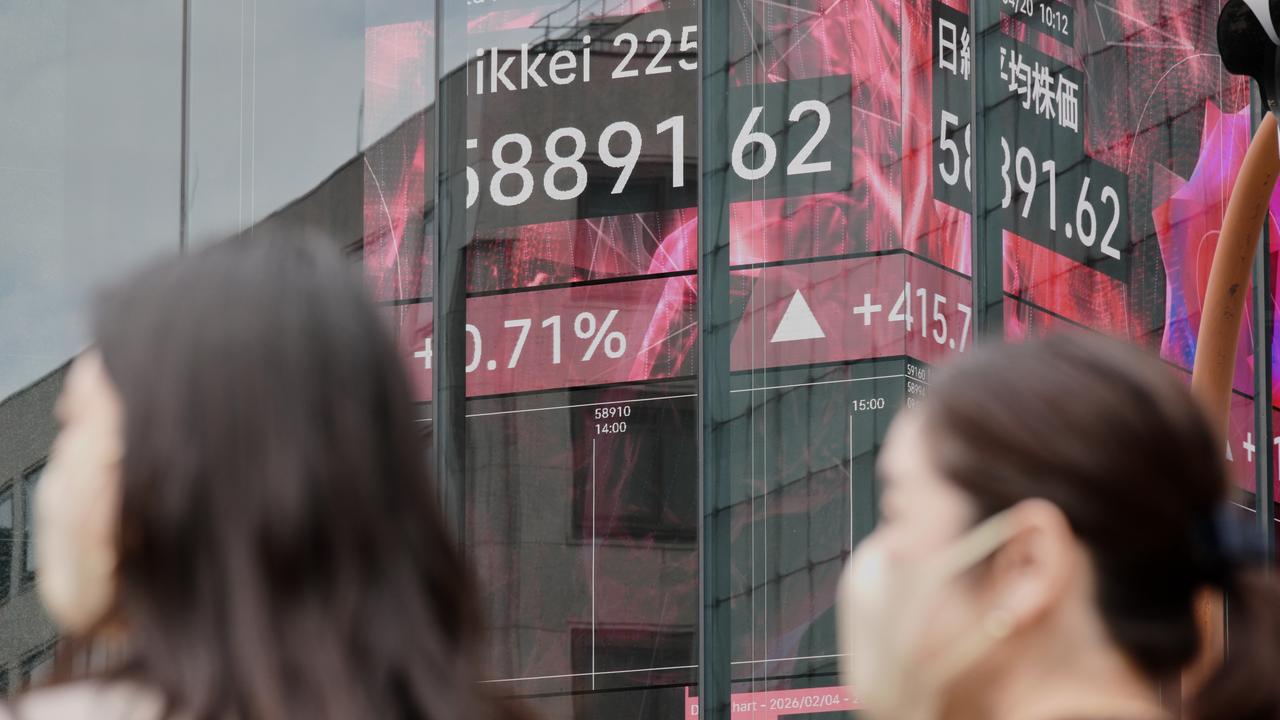
Stocks rebounded in early trading in Asia on Tuesday as markets took heart from reports Iran is considering attending peace talks with the United States in Pakistan, with renewed bets on AI underpinning demand.
Investors were also keeping their eyes on a Senate confirmation hearing later for Kevin Warsh, US President Donald Trump’s nominee to lead the Federal Reserve, which Trump has repeatedly criticised for failing to cut rates sooner and more aggressively.
MSCI’s broadest index of Asia-Pacific shares outside Japan was up 0.9 per cent, as South Korea’s Kospi rose 2.1 per cent to hit a record high for the first time since the Iran war began.
S&P 500 e-mini futures were up 0.1 per cent, while Brent crude slipped 0.4 per cent to $US95.09 ($A132.47) a barrel.
Japan’s Nikkei 225 tacked on 1.2 per cent, while Australian shares bucked the trend, slipping 0.3 per cent.
An uneasy ceasefire between the United States and Iran frayed after the US announced the seizure of an Iranian cargo ship, drawing vows of retaliation from Tehran. Iran said over the weekend it would skip a second round of negotiations, though a senior official later told Reuters the country may yet send delegates to talks expected in Islamabad.
Adding to the uncertainty, Vice President JD Vance remained in the United States on Monday, a separate source told Reuters, denying reports he was already on his way to Pakistan for talks.
The renewed tensions had reignited a surge in oil prices overnight as traffic through the Strait of Hormuz remained largely paralysed.
“While potential talks in Islamabad remain likely, rhetoric from Washington and Tehran continued to point to fragile and strained negotiations,” analysts from Westpac wrote in a research report.
Overnight, the S&P 500 was down 0.2 per cent on worries over whether the US-Iran ceasefire would hold, while the Nasdaq Composite snapped a 13-day winning streak, its longest in more than three decades.
Warsh’s confirmation hearing before the Senate panel is scheduled to begin on Tuesday, with his independence from the Trump White House expected to be a key focus.
Warsh will say he is “committed to ensuring that the conduct of monetary policy remains strictly independent,” according to his prepared remarks, while economists say his attitudes towards the central bank’s quantitative easing program will also be critical.
“In the past, Warsh was a vocal critic of the Fed’s ‘bloated’ balance sheet, as he called it, and argued that it creates a distortionary impact on asset prices,” said Bansi Madhavani, senior economist at ANZ in London.
“His preference for a smaller balance sheet is quite clear, but any guidance around what he thinks will be the optimal size, we think that will be relevant,” she said on a podcast.
The US dollar index, which measures the greenback’s strength against a basket of six currencies, held steady at 98.08, firmly in the middle of the range it has sat in during the past week.
The euro was fetching $US1.1782 ($A1.6414) and sterling traded at $US1.3522 ($A1.8838)5, both down a touch on the day. The risk-sensitive Australian dollar also eased 0.1 per cent to $US0.7171 ($A0.9990) in early trading.
The yield on the US 10-year Treasury bond was up 0.8 basis point at 4.256 per cent.
Bets on so-called dollar debasement languished. Gold was up 0.1 per cent at $US4,824.83 ($A6,721.60) after a month of moving sideways.
Cryptocurrencies fluctuated in the trading channel they have wallowed in since early February, with bitcoin down 0.3 per cent at $US76,072.61 ($A105,978.78) and ether slipping 0.8 per cent to $US2,320.92 ($A3,233.34).