
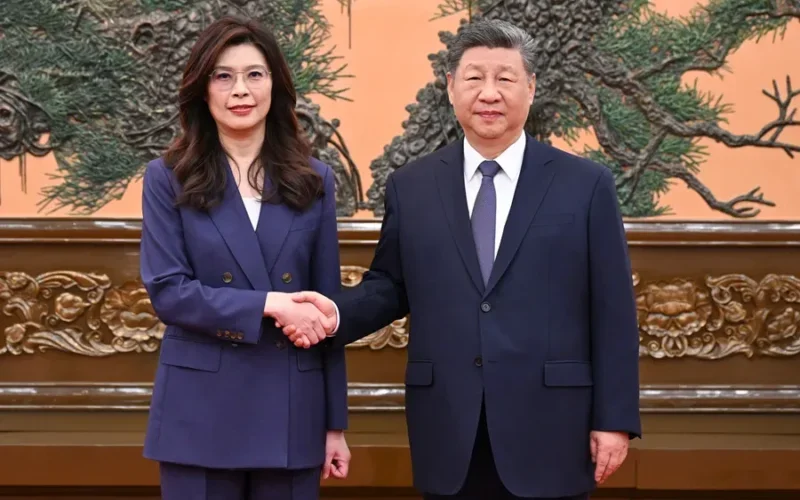
Last week’s meeting between Beijing and Taiwan’s main opposition leader is a bad sign for the China hawks and a sign of rapprochement. Marcus Reubenstein reports.
The combination of the US-Israel war on Iran and the anti-China media narrative in Australia has meant the visit of the leader of Taiwan’s main opposition party, Cheng Li-wun, to China has largely been ignored. Cheng chairs the Kuomintang (KMT) party, and she spent five days in mainland China from the 7th until the 12th of April.
Her public pronouncements indicate a belief that it is not in Taiwan’s interest to pin all of its hopes on an economic and military alliance with the US, and its future is better served with a pivot towards Beijing.
A significant proportion of Taiwan’s population does not want armed conflict with China. More importantly, Taiwan’s political leaders are acknowledging the fact that the US is becoming an increasingly unhinged and unreliable ally.
As reported by NBC News, Cheng points to Ukraine, saying,
People do not want to see Taiwan become the next Ukraine.
Add to that mix that Taiwan gets 70% of its oil from the Middle East, there is sentiment in Taiwan that the US bombing of Iran has been disastrously thought out and delivers Taiwan massive economic pain. Will Taiwan risk becoming the centrepiece of a future US military disaster?
In December, Cheng told the New York Times, “Could it be the United States is treating Taiwan as a chess piece, a pawn strategically opposing the Chinese Communist Party at opportune times?”
Taiwan’s ruling DPP (Democratic Progressive Party) had attempted to push a $US40B arms deal with the US through parliament in March, but that was sunk by Cheng’s KMT. The ruling DPP was eventually able to get a deal worth just $US11B through – around one third of an AUKUS submarine.
US war on Iran exposes Australia’s frail defence, AUKUS even more
Cheng’s China visit
The visit to China by Taiwan’s opposition leader took in three very significant cities, Nanjing, Shanghai and Beijing. Shanghai and Beijing, as financial and political capitals, were logical, but Nanjing is of great historical significance.
She visited the Sun Yat‑sen Mausoleum in Nanjing with a large Taiwanese delegation, a site honouring the founding father of the Republic of China, revered in both Taiwan and mainland China. Nanjing is also the site of one of Japan’s greatest wartime atrocities, the so-called Rape of Nanjing.
A small number of hardline figures in Japan’s ruling LDP continue to deny Japanese participated in any wartime atrocities. The LDP’s newly elected prime minister, Sanae Takaichi, stating that Japan would send in its military to aid Taiwan in any conflict with China, has dramatically escalated tensions between Beijing and Tokyo.
Takaichi is one of Japan’s most pro-US leaders, and Cheng’s visit to Nanjing would not be lost on the US. By extension, Cheng’s point of visiting Nanjing could be seen as a backhanded message to Japan, which hosts 55,000 US troops, to stay out of Taiwan’s affairs.
Implications for Australia
Cheng’s trip to China has implications for Australia and our foreign policies towards both our biggest trading partner and most important strategic partner.
The Albanese government has gone all in on the US’s East Asia military push, and now the US is showing clear signs of stress. The US has redeployed Thaad missile systems from South Korea to fight its war with Iran, while supercarrier naval vessels based in Japan, and operating in the South China Sea, have also been sent to the Gulf. Despite being the greatest military power in global history, it’s obvious it doesn’t take much to wear US forces thin.
Neither Prime Minister Anthony Albanese, Foreign Minister Penny Wong, nor Defence Minister Richard Marles has deviated from Australia’s blind support for the US war on Iran.
The question is, will they follow the US into an inevitably disastrous war against China or, worse still, act as a proxy in a future war?
Australia’s tilt towards offensive military capability, also enthusiastically supported by the LNP opposition, and the billions committed to submarines which may never arrive, do not augur well.
If the US cannot defeat Iran, there is no path to victory against an equally determined China, far better equipped, with the world’s second largest economy, and that is not a pariah state.
The US cannot bomb or sanction China out of existence.
Respected US political scientist Professor John Mearsheimer says, US President Donald Trump’s war with Iran is “manna from heaven” for China. He argues the war on Iran has made the US an irresponsible stakeholder in the international system and that China looks like the “adults in the room.”
China’s carrot and stick
China’s approach to Taiwan, and more broadly to much of its global diplomacy, has been a mix of carrot and stick. Beijing is still dangling carrots in front of Taiwan. Reunification with Taiwan remains the endgame,
but the overwhelming desire is that it should be achieved peacefully.
Cheng was warmly received by Chinese President Xi Jinping, and following Cheng’s visit, the Chinese government announced a list of ten new policies to promote economic and travel initiatives to strengthen ties between Beijing and Taiwan.
In the background, a looming stick could be an easily achievable Chinese blockade of commercial shipping around Taiwan. As Iran’s blockade of the Strait of Hormuz demonstrates, it doesn’t take a great deal of military firepower to cripple an economy.
What would, or could, Australia do to intervene? Hypothetically, that is a question which may face Australia, but a reconciliation, indeed possible unification between Taiwan and China, would render moot Australia’s current strategic policy.
Taiwan’s future?
While opinions in Taiwan about Cheng are divided, she has a realistic chance of becoming Taiwan’s next president at the 2028 election. To win, she doesn’t only have to run on China policy; there are plenty of domestic issues facing voters. Also, there is no suggestion that a reunified Taiwan would be considered as a province of China. Instead, it would become a special administrative region, citizens would keep their Taiwanese passports, and the New Taiwan Dollar would remain the official currency.
The line in the sand for Beijing would be separatist movements and their sympathisers speaking out publicly. Taiwan would also be prohibited from entering into any military alliances or agreements with other nations.
While this is the same set of conditions imposed on Hong Kong, Taiwan hardly has a tradition of democracy. For its first four decades as a territory, it was governed under martial law, and it wasn’t until 1996 that democratic presidential elections were held.
Current president, Lai Ching-te, is unpopular with his approval rating sinking to 33% in late 2025, having recovered to the low 40% mark in the most recent polls. Cheng’s approval rating is lower, reflecting the distrust Taiwanese people have for their political leaders.
In terms of specific issues, concerns over the economy rank first for Taiwanese voters.
The Chinese, that is to say those of Chinese ethnicity, are by and large very pragmatic. Cheng is betting on a belief that close ties with China represent the future and that the
Taiwanese people will come to distrust Washington more than they distrust Beijing.
Who’s next? Will Albo and Wong approve China attacking Taiwan?