
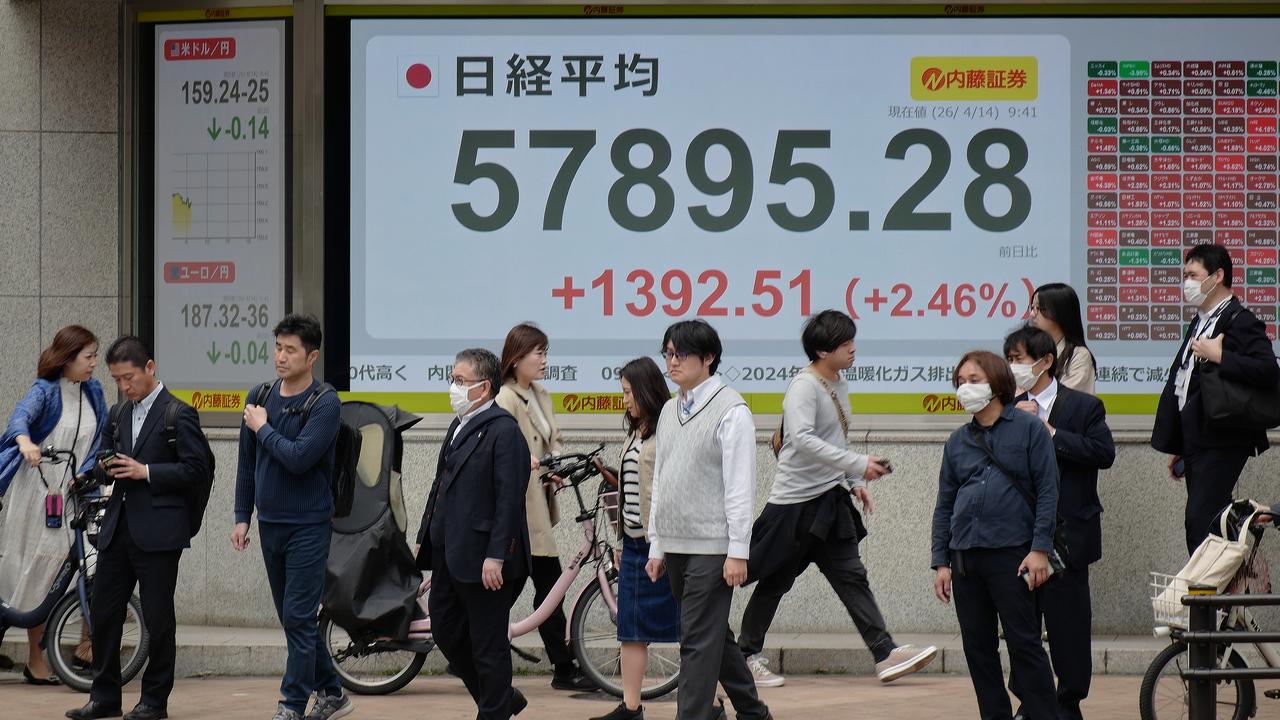
Asian stocks advanced while oil prices and the safe-haven dollar fell on Tuesday as the United States said it continued to engage with Tehran to make a deal even as it blocked Iran’s ports after the collapse of peace talks over the weekend.
Sources told Reuters that both sides have left the door open to dialogue and a US official said there was forward motion on trying to get to an agreement.
MSCI’s broadest index of Asia-Pacific shares outside Japan was up 1.0 per cent in early Asia trade, while Japan’s Nikkei and South Korea’s KOSPI rose more than 2.0 per cent each.
Nasdaq futures advanced 0.13 per cent while S&P 500 futures held steady, following an overnight rally on Wall Street, while EUROSTOXX 50 futures gained 0.63 per cent and DAX futures added 0.77 per cent.
“Markets are trading hope, not resolution,” said Charu Chanana, Saxo’s chief investment strategist.
“The failed weekend talks did not produce a deal, but they also did not close the door on diplomacy, and that is enough for equities to keep pushing higher for now.”
US President Donald Trump on Monday said Iran had “called this morning” and “they’d like to work a deal”. Reuters could not immediately verify the assertion.
The US military meanwhile began a blockade of Iran’s ports in a move aimed at putting pressure on Tehran.
Trump has said Washington would block Iranian vessels and any ships that paid such tolls and that any Iranian “fast-attack” ships that went near the blockade would be eliminated.
“The US has actually played that trump card. To me it’s important because they forced the onus back on Iran to open the Strait without the need to put those boots on the ground,” said Tony Sycamore, a market analyst at IG.
“It’s now forced the Iranians back to the drawing board.”
Oil prices slid as expectations for a resolution outweighed concerns over supply disruptions, leaving Brent crude futures down 2.7 per cent at $US96.66 ($A136.15) a barrel. US crude futures fell 3.0 per cent to $US96.13 ($A135.40) per barrel.
The dollar fell to a six-week low of 98.328 against a basket of currencies on Tuesday, as buoyant risk sentiment dampened demand for the world’s reserve currency.
That left the euro trading 0.05 per cent higher at $US1.1764 ($A1.6570) while sterling rose to a more than six-week peak of $US1.3514 ($A1.9035).
“The US and Iran have started to walk down the path of coming up to an agreement,” said Joseph Capurso, a strategist at Commonwealth Bank of Australia.
“However, the markets are still facing a global economic outlook that is deteriorating, and I think the risks are high that you get equity markets and credit markets and the like fall again, and that would push up the US dollar against probably all currencies.”
US Treasury yields were little changed, with the two-year yield last at 3.7722 per cent while the benchmark 10-year yield stood at 4.2854 per cent.
The inflationary pulse from the steep rise in energy prices has prompted investors to prepare for the possibility that a number of major central banks will lean towards raising rates, marking a sharp reversal from expectations prior to the war for rate cuts or a prolonged pause.
Elsewhere, spot gold was up 0.7 per cent at $US4,771.81 ($A6,721.14) an ounce.