
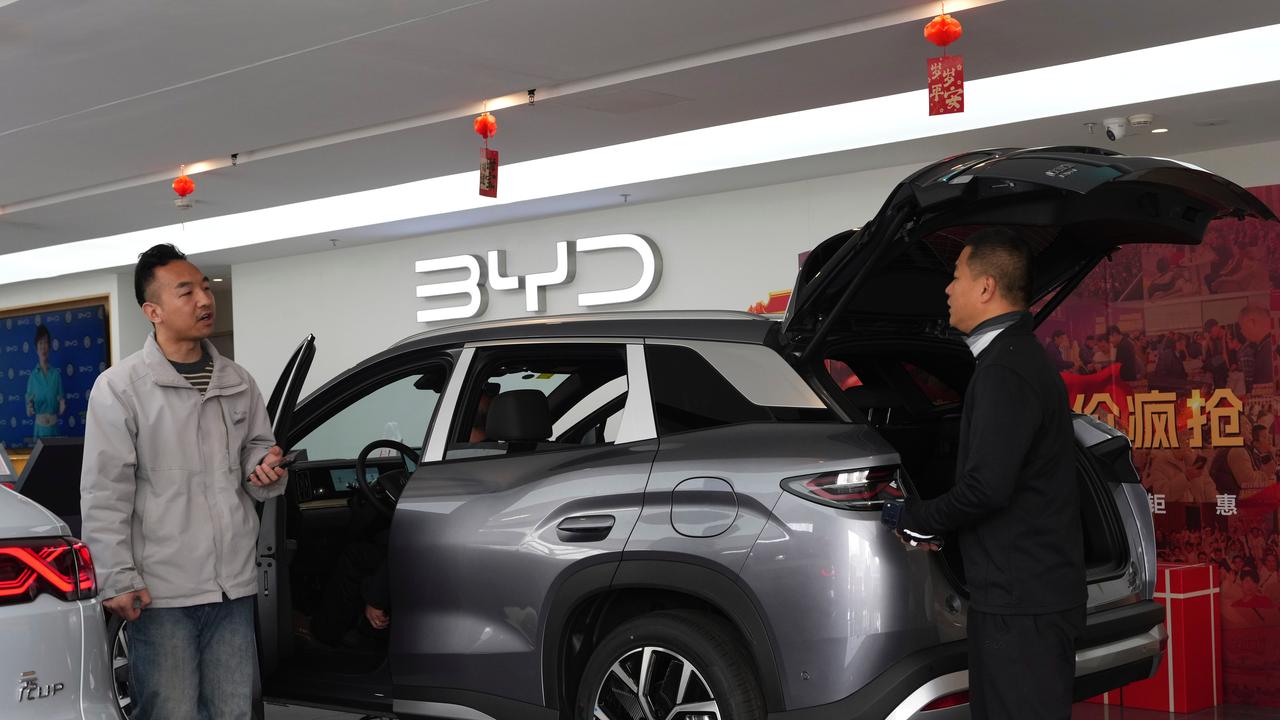
Chinese car maker BYD says its annual sales have risen to a record high, outpacing Tesla’s, but its profit fell for the first time since 2021 under pressure from cutthroat competition.
BYD, the largest electric vehicle maker, has been expanding into global markets including Latin America and Europe, where car analysts say profit margins are typically higher than in China.
It is also banking on cutting-edge technology upgrades to grow appeal, announcing a new powerful fast-charging battery days ahead of its earnings report.
With competition inside China at punishingly high levels, analysts foresee a tough road ahead this year.
But in a boost for EV makers, higher oil and petrol prices due to the Iran war are starting to recharge interest in renewable energy.
BYD annual sales reached $US116 billion ($A169 billion), the company said on Friday.
Domestic sales have been declining recently for Shenzhen-based BYD, which overtook Tesla in 2025 as the world’s biggest EV maker, selling 2.26 million electric vehicles last year, up 28 per cent from a year earlier.
Tesla said it delivered 1.64 million vehicles, down nine per cent.
The Chinese company’s revenue grew 3.5 per cent to 804 billion yuan ($A169 billion) in 2025, another record, eclipsing rival Tesla’s full year revenue of $US94.8 billion.
However, BYD said its annual profit was 32.6 billion yuan last year, down 19 per cent from 2024.
The company last booked a profit decline in 2021.
The Chinese car group has reported six straight months of declining sales.
Total sales in January-February fell 36 per cent year-on-year to 400,241 units, as higher overseas sales did not offset persistent weakness in domestic demand.
“They cannot rely on mass market EVs to help them keep the same volume that they were selling,” said Chris Liu, a Shanghai-based senior analyst at advisory group Omdia.
A fierce price war in China, the world’s biggest car market, has hurt BYD’s profitability, and rivals such as Geely Auto were gaining ground in early 2026.
“We also recognise that competition in the NEV (new energy vehicle) industry has reached a fever pitch, and is undergoing a brutal ‘knockout stage’,” chairman Wang Chuan-fu wrote in its earnings report on Friday.
Wide-reaching government subsidies meant to encourage Chinese drivers to switch to EVs have been extended but are scaled back this year, putting pressure on car makers.
Expectations are that the Iran war and the global energy shock would push more people to switch to EVs, with the likes of BYD standing to gain at home and overseas.
BYD shares traded in Hong Kong have fallen more than 20 per cent over the past year but have been rising in March.
Overseas, BYD plans to keep growing its global market share to hone its profits.
It has made inroads in the United Kingdom, Brazil and Argentina and is aiming to sell about 1.3 million vehicles overseas in 2026, up from about 1.05 million last year.
Its strategy in building and expanding factories overseas will also help boost its international market growth, said Claire Yuan at S&P Global Ratings.