

Angus Taylor ousting Sussan Ley as leader of the Liberal Party reinforces longstanding perceptions about the Party’s treatment of women. Aleta Moriarty reports.
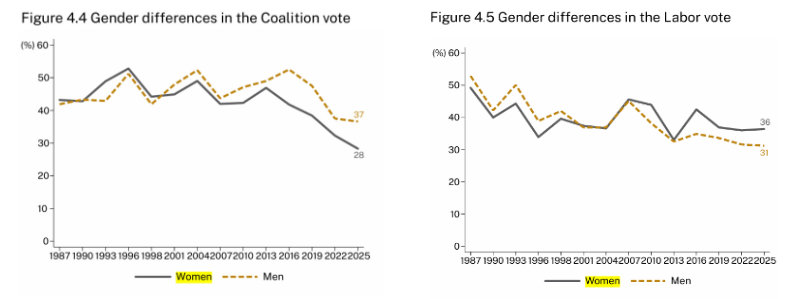
The 2025 election showed a widening chasm in the composition of two-party preferred voting, with the Coalition attracting 9% more votes from men than women, with women voters less likely to vote for the Coalition than at any time in recent history.
In particular, young and middle-aged women have abandoned the party; only 19.8% voted Coalition (less than 1 in 5).
This was a consolidation of a long-term trend. The 2022 election saw the Coalition’s women problem reach crisis levels.
Just 32% of women voted for the Coalition, representing a collapse in female support, driven by the Morrison government’s mishandling of the Brittany Higgins rape allegation and broader treatment of women.
The “treatment of women in politics” was identified as the second biggest weakness for the Coalition at the election, coming narrowly behind aged care.
Source: Griffith University
Labor’s women’s vote is also on the decline, with women feeling unrepresented on key issues like housing, education and other key social issues that impact them.
The Liberal Party’s voter base is increasingly old and male. According to demographic analysis, mostly the 55+ age group. The party is essentially living off older voters who remember when the Liberals supported women, but those voters are dying, and younger women are moving sharply left.
Misogyny legacy
The Liberal Party’s modern reputation for misogyny is still raw, including Tony Abbott’s long history of offensive remarks. Perhaps most infamous was his 2010 comment about carbon pricing: “What the housewives of Australia need to understand as they do the ironing” is that electricity prices would increase.
In 2013, he praised a female candidate’s “sex appeal”, triggering widespread criticism. He described telling his daughters their virginities were “the greatest gift you can give someone”. He once suggested childless, unmarried Prime Minister Julia Gillard should “make an honest woman of herself”. As Minister for Health, he called abortion “the easy way out”.
Even today, he doesn’t mind kicking a woman, attacking Child Sexual Abuse Advocate Grace Tame saying she was “unworthy” of Australian of the Year.
And if Abbott established the template, Scott Morrison perfected the art of tone-deaf responses to women’s issues. His handling of the Brittany Higgins rape allegation in 2021 crystallised everything wrong with the Liberal Party’s approach to women.
The Morrison government’s mishandling of the Higgins allegation sparked unprecedented public anger. On March 15, 2021, an estimated 110,000-150,000 people across Australia participated in the March4Justice, the largest women’s march ever held in the country.
The protests were triggered by a perfect storm: Higgins’ rape allegation, historical rape allegations against then-Attorney General Christian Porter, sexual harassment revelations collected by activist Chanel Contos, and the broader recognition that gender equality in Australia was declining.
The marches may have contributed to the Morrison Government’s defeat in the 2022 federal election, as voters, particularly women, punished the Coalition for ignoring their concerns. And women today have not forgotten or forgiven, particularly as they see poor Brittany Higgins dragged through the legal system after being raped.
The combination of decades of sexist comments, structural underrepresentation, and hostile responses to women’s concerns has created a perception the Liberal Party cannot shake. Political scientist Dr Williams noted the party “has not been a frontrunner for women since the 20th century”.
It’s also unlikely that One Nation, which has recently declared a decidedly anti-feminist, pro-life platform, will pick up reasonable centrist to centre-right women voters.
Education and age factors
The strongest predictor of voting against the Coalition is University-educated women. These voters consistently turned away from both major parties, but especially from the Coalition.
The Liberal Party’s base — older, male voters — actively resists the changes necessary to attract younger women. This creates a vicious cycle: the party can’t attract young women without structural change, but its existing base won’t allow structural change.
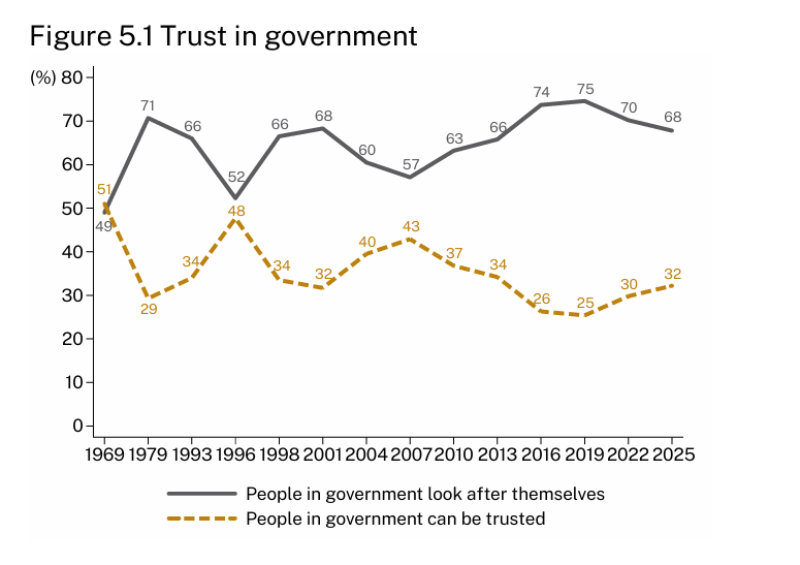
Moreover, as better-educated women become more politically active, the two-party system is becoming increasingly toxic, with distrust on the rise according to a study by ANU and Griffith University.
Source: Griffith University
The Glass Cliff
Currently, four women across Australia are leading the Liberal opposition: Kellie Sloane (NSW), Jess Wilson (Victoria), Lia Finocchiaro (Northern Territory), and Ashton Hurn (South Australia). This is the first time women have comprised the majority of Liberal State leaders
But there’s a catch. In 124 years of federation, only one female conservative leader, Gladys Berejiklian, has ever won a state election and served as premier. (NSW 2019).
The only successful Liberal woman premier, she became the first non-Labor woman to win a state election in 2019 only to resign in 2021 amid an ICAC corruption investigation.
Two women have done so in territories: Kate Carnell (ACT, 1990s) and Lia Finocchiaro (NT, current).
Otherwise, it’s been “defeat after defeat” for the 17 women who have led the party across Australia’s nine jurisdictions.
As one Crikey headline put it ($): when it comes to the Liberal Party’s women problem, “rats learn faster.”
The 2025 election features Gen Z and Millennial voters outnumbering Baby Boomers for the first time. These younger voters, especially women, are moving sharply left, with university-educated women identified as the strongest predictor of votes for independents and Greens, disenfranchised with the major parties.
Until the party undertakes genuine structural reform, not performative appointments of women to clean up electoral disasters, it will continue to haemorrhage female voters to the Greens and independents at accelerating rates.
In a country where gender parity in parliament is finally within reach, the Liberal Party’s resistance to change doesn’t just look anachronistic. It looks terminal.
The question isn’t whether the Liberal Party can afford to ignore its women’s problem.
The question is whether it can survive as a party when fewer than one in five young women will vote for it.
A dying demographic: how Murdoch is slowly killing the Liberal Party