
Bowdens proposed mine in central NSW is under increasing pressure to ensure protection of the site’s heritage, cultural significance and water supply. Michael Sainsbury reports.
Silver Mines Ltd has so far failed to properly survey Aboriginal cultural heritage for its proposed Bowdens’ lead, zinc and silver mine near Lue in central NSW. It puts it squarely in the regulatory danger zone that saw the McPhillamy’s Gold Project near Blayney, suspended for 30 years.
Aboriginal heritage for mining projects came into focus following the destruction of Juukan Gorge in May 2020, and controversy over Woodside’s operations across northern Australia. The Federal Environment Minister can reverse approvals by state and Federal governments under the Aboriginal and Torres Strait Islander Heritage Protection Act or the Environment Protection and Biodiversity Conservation Act 1999 (EPBC Act), amended late last year.
In a post-Juukan regulatory climate, projects that cannot demonstrate continuous consultation, defensible survey coverage and a credible understanding of cultural significance are increasingly being stopped, or left to unravel in court.
That is the risk now confronting Bowdens, where both the peak local Wiradjuri body and an independent archaeologist say the project’s Aboriginal heritage assessment is structurally flawed and incapable of supporting consent, laid out in documents submitted to the NSW government that have been obtained by MWM.
Cultural significance ignored
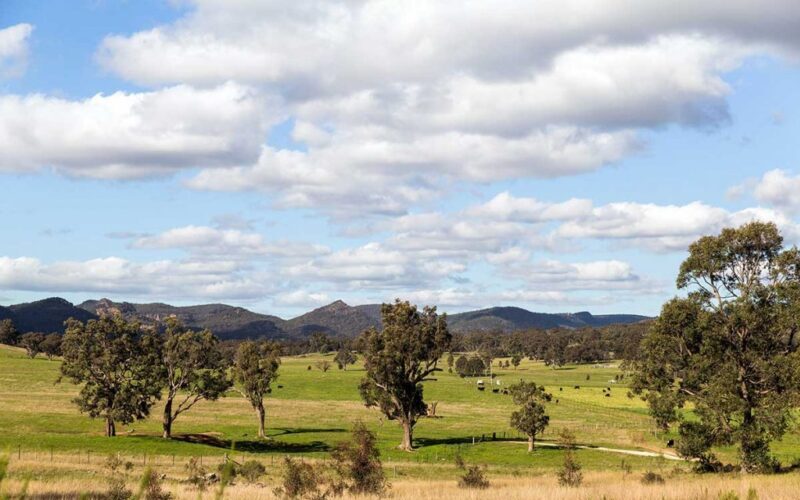
Beyond procedural failures, Wiradjuri experts say the project footprint sits within a culturally significant landscape that has never been properly assessed as a whole. With abundant water, elevated terrain, caves, grinding grooves, scarred trees and extensive surface artefacts, Aboriginal groups describe the Bowdens site and surrounding areas, including Bingman Hill, as a culturally significant landscape.
Scores of Aboriginal artifacts on multiple properties around the mine site have been identified, and there are rock paintings on properties adjacent to the site.
That cultural landscape context has never been properly integrated into Bowdens’ assessment, nor the site properly surveyed, Aboriginal groups say. A map of artefacts obtained by MWM shows the vast number of artefacts in the land surrounding the mine site.
In a formal letter to the NSW planning minister, the Wellington Valley Wiradjuri Aboriginal Corporation (WVWAC) calls for Bowdens’ Aboriginal cultural heritage survey to be “completely redone”, saying it relied on “sporadic surveys from 2011–2019”,
that were never properly reported, reviewed or consulted on with Traditional Owners.
WVWAC also points out that the Environmental Impact Statement itself concedes the Landscape 2020 Aboriginal Cultural Heritage Assessment has “no separate reporting for each of the individual survey periods”.
That approach, the corporation says, meant Aboriginal people “did not have an opportunity to discuss and make any recommendations to a report from 2011 to 2019”, a failure it describes as “counter to the code of practice and the consultation guidelines”.
Most critically, WVWAC says the EIS contains “no detailed transect mapping, which is a requirement from the state government”, meaning there is no way to verify what ground was surveyed – or missed.
Inadequate surveys
Those concerns were independently reinforced by a June 2025 peer review by archaeologist Doug Williams, who concludes the Landskape report is “deficient in a number of respects that compromise its ability to suitably support a development of high impact such as the Bowdens mine.”
Williams describes the survey work as “piecemeal”, conducted in “very short bursts over 9 years with no intervening documentation”, calling it “an ineffective and unfair way to engage Aboriginal stakeholders”. He identifies multiple “lapses in Aboriginal consultation longer than that normally allowed”, including multi-year gaps with no documented engagement.
On coverage, Williams is blunt: “The survey method does not supply evidence of survey traverses (a requirement of the Code of Practice)”, adding there is
no evidence that survey coverage was as extensive as asserted.
The archaeological documentation itself is also found wanting. Although the report claims around 500 artefacts were identified, Williams notes there are “no individual artefact records”, no measurements and “no photographs of examples of stone artefacts” provided to Aboriginal stakeholders — a failure he says “precludes meaningful consideration of site significance.”
Threats to water supply
According to the Elders, the site contains at least 29 springs, as well as seeps and swamps, providing a permanent water supply that underpinned sustained Aboriginal occupation. Threatened Mountain Swamps and Peatlands are also present and require protection.
Multiple reports prepared for Bowdens, including those by Landskape, Cardno, Jacobs and WRM Water and Environment, have identified springs, swamps and seeps across the mine footprint. Elders say no evidence has been produced to support the claim that water is not permanent.
Williams’ peer review reinforces that concern, criticising the report for underestimating water reliability and for wrongly restricting assumptions of significant archaeology to areas near major watercourses, an approach he says is “demonstrably not the case” in the region
WVWAC also raises alarm over later “supplementary” heritage work relied on by Bowdens. A November 2024 “visual inspection” reported no new sites — but WVWAC says it was conducted “without any Aboriginal Cultural Heritage Sites Officer also being present”, and again with no transect mapping or coverage supplied
Williams warned that deferring unresolved heritage issues until after approval is fundamentally flawed.
To seek approval and only after that undertake further assessment is exceedingly poor heritage management practice,
he writes, and “counter to principles of ‘free, informed and prior consent’.”
That warning mirrors the reasoning now being tested in the Federal Court over McPhillamy’s, where the federal environment minister concluded that uncertainty over Aboriginal heritage impacts constituted unacceptable risk, triggering a protection order.
Bowdens said it would not be responding to questions put to the company by MWM “at this time.”
A spokesperson for the Department of Planning, Housing and Infrastructure told MWM: “The Department is currently waiting for additional information from the applicant on the proposal. The Independent Planning Commission will be the consent authority for this proposal, and once the Department has completed its assessment, it will be referred to them for determination.
“The Department can’t speculate on any future Federal heritage protection action that may be brought under Federal legislation.”
After previously promising its shareholders that it had filed all the relevant paperwork to advance its project to the NSW Independent Planning Commission for evaluation, Silver Mines told the ASX on December 23 that it was conducting new biodiversity surveys early in 2026 for a new report.
MWM understands that the IPC’s determination process will provide a further opportunity for the community to have its say.
Back to Obeid? Fast-track housing laws a stalking house for fast-track mines