
“I couldn’t be part of a Writers Festival accepting this dirty money from the Club.” Former ambassador Gregory Andrews resigns from Canberra Writers’ Festival over National Press Club links.
Last week I resigned as Deputy Chair of the Canberra Writers Festival because I could no longer reconcile my governance responsibilities with the Festival’s funding and other links with the National Press Club.
It wasn’t an easy decision, because I care about literature, ideas, and public debate. During my time on the Festival Board, I led development of governance policies designed to strengthen accountability, support cultural safety and encourage respectful and open dialogue.
My decision to resign reflected a growing concern about the National Press Club: its culture, its judgement, its relationships and its increasingly problematic role within Australia’s media and political establishment.
As a former ambassador, senior public servant and board director, I’ve spent much of my professional life working within institutions. I understand that no institution is perfect. I also know governance problems rarely appear overnight. They emerge gradually, as organisations become comfortable with their own power, status and assumptions.
What happened to the NPC
This is what I believe has happened at the National Press Club. The Club presents itself as Australia’s premier forum for journalism and democratic debate. Politicians seek its stage. Governments, corporations and lobby groups value access to its audiences. But with that privilege comes responsibility. And increasingly, the Club appears
less interested in challenging power than in managing its relationship with it.
Cancelling Chris Hedges for Israel Ambassador
Cancelling journalist Chris Hedges, who was due to speak about Gaza, raised serious questions about the Club’s commitment to open debate.
Its subsequent decision to platform the Israeli Ambassador during a period of horrific civilian atrocities in Gaza and ongoing genocide proceedings before the International Court of Justice raised further questions. The Club allowed the
Ambassador to reject allegations of genocide and defend Israel’s atrocities in Gaza.
Follow the money
The Club’s funding arrangements also deserve serious scrutiny. Michael West Media has reported that more than a quarter of the Club’s sponsors are part of, or work for, the global arms industry. It reported that 21 arms-industry or related sponsors contribute about $525,000 annually.
I couldn’t be part of a Writers Festival accepting this dirty money from the Club.
But a deeper issue for the National Press Club is structural. Its leadership, membership, sponsors and regular speakers are drawn overwhelmingly from the same ecosystem of politicians, senior journalists, lobbyists, public affairs professionals and corporate interests. That proximity creates access, influence and prestige. But it also creates blind spots.
The Club appears to be less willing to challenge the assumptions of the circles in which it operates and more inclined to manage dissent than engage with it. It is not representative of the broader community despite continuing to speak in its name.
The Pauline Hanson incident
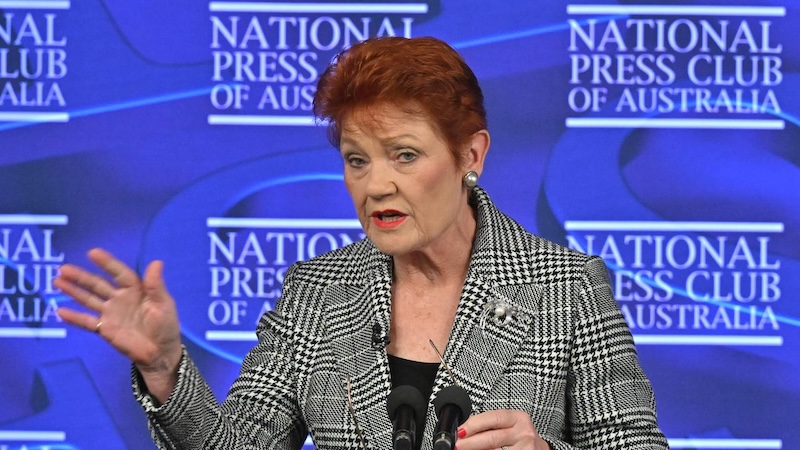
This week’s appearance by Pauline Hanson provided a fresh illustration. When Guardian journalist Sarah Martin asked a legitimate question, Senator Hanson responded by attacking the journalist herself. The Club appeared more concerned with managing the event than defending the role of journalism in holding power to account.
And its response to a peaceful protest during the event also reinforced that perception.
After a banner was unfurled, the Club issued a statement apologising to Senator Hanson and indicating the matter would be referred to the Australian Federal Police. Whether one agrees with the protest or not,
the response was disproportionate
and indicative of an institution increasingly uncomfortable with dissent.
Viewed individually, each of these incidents could be explained. Collectively, they tell a different story. They suggest an institution that’s defensive and overly comfortable with itself and established powers. This is not merely a political problem.
It’s a governance problem.
Because good governance requires independence, transparency and diversity of thought. And most importantly, it requires institutions to subject themselves to the same scrutiny they demand of others.
Institutions in decline
Across Australia, trust in institutions is declining. People lose trust when institutions stop practising the values they preach. They lose trust when organisations that celebrate free speech suppress dissent, and when institutions that demand transparency from others resist scrutiny of their own funding, leadership and culture.
No wonder young Australians are looking elsewhere for information, analysis and debate.
The National Press Club is not responsible for Australia’s broader crisis of institutional trust. But it has become a symbol of it. It has a history of asking difficult questions of Australia.
Perhaps it’s now time for Australia to start asking a few difficult questions of the National Press Club.
Weaponising media. National Press Club and its arms industry sponsors