
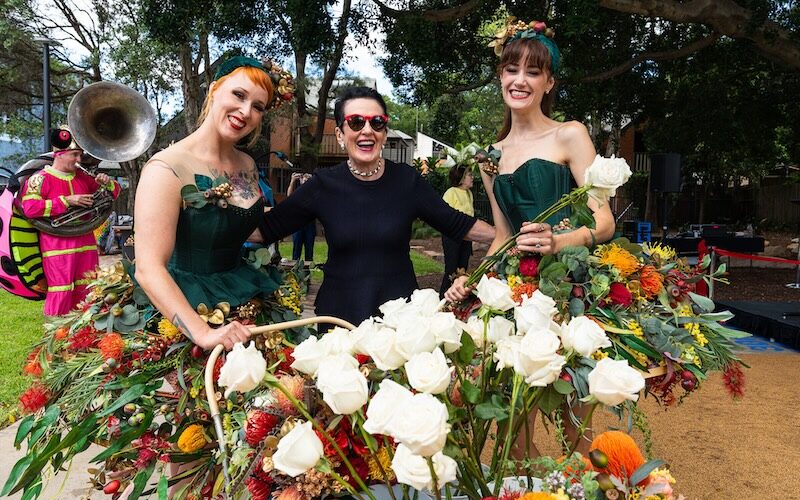
Clover Moore capitulates to Murdoch media and Minns, cancels today’s Sydney debate on ‘Globalise the Intifada’. Andrew Brown writes on the impact of cancel culture.
What Comes After the Words
There is a particular kind of cowardice that wears the mask of governance. It does not arrive announcing itself. It arrives incrementally, each step dressed in the language of safety, of balance, of community cohesion, of protecting the vulnerable.
By the time the architecture is visible, it is nearly complete. Australia is very nearly there.
Clover Moore did not cancel a riot. She cancelled a conversation.
A ticketed talk in a city-owned venue, advertised as a debate about whether a phrase is right or wrong to say. No weapons. No march. No named threat in her statement, no police advice cited, no legal basis offered.
Words, and the prospect of Australians hearing them, were enough.
The Lord Mayor of Australia’s most populous city cancelled a public discussion because a tabloid campaign demanded it. She then published a statement condemning the tabloid campaign.
This is what capitulation looks like when it needs to feel like principle.
But Moore’s cancellation is not the story. It is a symptom. To understand the story, you need to read the list.
Tame, Kostakidis, Lattouf, Abdel-Fattah
Grace Tame, former Australian of the Year, said “globalise the intifada” at a public rally. Mary Kostakidis, one of this country’s most decorated journalists, retweeted a tweet. Antoinette Lattouf reposted a Human Rights Watch report documenting Israel’s use of starvation as a weapon of war. Randa Abdel-Fattah, a Palestinian Australian author, was invited to speak at Adelaide Writers’ Week about literature. I wore a t-shirt.
Each of these acts triggered a coordinated campaign of pressure, complaint and punishment. None were unlawful. None threatened a single person.
What they shared was a thread so thin it should embarrass the institutions that treated it as a crisis: each person, in some way, expressed solidarity with Palestinian people or dissent toward the conduct of the Israeli state.
That was sufficient. That has always been sufficient.
Capitulation – and the Israel lobby
A Federal Court found Lattouf’s termination from the ABC unlawful. The complaint that produced it did not come from editorial management acting on journalistic grounds.
It came from an organised campaign run through the same lobby networks that have spent years cultivating relationships inside Australian newsrooms, university administrations and the offices of federal and state ministers.
The lesson the ABC’s capitulation sent to every journalist in this country was not subtle.
Cover this war carefully.
Cover it the approved way. Do not stray from the approved framing. Or we will make the call, and your employer will answer it.
Abdel-Fattah was disinvited from Adelaide Writers’ Week. Queensland Premier David Crisafulli publicly recommended other writers’ festivals ban her too. He was not embarrassed to say so.
He said it as though it were a reasonable position for a democratically elected leader to hold: that a Palestinian Australian author should be made unwelcome at literary festivals across her own country because she writes about what has been done to her people. Nobody in federal parliament thought this warranted serious scrutiny.
Bondi and the t-shirt
I have worn my t-shirt at Bondi Beach twice now. It says what I believe about Israel and Zionism, clearly and without ambiguity.
On Easter Monday, eighteen police officers surrounded me. I was detained and arrested, charged with causing offence. Not incitement. Not threat. Offence.
Police rush Bondi Beach, apprehend ‘F … Israel’ tee-shirt man … again
The Australian Constitution protects political communication as a right so fundamental that the High Court has found it implied in the document’s structure. The eighteen officers did not appear to have read it. Neither, it seems, did the commanders who sent them.
When Isaac Herzog arrived in Sydney in February, thousands marched to Town Hall. A UN commissioner had already said his visit was a tragic mistake, that Australia had a legal and moral imperative to detain him. The Australian government gave him diplomatic immunity and a state welcome instead.
What the protesters were met with was not crowd management. Police used pepper spray and made arrests. Demonstrators were beaten and shoved. One woman described being lifted off the ground and punched in the head while recording footage near the Town Hall steps.
Officers were filmed forcibly dispersing a group of Muslims praying in the street. Police assistant commissioner Peter McKenna held a press conference and said he was very proud of his officers’ conduct. Minns blamed the march organisers for refusing to relocate to Hyde Park.
A democratic march in a democratic city, beaten back by a state that had decided the sensitivities of a foreign head of state outweighed the physical safety of its own citizens.
The impact of cancel culture
Now comes the legislation that makes what was ad hoc into something permanent.
Queensland has already passed laws imposing up to two years in prison for chanting “globalise the intifada” or “from the river to the sea” in public. Twenty-five people have been arrested under them.
These are not phrases that have been found by any court to constitute incitement. “Intifada” is an Arabic word meaning uprising, used in the context of Palestinian resistance to occupation, a resistance that international law recognises as legitimate.
“From the river to the sea” is a liberation slogan used for decades across the Arabic-speaking world and by human rights advocates globally. Under Queensland law, speaking these words in a manner deemed offensive now carries a heavier criminal sanction than many acts of physical violence.
The legislation does not target the violent. It targets the vocal.
And above all of this sits the legal and institutional architecture that will make the suppression self-sustaining.
Jillian Segal, appointed by the Albanese government as Special Envoy to Combat Antisemitism, delivered a plan that the government has now adopted in full. At its centre is the International Holocaust Remembrance Alliance definition of antisemitism, which the Australian government has made its official standard.
The definition’s own original author, Kenneth Stern, has rejected its use as a regulatory instrument, warning explicitly that it would be weaponised to silence political speech.
That warning was disregarded.
The Segal controls
Segal’s accompanying handbook, published as authoritative government guidance, states that anti-Zionism is an expression of hatred toward Jews, and that it is antisemitic to describe Israel as practicing apartheid, oppression, racism or genocide.
These are not outlandish positions. They are the documented conclusions of the United Nations, the International Criminal Court, Amnesty International and Human Rights Watch. Under the framework Australia’s government has now officially adopted, to cite those conclusions is to risk being classified as a purveyor of hate.
The plan goes further. Segal has proposed appointing herself as a monitor of media organisations including the ABC and SBS, with the stated aim of ensuring fair and balanced reporting. It recommends that charities, universities and cultural institutions deemed to facilitate antisemitism lose public funding.
A coalition of Jewish groups, including Jews Against the Occupation, the Jewish Council of Australia and others, wrote that Segal’s plan to censor the media, defund universities and the arts, and police political speech would not make Jews safer.
That statement received almost no coverage in the mainstream press.
The press was busy running the campaigns the plan was designed to enable.
The F word
This is the point at which it becomes necessary to ask the question that comfortable people prefer not to ask. What is the name for a political system in which the state bans phrases, monitors journalists, defunds cultural institutions that express dissent, authorises police to arrest citizens for the words on their clothing, and constructs all of this under the legislative cover of protecting a foreign government from criticism?
We have names for such systems.
We apply those names to other countries. We have not yet applied them to ourselves, but the architecture is nearly identical.
Democracies rarely die with a declaration.
They erode through accumulation, each individual decision defensible in isolation, the pattern visible only when you hold the full list in your hands and read it from beginning to wherever it currently ends. Protest. Tweets. Reports. T-shirts. Phrases. Sentences. Debates. Literary festivals. Newsrooms. University funding.
The list has been growing for two years and it has never once grown shorter.
I support freedom of speech … however
Moore’s statement contains a line that deserves to outlast the news cycle she wrote it for. She says: “I have long supported the principles of peaceful assembly, protest and freedom of speech. However, these rights must always be balanced with a responsibility.”
That however is doing the heaviest lifting in the history of Australian civic language.
Every right stripped from every citizen in every country that has walked this road was stripped with a however attached to it. However, the security situation. However, community cohesion. However, the sensitivities of the moment.
However.
There is nothing abstract about where this goes. It is not speculation. The legislation already exists. The arrests have already happened. The monitoring is already being planned. The defunding is already being threatened.
A government envoy has already told Australians, in an official handbook, that opposing the political ideology underpinning a foreign state is an act of religious hatred.
I have been arrested twice for a t-shirt. Twenty-five people have been arrested in Queensland for words. Antoinette Lattouf was fired from the national broadcaster for a repost. A Palestinian author cannot speak at a literary festival in her own country. A debate about a phrase was cancelled by the Lord Mayor of Sydney because the tabloids ran a campaign and she did the maths.
What comes after the words?
We are finding out, in real time, in full view, with the explicit sanction of elected governments and the silence of a press gallery that has decided looking away is easier than looking at what they have become part of.
Every generation that has watched a democracy hollow itself out from the inside has left behind the same testimony. We did not think it would go this far. We did not think they meant it. We thought there would be a moment when the institutions held.
The institutions are not holding.
Antisemitism Bill. Same shirt. Different stairs. Years in prison.