
Asian share markets were in a more sober mood on Thursday as cracks quickly began to appear in the fragile Gulf ceasefire, nudging oil prices back up and reminding investors the inflationary fallout will last for a long time yet.
There was scant sign that the Strait of Hormuz was open in any meaningful way, with Iran flexing its control over the vital oil artery and demanding tolls for safe passage.
“You have a fifth of the world’s oil supply moving through a corridor that is still effectively under the influence of one of the parties to the conflict,” said Nigel Green, CEO at deVere Group.
“That’s not stability. You don’t need a full blockade to move oil markets sharply higher again.
“Missiles are still being launched in the Gulf, Israel is still engaged on another front, and yet markets are behaving as though the region has normalised.”
As a result prices for US crude futures edged up 2.8 per cent to $US96.99 ($A137.50) a barrel, while Brent rose 2.1 per cent to $US96.74 ($A137.15).
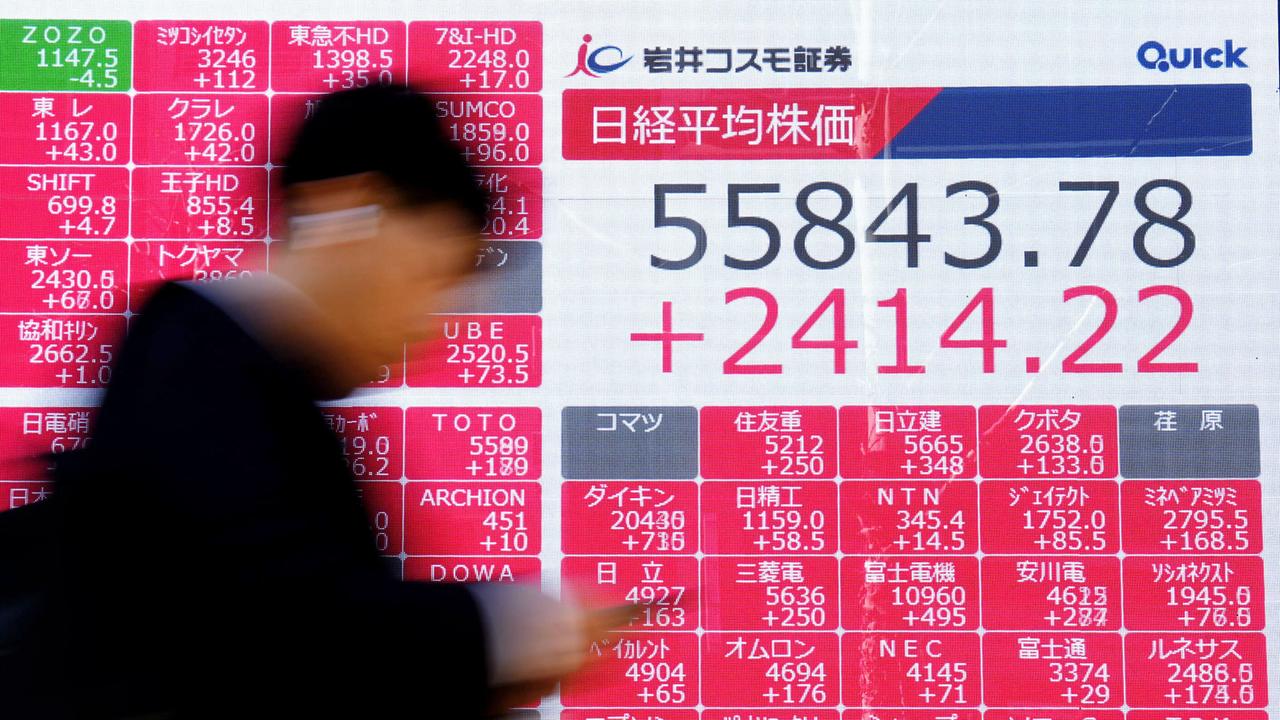
Japan’s Nikkei dithered either side of flat, after jumping 5.4 per cent the previous session. South Korea dipped 0.4 per cent, following a leap of 6.8 per cent. MSCI’s broadest index of Asia-Pacific shares outside Japan eased 0.3 per cent.
On Wall Street, S&P 500 futures and Nasdaq futures were both off 0.2 per cent as Wednesday’s surge petered out.
For a mixed Europe, EUROSTOXX 50 futures inched up 0.1 per cent, DAX futures fell 0.3 per cent and FTSE futures rose 0.5 per cent.
With oil prices still around 40 per cent higher than pre-conflict, an inflationary spike is about to show up in the hard data across the globe.
Figures on US core prices for February due later Thursday are expected to show a chunky 0.4 per cent rise for a second month, and that was before the surge in energy costs.
Minutes from the Federal Reserve’s last policy meeting showed a growing number of members felt a rate hike might be needed to contain inflation, though many hoped the next move would still be a cut.
That tempered a rally in Treasuries, which proved modest compared to the big gains seen in European debt markets. Yields on US 10-year notes sat at 4.29 per cent, compared to 3.96 per cent before the attack on Iran.
Fed fund futures imply only 7 basis points of easing for the rest of this year, having given up on 50 basis points of cuts since the end of February.
“The committee broadly agreed that it was too early to act, suggesting the Fed will likely remain on hold this year, in line with our view,” said analysts at JPMorgan in a note.
They also saw risks shifting to just one rate hike from the European Central Bank this year, rather than two.
The shifting outlook for rates saw the dollar pare some of its knee-jerk losses, with the euro flat at $US1.1660 ($A1.6530) and off a top of $US1.1721 ($A1.6617).
The dollar steadied at 158.60 yen, having fallen as far as 157.89 at one stage on Wednesday.
In commodity markets, gold was flat at $US4,718 ($A6,689) an ounce , after bouncing as high as $US4,777 ($A6,772) overnight.