
Federal Parliament will be recalled next week to debate and pass new hate speech laws in the wake of the Bondi massacre. But will it target all hate speech? Al The Writer asks.
It’s being hailed as the “toughest hate laws Australia has ever seen” in response to the devastating Bondi Beach mass shooting in December 2025.
The Combatting Antisemitism, Hate and Extremism Bill 2026 will increase penalties for hate crimes, create new offences for inciting hatred, and expand bans on prohibited Nazi symbols. Will it also target people like Wissam Haddad, who was found guilty in July 2025 of breaching the Racial Discrimination Act in sermons posted online?
Hate speech post Bondi
In the immediate aftermath of the Bondi attack, the digital sphere became extra ugly. Deakin University research tracking online discourse reveals antisemitic content surged, particularly blaming all Jews for Israel’s actions.
Anti-Muslim posts made up 18.4% of all Bondi-related content by December 16 (nearly 1 in 5 posts), and Reddit saw a spike to 3,091 anti-Muslim posts on December 15, up from 530 the day before. Conspiracy theories, especially false flag claims, played a key role in fuelling both antisemitic and anti-Muslim hate.
Online hate dominates
While some hate speech occurs offline, the majority is transmitted online. In Australia, eSafety Commissioner research shows that 18% of adults have personally experienced online hate as of 2022, a sharp increase from 14% in 2019. A 2025 report from the Commissioner found that the highest categories of online hate were on the basis of politics, age and gender, followed by appearance, race, nationality and religion. (In all likelihood, appearance is included in the gender category.)
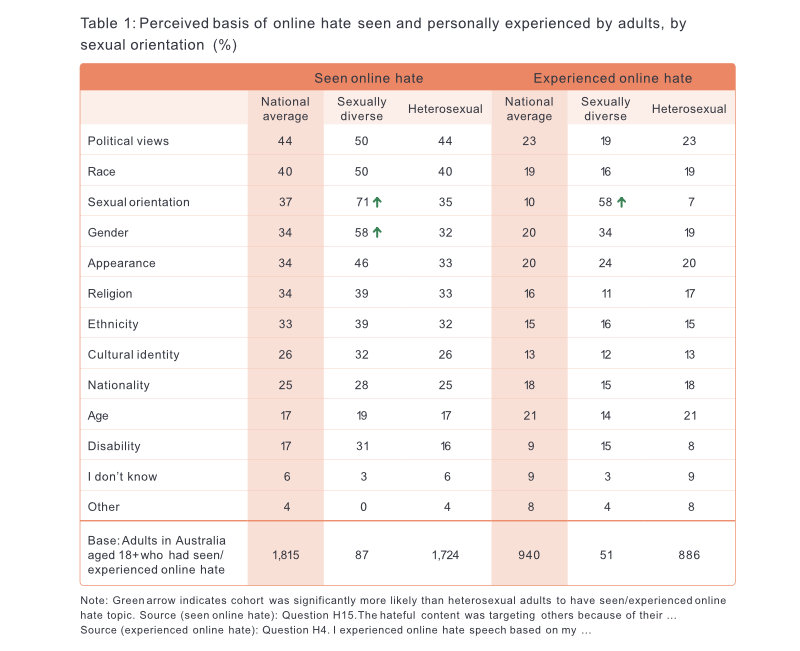
Source: eSafety Commissioner report Feb 2025
With political views ranking as the number one basis for online hate at 23%, the importance of political leaders setting the right tone cannot be overstated.
As eSafety Commissioner Julie Inman Grant has stated: “No Australian living in our community today should have to endure hateful abuse because of who they are.”
Women and LGBTIQ+ Groups
Just a year and a half ago, in April 2024, Joel Cauchi stabbed and killed six people, five of them women, one man, at Bondi Junction shopping centre in what NSW Police Commissioner Karen Webb described as an attack that “obviously” targeted women.
While an inquest later found no definitive evidence that Cauchi was part of the incel community, his actions were celebrated online by incels who venerated him as a “saint”. According to GNET research, incel forum users posted comments like “Australian sluts deserved this”.
The connection between digital hatred and physical violence is not correlation but causation. Studies from Germany found that upticks in attacks on refugees – including arson and assault – followed spikes in anti-refugee Facebook posts by far-right parties.
A 2021 global survey revealed that 73% of female journalists have experienced some form of online violence. Critically, 20% of female journalists said they had been attacked or abused offline in connection with hate experienced online.
Likewise, a 2019 eSafety Commissioner report found that LGBTIQ groups were among the largest targets of hate speech in the country, well above the national average, alongside Indigenous people.
However, when Independent MP Allegra Spender recommended that hate speech laws include protections for LGBTIQ+ groups, the Australian Jewish Association attacked her, posting: “Please don’t use the murder of Jewish people at a Chanukah event to push your ‘LGBTQIA’ laws which have already been rejected by both sides of politics.”
The elephant in the room
The reality is, unless we force social media platforms to stop acting as conduits for hate, none of this matter. All the legislation, education, and counter-speech in the world are meaningless when algorithms designed to maximise engagement actively amplify hatred.
The platforms don’t care if the content radicalises – they care if it generates clicks.
As AI capabilities expand, the capacity to generate and disseminate hate at industrial scale will only accelerate. We can pass all the laws we want, build all the community resilience programs we can fund,
but until we regulate the architecture that turns whispers of hatred into roars,
and until we hold the platforms that profit from division genuinely accountable with measures that actually hurt their bottom line, we are not solving the problem, we are managing its symptoms while the disease metastasises.
Antisemitism Bill. Same shirt. Different stairs. Years in prison.