
Antisemitism is about to become a criminal offence under the proposed Combatting Antisemitism Hate and Extremism Bill. Andrew Brown checks state over-reach.
Until very recently, wearing a T-shirt that said “Fuck Israel fuck Zionism” in public was legally dull. Crude. Offensive. Unpopular in polite company. But constitutionally protected.
In 2024 the Federal Court made the line explicit. Criticism of Israel or Zionism is not antisemitism. One targets a state and an ideology. The other targets a people. Conflating them is legally wrong and constitutionally dangerous.
That distinction sat inside Australia’s implied freedom of political communication. You could be angry. You could be offensive. You could say things that made powerful people uncomfortable. That was the point.
Prosecution or persecution? Charges dropped against Bondi ‘F*** Israel tee-shirt man
Today that line is being erased.
The Albanese government is introducing the Combatting Antisemitism Hate and Extremism Act 2026 into Parliament.

Loading…

 Reload document
  Open in new tab
 It is sold as protection. It operates as control.
Under this law, clothing is no longer just expression. It is conduct. A T-shirt is not an opinion. It is an act. Your chest becomes a regulated surface.
The Act expands criminal vilification to include national origin. Israel is a nation-state. That alone pulls political criticism into criminal territory. Zionism is treated in public discourse as inseparable from Jewish identity, whether critics accept that framing or not. The law does not care what you mean. It cares how a hypothetical reasonable person might feel.
Not actually feel. Hypothetically.
A ‘reasonable person’
The Act is explicit. It does not matter whether anyone was intimidated. It does not matter whether harm occurred. If a reasonable person could feel fear or intimidation, the threshold is met.
That is not law anchored in harm. It is law anchored in vibes.
This is how the “fuck Israel fuck Zionism” shirt moves overnight from protected political speech to something police can order removed, seize, record, investigate, and prosecute. Not because it calls for violence. Not because it threatens anyone. But because it offends in the wrong direction.
Now comes the farce that exposes the whole structure.
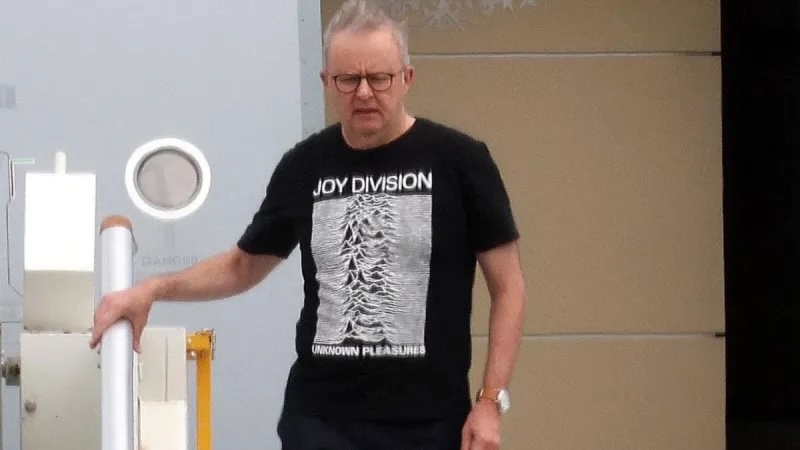
Consider the Joy Division T shirt.
The band name is a direct reference to Nazi camp brothels. This is not interpretation. It is historical fact. Ugly. Loaded. Uncomfortable.
An Albo
And yet Anthony Albanese has worn one publicly. Down airplane stairs. On camera. Smiling. No police interest. No public safety panic. No suggestion that Jewish Australians might feel intimidated. Apparently, Nazi references are fine when they come with a record collection and executive power.
Now put that exact same shirt on a protester at a pro-Palestinian march.
Nothing about the shirt changes. The cotton does not mutate. The history does not shift. The reference does not soften.
What changes is the wearer.
Suddenly the shirt is no longer culture. It is context. It appears at a protest critical of Israel. Jewish Australians are now a foreseeable audience. The historical Nazi association becomes relevant.
A reasonable person could feel intimidated.
That is all the law needs.
Police can direct the protester to remove or cover the shirt. They can eject them from the march. They can seize it. They can record the incident. If the protester refuses or the moment escalates, a charge becomes thinkable.
The maximum penalty runs into years of prison.
Not because anyone believes the protester is a Nazi. Not because violence followed. Not because intent was proven. But because context has been criminalised and discretion now does the heavy lifting.
This is not accidental. It is the design.
At His Majesty’s discretion
The law does not criminalise symbols evenly. It criminalises them selectively. It relies on complaints. On discretion. On who is wearing the shirt and where they are standing when they do it.
Power insulates. Dissent exposes.
The Prime Minister can wear the shirt on camera, and the law looks away. A protester wears the same shirt on a march, and the law wakes up, sharpens its knives and starts counting years of imprisonment. Same cotton. Same ink. Same history. Different power. That is not accidental.
That is exactly how this law is meant to work.
Once you reach the point where a T-shirt worn by the powerful is culture and the same T-shirt worn by the powerless is prosecutable conduct, free expression has already collapsed. It has not been banned. It has been rationed.
This is not about protecting communities. It is about disciplining speech. Teaching citizens to pre-censor. To understand that some political opinions are now too dangerous to wear in public.
When clothing becomes conduct, and perception replaces harm, stupidity is no longer a side effect. It is the operating system.
And once the law starts policing context instead of conduct, prison stops being a punishment. It becomes a warning.
A lawyer’s opinion on the proposed legislation:
There’s no express constitutional right to free speech or political affiliation, so any protection for wearing either shirt relies on the implied freedom of political communication. That operates as a limit on legislative power, not a personal shield.
What’s notable is how deliberately this Bill is drafted to blunt that implication. It reframes political expression as regulation of “conduct” by expressly capturing the wearing of clothing in public. It expands protected attributes to national origin, pulling criticism of a foreign state into the criminal frame. It also removes any requirement for actual harm, relying on a hypothetical reasonable-person fear test.
That structure makes criminal prosecution a realistic outcome where either a “Fuck Israel Fuck Zionism” shirt or a Joy Division shirt is worn in a protest context. The Constitution would offer only limited, post hoc protection, likely raised after charge. Courts may accept Parliament’s public safety framing.
In practical terms, the implied freedom gives an argument on appeal, not protection from prosecution.