
Coal and gas have finally been eclipsed by renewable energy as wind and solar tip in half the power to Australia’s electricity grid. Stephanie Tran reports an historic event.
Australia’s electricity grid has reached an historic milestone, with renewables supplying almost half of all power across the national electricity market in the final quarter of 2025 and exceeding 50% in Western Australia for the first time.
And dispelling once and for all the fossil fuel myths that coal is cheaper than renewable energy, the December quarter figures show the substantial differences in costs per megawatt hour.
Data from Open Electricity shows renewable energy accounted for 49.9% of electricity generated across the National Electricity Market (NEM), which covers New South Wales, Queensland, Victoria, South Australia and Tasmania, in the final quarter of 2025. For the full calendar year, renewables supplied a record 42.9% of NEM generation.
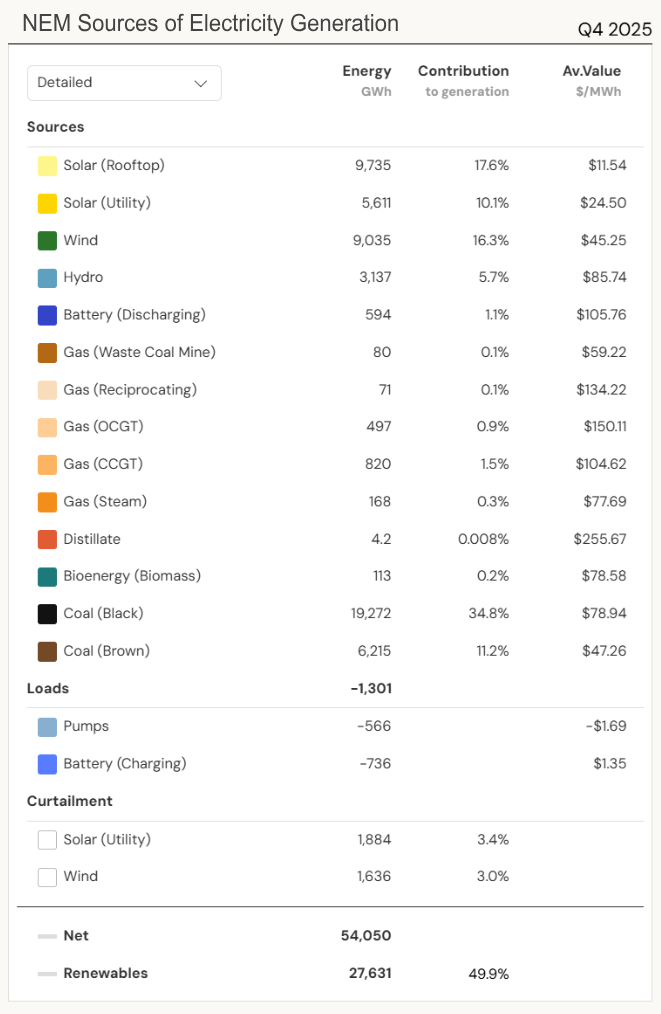
Source: Open Electricity
Western Australia, which operates outside the NEM through its South West Interconnected System (SWIS), beat the eastern states in the race to the milestone. Renewables made up an average 50.7% of electricity generation in the December quarter, giving WA bragging rights as the first major Australian grid to exceed 50% renewable electricity generation over a quarter.
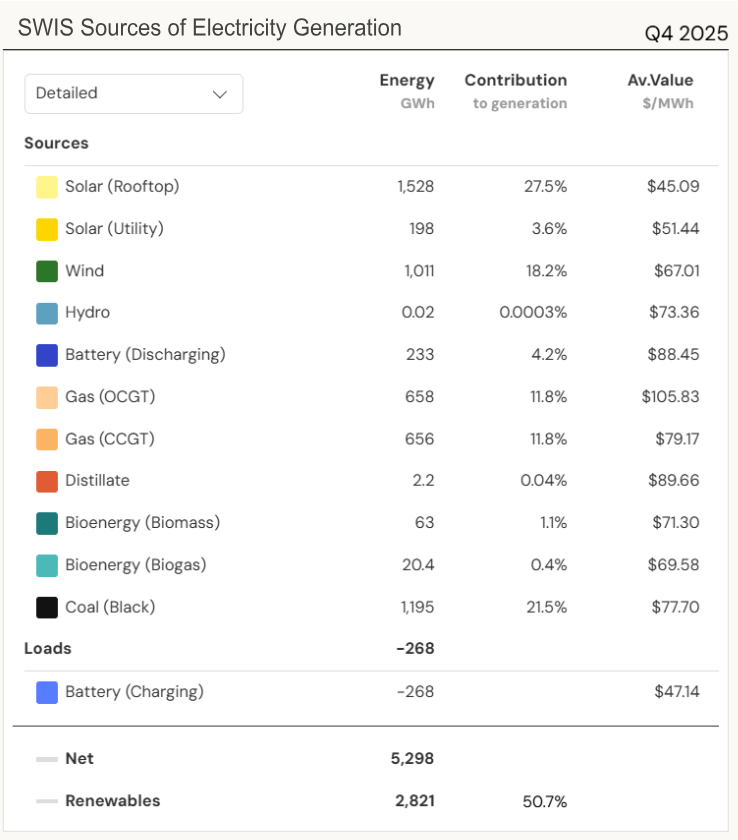
Source: Open Electricity
Bowen targets possible but long-shot
Tim Buckley, director of Climate Energy Finance, said the December quarter marked a turning point for Australia’s energy system.
“This is the first time Australia has generated more than 50% of its electricity nationally from renewables in a quarter,” he said, describing it as clear evidence the country was “making strong progress” towards the federal government’s clean energy targets.
The surge in renewables comes as climate and energy minister Chris Bowen pushes towards Labor’s goal of reaching 82% renewable electricity by 2030, a target he has described as “ambitious and achievable”.
Buckley agreed the task would be challenging but said the latest figures showed
the goal remained within reach.
“The fourth quarter of 2025 shows we’ve already made significant progress,” Buckley said. “But we need an acceleration and expansion of investment to deliver the 82% target.
“The good news is that wind, solar and battery projects can be built quickly. The real obstacles over the past five years have been planning approvals and grid connection issues, and we’re finally seeing signs that those barriers are being addressed.”
Power bills to fall
The rapid expansion of renewables is also reshaping electricity prices. Average wholesale power prices across the NEM fell 48% year-on-year in the December quarter to A$68 per megawatt hour, among the lowest levels in the world. Across the full year, wholesale prices averaged A$108/MWh, an 18% fall compared with 2024.
Buckley said the link between rising renewable generation and falling prices was now unmistakable. “The correlation between high renewables and lower electricity prices is more than a coincidence,” he said, pushing back against claims that clean energy was driving price rises. “The clear driver of hyper-inflated energy prices over the last three years has been record-high fossil fuel prices.”
Gas continues to shrink
According to Buckley, Australia’s exposure to volatile global gas and coal markets, despite being one of the world’s largest fossil fuel exporters, had left households vulnerable. “That reflects years of regulatory capture by fossil fuel vested interests,” he said. “The solution to high energy prices is building rapidly, and it’s building renewable energy capacity at scale.”
Gas’s role in the power system continues to shrink. In the December quarter, gas accounted for a record low 2.9% of electricity generation in the NEM.
Buckley said the data showed fossil fuels were losing their dominance.
This is a landmark moment where fossil fuel generation fell below 50% for an entire quarter for the first time in Australia
“It proves we are making strong progress towards electrification and decarbonisation.”
Investment remains the critical constraint. Buckley said Australia needed a far faster build out of both renewable generation and energy storage, at household and utility scale. While rooftop solar and home batteries were booming, supported by the federal government’s Cheaper Home Battery Program, utility-scale wind and solar had been held back by slow approvals.
Feds ramp up approvals, both fossil and RE
“Australia leads the world per capita in rooftop solar and behind the meter batteries, and that leadership has accelerated in the last six months,” Buckley said. “What we now need is the same urgency applied to utility scale wind, solar and battery storage.”
He pointed to major progress in battery energy storage systems in 2025, which he said was transforming the economics of renewables by allowing cheap solar energy generated during the day to be stored and used during evening peak demand. Australia is now the third largest market globally for battery storage installations, behind China and the United States.
“If we can build replacement capacity at the speed and scale required,” Buckley said, “these investments will permanently reduce energy price inflation and that’s something the Australian public needs to understand.”