
Médecins Sans Frontières has warned Israel’s suspension of NGO operations in Gaza would be “absolutely devastating”. Stephanie Tran reports Australian reaction to Israel expelling humanitarian orgs.
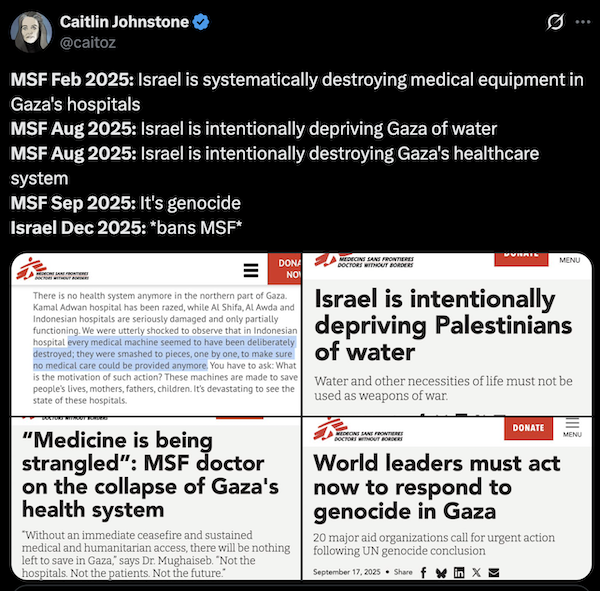
Overnight, Israel announced it has banned the world’s leading humanitarian agencies from Gaza, including Doctors without Borders (Médecins Sans Frontières), World Vision, Oxfam, Caritas and more than two dozen others. For antisemitism.
Ashley Killeen, director of engagement at Médecins Sans Frontières (MSF) Australia and New Zealand, said MSF was continuing to operate in Gaza but remained in limbo about whether it would be allowed to remain.
“We’re continuing to operate in Gaza, unless we hear otherwise,” Killeen said. “We are awaiting official communication from Israeli authorities whether we have or have not received registration.”
Israel has said it will halt the operations of 37 international humanitarian organisations in the Gaza Strip from 1 January 2026, accusing them of failing to meet new requirements introduced by its Ministry of Diaspora Affairs and Combating Antisemitism.
The new regulations require aid groups to submit detailed information on their staff, funding and activities, and include conditions that organisations “must not engage in any activities or criticism which delegitimise the state of Israel”.
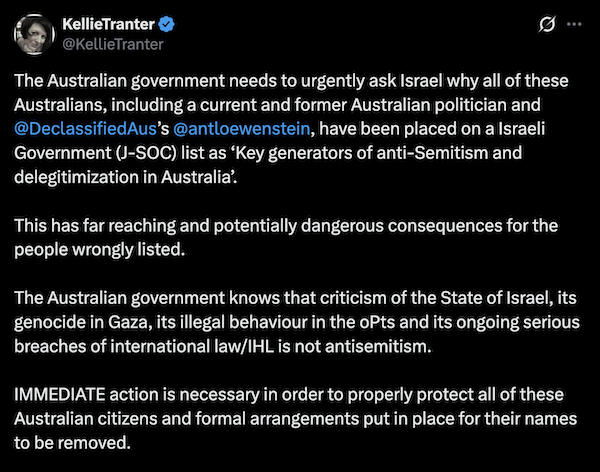
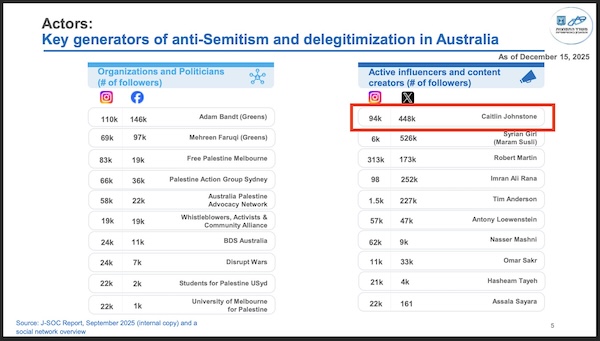
The Israeli Ministry also came under fire on Monday for releasing a report naming dozens of Australians as “Key generators of anti-Semitism and delegitimization in Australia”.
Killeen said MSF was currently in a “grey area” following the December 31 deadline set by Israeli authorities.
“The 31st of December was the deadline so I’m sure we’ll know in the next 24 hours,” she said. “But what we can say is that if this comes into effect, it will be absolutely devastating.”
MSF is one of the largest medical providers operating in Gaza. Killeen said the organisation currently supports six hospitals and two field hospitals, delivering a scale of care that would be impossible to replace.
“In 2025, we delivered 800,000 outpatient consultations,
100,000 trauma surgeries, and delivered 10,000 babies.
“This gives you a sense of the huge gap that will be there if we are told that we have to cease these operations,” she said.
Gaza’s health system is heavily reliant on international NGOs, with local facilities overwhelmed, damaged or destroyed.
“We’re experienced in operating in these types of situations where the infrastructure and the medical facilities are decimated,” Killeen said. “So to be able to replace that, I’m honestly not quite sure how that would happen.”
“The population of Gaza is reliant on these international NGOs. This is not something that is a complementary service. It’s a core service.
And if it’s not there, it’s horrific to think what will happen to these people.”
Killeen expressed concern that organisations similar to the Gaza Humanitarian Foundation (GHF) may be brought in to fill the gaps left by the NGOs. In August, the UN called for the dismantling of the GHF after 859 Palestinians were killed while seeking food at GHF sites.
“We know that there have been interventions introduced, such as the so-called ‘humanitarian hubs’, where people have gone to receive food and have been met with gunshots,” she said. “The prospect of that type of solution is terrifying.”
MSF has operated in Gaza since 1989 and employs a predominantly Palestinian workforce, many of whom are unable to leave the territory.
“We will do everything to try and remain in Gaza,” Killeen said. “The majority of people that work for MSF in Gaza are Palestinian. They can’t leave. We come in and we complement that with international staff, but these are people that are there, their families there.
“To no longer be there and provide this service – it’s so much more than taking away a lifeline for people. It’s ripping the fabric of the community.”
NSW passes protest ban, Premier ducks questions on armed CSG on Sydney streets