

With the e-bike market exploding in Australia, record numbers will be found under the Christmas tree this year. But how safe are they? Andrew Gardiner asks.
If our epidemic of e-bike accidents exasperates you, chances are you’ll want to blame someone. Those looking to cast a ‘villain’ for this tragedy need look no further than Barnaby Joyce, who, as Transport Minister, pulled the rug out from under existing e-bike safety protocols in 2021.
That’s right, readers: safety guardrails we’d adapted from Europe in 2011 to regulate the import of e-bikes were removed from rules around the Road Vehicle Standards Act – quietly and without much in the way of public debate – under Joyce and his junior minister, Kevin Hogan.
The most we see by way of explanation is that it was to “simplify the definition of e-bikes”, which were deemed “not road vehicles” under the Act – a move which flies in the face of what residents see, daily, in coastal suburbs from Cronulla to Coolangatta.
MWM is not suggesting any corrupt or otherwise nefarious intent on their part. Instead, it seems Joyce, Hogan, and the bureaucrats below them had no idea what quietly changing a few words would bring.
But what did they expect? With importers no longer having to worry about pesky safety standards, and retailers allowed to flog cheaper, shoddier versions of what would soon become a go-to Christmas gift, e-bikes flooded the country.
Soaring sales (and casualties)
From just 9,000 in 2017, under the axed import protocols, e-bike imports soared to 261,000 last year, many of the latter arrivals with sub-standard lithium-ion batteries and easy-to-hack speed limit software. Cue the well-publicised array of deaths and injuries from battery fires, or from kids riding along busy roads. sometimes at speeds of up to 50km/h or more.
The casualty numbers were shocking: 40 riders have died nationally over the past five years. Meanwhile, more than 500 e-bike riders presented to NSW emergency departments over the 24 months to last December, and hospitalisations from e-bike injuries in Victoria have jumped by 627 per cent ($) since 2019.
A 2025 study found that e-bike riders were twice as likely to suffer traumatic brain injury as those on regular bicycles. Meanwhile, in NSW (the only state to publish such data), there were 323 fires caused by lithium-ion batteries used by e-bikes last year, almost double the number in 2022.
Amid a frenzy of media attention around this carnage, state parliaments and authorities launched a string of inquiries into e-bikes and other rideables. For her part, Federal Transport Minister Catherine King announced she would restore the European e-bike standards, known as EN-15194, by the end of the year.
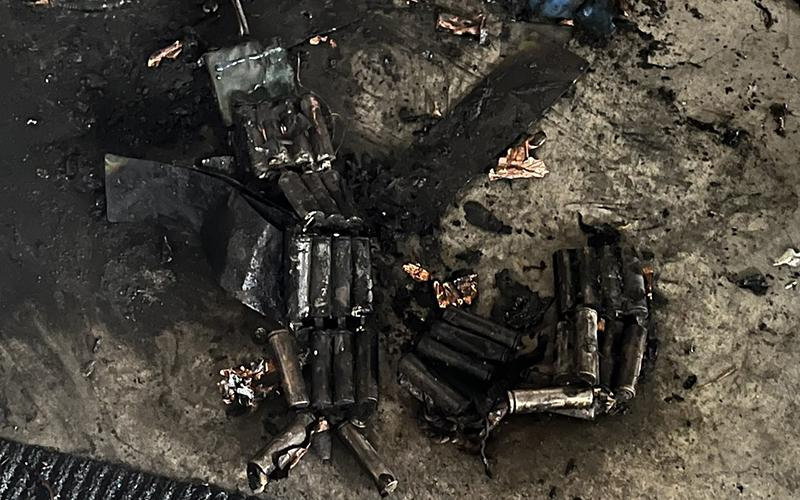
The remains of an e-bike after its lithium-ion battery exploded. Image supplied.
Damage already done
King’s belated move will do nothing to remove the thousands of sub-standard e-bikes that made it onto our streets while the European rules were scrapped. That onerous task has been left to state police and officials, who must again navigate a labyrinth of road rules and specs – just as they did after EN-15194 was first adopted in 2011 – to make sure everything is in sync with those rules at the local level.
It’s hard to estimate how many dangerous e-bikes are out there, since Joyce and Hogan’s laissez-faire approach meant importers didn’t even have to let authorities know they were bringing them in. Suffice to say, the estimate is high and growing.
Safety fears are heightened by overpowered bikes, a lack of proper training for riders, a failure to wear helmets, and a plethora of unregistered and illegal e-bikes with backyard modifications. And if anything, the situation for e-scooters is even more out of control.
“There are even fewer regulations for e-scooters than there are for e-bikes, and they’re accident-prone too”, Bicycle Queensland’s Andrew Demack told MWM.
We contacted Joyce and Hogan for their take on the situation, but have not heard back.
Standards mismatch
Under the axed European standards, imported e-bikes must have motors with a 250-watt power limit, which cuts off at 25km/h and will only contribute when riders are pedalling. Once Joyce and Hogan scrapped those rules, however, the NSW government raised the maximum allowable continuous power rating for e-Bikes from 250 to 500 watts in 2023, against its own experts’ advice.
While other states kept a 250-watt limit on motors, the genie was out of the bottle on uniform laws. NSW, the final state to adopt the European standards, seems “more interested in regulating battery fires” than speed or power, while Queensland seems to have the opposite approach, Peter Burke, Executive Officer of Bicycle Industries Australia, said.
“We need harmony of regulations across the country”, he added. That could be easier said than done.
Speed tweaks
Then there’s the problem of riders tweaking e-bikes so they can go faster than the mandated 25 km/h, or of flat out ignoring the need to pedal to comply with the rules. “So many of the models kids use have a throttle, which really makes them motorbikes”, MWM’s own Josh Barnett, an e-bike owner, says.
Many riders “barely follow the regulations”, and “if you modify the software you can easily change an e-bike’s speed limit”, Josh added. Other ways of getting around speed limits include adjusting the display settings, using a special tuning dongle, and replacing the controller.
In an effort to address this and the broader problem of relaxing e-bike regulations by executive fiat, ‘Teal’ independent Sophie Scamps has gone a step further than King’s planned restoration of EN-15194. The Mackellar MP recently tabled her own private member’s bill, encoding e-bike regulations into legislation and tackling tampering with a bike’s speed limits.
“E-bikes … are an important part of the shift to cleaner, more active transport, but the technology has raced ahead of safety legislation” Scamps said. “I am very worried we are going to see more tragedies involving … these powerful e-bikes unless we act urgently to introduce clear national safety standards,” she added.
Not a federal issue?
You’d think a ‘motherhood’ statement like that would generate unity-of-purpose from our political class, but Labor frontbencher Anika Wells demurred. “I am wheely excited to see those ‘Teals’ come peddling up the hill, but I’ll be focusing on federal laws today,” she said, mocking Scamps and dismissing e-bikes as exclusively a state issue, which it isn’t.
Liberal Senator Jane Hume echoed Wells’ thoughts. “If (Canberra) is spending its time talking about bike riding, we’ve lost our way“.
It seems only catastrophes of Port Arthur (1996) proportions bring the kind of bipartisan support – across all levels of government – needed to solve something as knotty as our inundation by shoddy e-bikes.
And knotty it is: trying to stop young Leo from fiddling with his Lil Rippa to make it faster than his mate’s from across the road, or telling him not to do lithium-ion charged wheelies in spots deemed ‘dangerous’ by the grown-ups, seems as futile a task as banning kids from social media.
As for Barnaby Joyce, his days as a minister appear to be over. “And that’s a good thing”, one source joked. “He can’t stuff up our e-bike rules any further from the crossbench”.
Barnaby, Brussels and Out of Control E Bikes | The West Report