
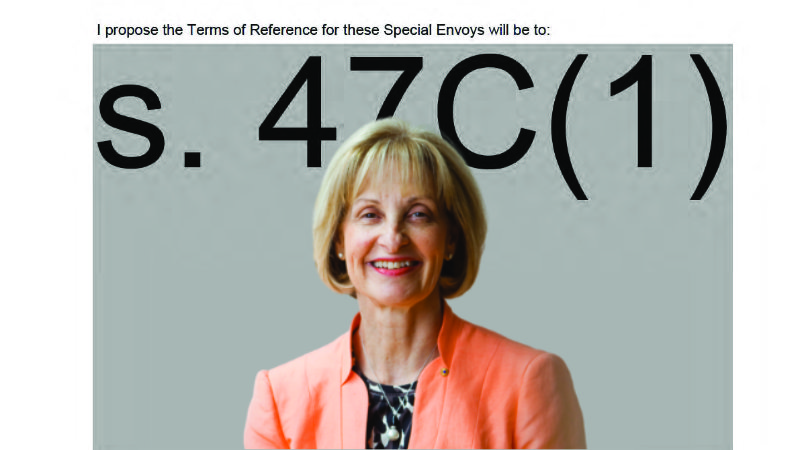
Jillian Segal, Australia’s controversial Antisemitism Czar and Israel lobbyist procured an extra $12.9m funding from PM Anthony Albanese, heavily redacted FOI documents show. Stephanie Tran reports.
The Albanese government has blocked key details about the appointment of Jillian Segal as Australia’s special envoy for antisemitism, with freedom of information documents (FOI) revealing a process almost entirely obscured by redactions.
The documents, released by the Department of Home Affairs in response to an FOI request, show the government relied on wide-ranging secrecy exemptions to withhold internal briefings, candidate assessments, deliberative advice to ministers, and all correspondence between Segal and the Prime Minister’s Office.
Beyond a set of boilerplate terms of reference, the documents shed little light on why Segal was chosen. What’s deliberately missing, however, is the real story.
Selection process almost entirely redacted
One of the key questions the FOI sought to answer was how Segal came to be selected. In correspondence to staff in March 2024, Home Affairs officials described an intention to provide the Prime Minister with “up to 6 candidates” reflecting “the demography of Australia”, diverse identities and gender, and “trusted relationships” in their communities.
But every document detailing assessments or the rationale for selection was either heavily redacted or withheld in full, primarily under the FOI Act’s deliberative processes exemption under s47C.
The Information Officer’s decision letter notes that Home Affairs undertook “extremely thorough” searches, but still located no resume, no risk assessments and no evaluation criteria.
The Department’s claim that it could not locate a copy of Jillian Segal’s CV appears to be at odds with the government’s own records. In a June 2024 letter to the Prime Minister, Immigration Minister Andrew Giles explicitly stated that Segal’s “Curriculum Vitae, Private Interest Declaration and Appointments Details pro-forma are at Attachment D.”

Loading…

 Reload document
  Open in new tab
 Urgency and budget blowouts
What survives the redactions paints a picture of a high-speed, politically sensitive process.
The documents reveal the existence of an “Israel Hamas Social Cohesion Taskforce” within Home Affairs, headed by Giles.
In February 2024, Giles wrote to Anthony Albanese seeking “urgent agreement” to appoint envoys to combat Antisemitism and Islamophobia, citing the “immediate and significant rise in Antisemitism and Islamophobia … exacerbated by the 7 October 2023 Hamas terrorist attacks on Israel [and] the ongoing conflict and the dire humanitarian situation in Gaza.”
On 21 June 2024, Giles personally recommended Segal as the preferred candidate for the Special Envoy to Combat Antisemitism.
In a letter dated 25 June 2024, Albanese agreed to Segal’s appointment. Albanese also approved an additional $12.9 million of funding for the role.
“The 2024-25 Budget provided $4.0 million over two years from 2023-24 for the appointment of the Special Envoys, as a decision taken but not yet announced. Noting the appointments will now be for three years instead of one and additional support staff may be required, I agree to provide up to an additional $12.9 million in total over three years from 2024-25 for up to 12 staff, with offsets to be agreed in the 2024-25 Mid-Year Economic and Fiscal Outlook (MYEFO) context, subject to agreement with the Department of Finance.”
Public interest outweighed by need for secrecy
In its decision, Home Affairs argued that releasing deliberative material would hinder officials’ ability to provide “full and frank advice” on future appointments, and that releasing names or details of candidates would be an unreasonable breach of personal privacy.
The Department explicitly acknowledged that disclosure would “promote the objects of the FOI Act” and “inform debate on a matter of public importance” but still maintained the public interest favoured secrecy, particularly to avoid “prejudicing” internal government processes.
The information officer stated the following:
“I consider that the public interest in protecting the process of the provision of free and honest confidential advice by a Department to its Minister has, on balance, more weight, than the public interest that might exist in disclosing the deliberative matter. Endangering the proper working relationship that a Department has with its Minster and its ability to provide its Minister with honest advice confidentially would be contrary to the public interest.”
Jillian Segal’s many hats: Special Envoy for Antisemitism and Israel lobbyist extraordinaire