
Australia’s sanctions regime on Israel is not holding many perpetrators accountable for grave human rights abuses and war crimes. Karen Edyvane on Amnesty International report just released.
As illegal Israeli settlements and settler violence escalate across the occupied West Bank, Australia has sanctioned only half of those sanctioned by our allies.
Despite Foreign Minister Penny Wong’s recent announcement of additional sanctions, Australia’s response has not only been minimal, slow and ineffective, with any serious sanctions reform in effect ‘vetoed’ by the Israel Lobby.
Amnesty International has just released a major report detailing Israel’s accelerating annexation and ethnic cleansing of the West Bank – particularly the Palestinian Bedouin and herding communities.
The report is It is a detailed and chilling account of Israel’s state-led and state-funded systematic campaign of ethnic cleansing and settler-army violence. Resulting in an “exponential rise in state-backed settler violence
terrorising and expelling thousands of Palestinians to annex land.
Settler escalations ignored
Israeli settlements, considered ‘illegal’ under international law, have increased by 80% since the far-right Netanyahu Government took power, with 102 new settlements established since 2022.
Since October 7, 2023, the West Bank has seen a major escalation in Israel’s State-sponsored ethnic cleansing, including state-led settlement expansion, forced displacement, illegal land confiscations and settler-army violence.
Controversial measures such as the E1 settlement project and new land ownership rules have been designed to undermine the 1993 Oslo Accords, and ‘accelerate settlements’; and importantly, establish “de facto” annexation of the West Bank and, in the words of Finance Minister Bezalel Smotrich,
bury the idea of a Palestinian State.
Since October 2023, there have been more than 3,000 settler and military attacks across the West Bank— approximately five every day —killing 1,096 Palestinians, around one-fifth of them children.
In January 2026 alone, more than 200 violent settler-army attacks were reported in the Masafer Yatta region in the South Hebron Hills. At least 50 Palestinian villages, mostly Bedouin herding communities, have been totally erased and displaced from their historic lands.
Settlers have seized over 18% of the land designated for a future Palestinian state, with few repercussions.
International sanctions
International pressure has grown, led largely by the Global South through sanctions, legal action and arms embargoes. While calls are increasing to suspend the EU-Israel Trade Agreement, any progress has been blocked by Germany (a major weapons supplier to Israel) and Italy, which have argued for dialogue.
Spain, Ireland, the Netherlands, Belgium, Italy, Canada and Japan have all imposed arms embargoes or halted weapons sales to Israel.
In contrast, Australia has no arms or trade embargos, and progress on sanctions against Israel’s settlements and settlers has been slow and limited. The Australia Palestine Advocacy Network (APAN) has described Australia’s sanctions system as “broken” – due to its abject failure to hold Israel accountable for its ongoing human rights abuses, ethnic cleansing and genocide of Palestinians.
Last week, Penny Wong issued yet another public condemnation of escalating settler violence in the West Bank – reiterating “the Foreign Ministers of Australia, Canada, France, Norway and the United Kingdom, coordinated action to introduce sanctions and other measures to hold extremist settlers accountable for the horrific levels of settler violence against Palestinian civilians.”
But just how coordinated and effective have Australia’s sanctions efforts been?
Australian sanctions lag behind
After the October 2023 attacks and the following genocidal war in Gaza, Australia first imposed sanctions in July 2024 against seven settlers and one extremist entity, the ‘Hilltop Youth’, over its settler attacks across the West Bank.
In June 2025, Australia joined the UK, Canada, New Zealand and Norway in imposing a second round of Magnitsky-style sanctions on Smotrich and National Security Minister Ben-Gvir. In September 2025, Australia re-listed the extremist ‘Lehava’ — which was originally listed in 2001 under UN Security Council obligations.
Last week, over a year later, Australia targeted an additional three individuals with sanctions, and, for the first time, four settler outposts – all of whom are already internationally sanctioned (by the UK, Canada and/or the EU), many years ago.
As such, 5 out of 7 individuals/entities in the latest round of sanctions by Australia were sanctioned two years ago by our closest allies.
In short, Australia’s sanctions regime against Israel has neither been ‘coordinated’ nor kept pace with our closest allies. Rather, it has consistently, and reluctantly, followed international partners, often by several years.
Australia has never initiated independent action.
As such, Australian charities clearly linked to Israeli settlement activity, including Chai Charitable Foundation and United Israel Appeal, continue to operate with impunity – because only six Israeli entities/organisations have been sanctioned by DFAT.
In short, you can’t violate DFAT’s sanctions list + hardly anyone is on it!
Charities funding Israel’s illegal settlements untouchable, Labor says
Who’s missing?
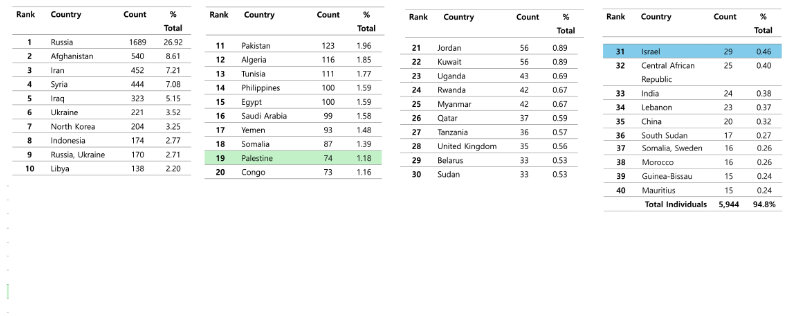
According to the Department of Foreign Affairs and Trade’s (DFAT) Sanctions List as of May 20, 2026, Australia has sanctioned only 18 of the 40 Israeli individuals and entities targeted by international partners.
Of the over 2,400 ‘entities’ listed by DFAT, nearly one-third are Russian (719). Palestine and Israel (combined), rank 6th (ie. 70 entities or 2.8%),
Ironically, Australia has sanctioned more British citizens — 35 individuals — than Israelis, despite the ICJ currently examining Israel’s ‘plausible genocide’ in Gaza and the court’s landmark July 2024 ruling that Israel’s prolonged apartheid and belligerent and lethal occupation since 1967, is unlawful.
Notably absent from Australia’s sanctions list are several high-profile extremist settler figures – individuals already sanctioned by Australia’s close allies.
Including Daniella Weiss, sanctioned by the UK, Canada and the EU, and described as the “godmother” of the settler movement and a prominent advocate for the biblical “Greater Israel” vision. In 2025, Weiss featured in Louis Theroux’s BBC documentary The Settlers.
Other notable sanctioned individuals/entities ‘missing’ include:
- Isaschar Manne of ‘Manne Farm’ in the Hebron Hills.
- Reut Ben Haim and Shlomo Yehezkel of ‘Tzav 9’, accused of blockading humanitarian aid trucks entering Gaza.
Australia’s sanctions will also remain largely ineffective if they just focus on individuals – and fail to target the broader and well-documented political, military, religious and organisational structures that support settlement expansion, annexation and settler violence.
In February this year, Australian members of the Global Sanctions Coalition (GSC) (ie. the JCA, Amnesty, APAN, Medical Association for Prevention of War) called on Australia to sanction the World Zionist Organisation (and its entities) – and also, Israeli settler politicians and Israel’s ‘Settlement Division’.
Potential extremist settler politicians for sanctions include (among others):
- Orit Strock: The Minister of Settlements and National Missions, who has drawn intense criticism from groups like Amnesty International for distributing state-funded equipment, cameras, and all-terrain vehicles directly to radical settlers to occupy Palestinian grazing lands. [1, 2]
- Zvi Sukkot: A Member of the Knesset known for leading Knesset committees that favor deep West Bank annexation. He has actively championed controversial conferences encouraging the relocation or displacement of the population in Gaza. [1, 2, 3]
- Amihai Eliyahu: The Heritage Minister who sparked massive global outrage by publicly suggesting that dropping a nuclear weapon on the Gaza Strip was “one of the possibilities” during the conflict. [1]
The GSC also called for sanctions against 3 settlers/construction companies involved in the widespread destruction of Palestinian civilian property (West Bank, Gaza) – Alon Elgali (Meshek Afar Ltd), Harel Libi (Libi Construction and Infrastructure Ltd), and Uria Loberbom (founder of the Uria Unit). Harel Libi and his company were sanctioned by the UK over a year ago. Australia has still to act.
Even as Israeli violence expands beyond Gaza and the West Bank, into southern Lebanon, Australia has failed to sanction major extremist settler organisations, such as ‘Uri Tzafon’ and networks supporting annexation and ethnic cleansing of Lebanon.
The West Bank. Israel’s atrocities in clear sight, but out of mind
Australia’s sanctions regime urgently requires an overhaul to comply with international legal standards and address Israel’s serious ongoing human rights violations and escalating violence in the West Bank and Occupied Palestinian Territories.
In 2021, prominent human rights barrister Geoffrey Robertson condemned the failure of Australia’s sanction system:
Targeted sanctions should be about human rights, rather than foreign policy.
“The government does not understand that sanctions will only be credible if they are just and backed by the objective opinion of experts on human rights – not of politicians or ministers.”
Amnesty International’s major report on the West Bank this week has argued that the international community’s ongoing silence and failure to act resolutely to stop Israel’s crimes has “emboldened the Israeli authorities to escalate a brutal campaign to forcibly displace Palestinians and expand its control over land in the West Bank.”
Israel lobby sells stolen Palestinian land to Australian investors