
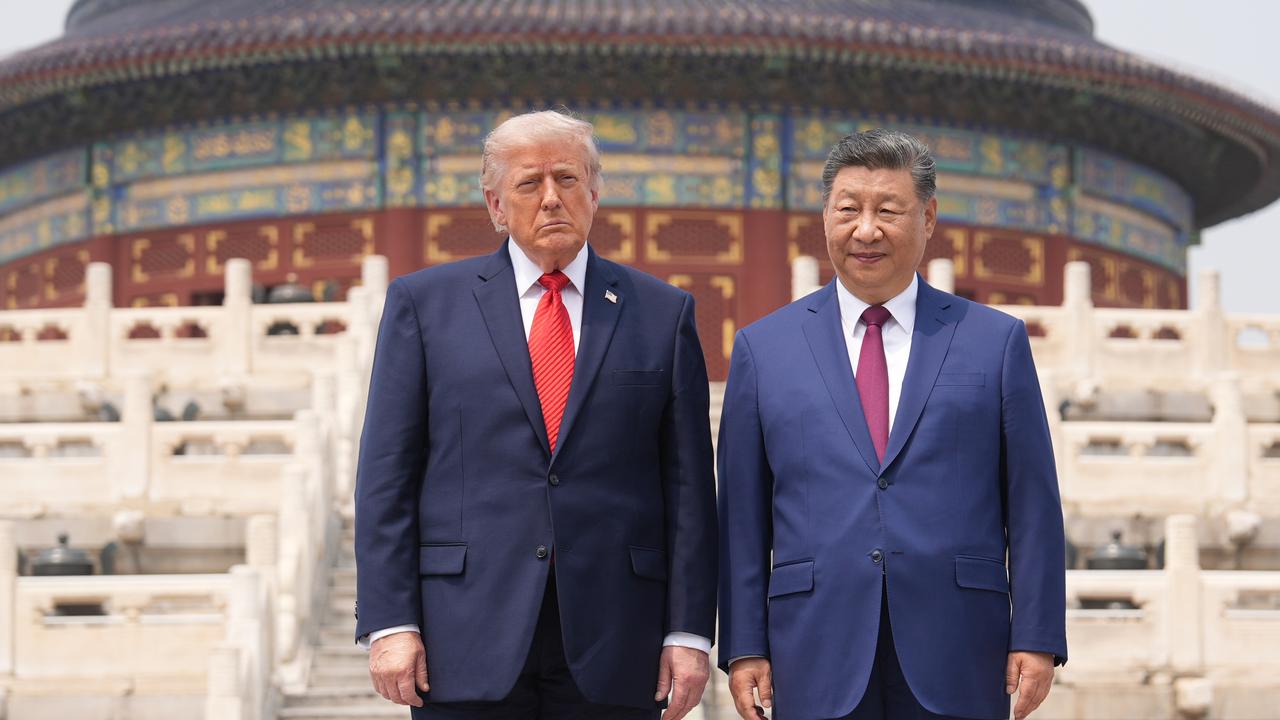
Chinese President Xi Jinping has hailed a “new positioning” of ties with the United States that envisages co-operation with measured competition, following his summit with US President Donald Trump.
Trump’s Beijing visit, the first by a US president in nearly a decade, runs until Friday at a time when his Iran war is denting domestic approval ratings ahead of mid-term elections.
Xi said both leaders agreed that building a “constructive, strategically stable relationship” would guide ties in the next three years and beyond, according to a Chinese foreign ministry statement.
Xi described such ties as based primarily on co-operation but with measured competition for “a normal stability in which differences are controllable, and a lasting stability in which peace can be expected,” the ministry added.
Analysts said the reference to “constructive strategic stability” showed China was following gradations in relations that yield a framework for diplomacy in which it can manage multi-faceted ties with the United States.
The new Chinese framing echoed the formulation of “constructive strategic partnership” proposed in 1997 – the most positive following the end of the Cold War – and signalled China’s desire to put relations on surer footings.
China had framed ties with the US in terms of partnership and co-operation in the 2000s and early 2010s.
But increasing competition and rivalry after China overtook Japan to become the world’s second largest economy in 2010, as well as Xi’s ascendance to power in 2012 and Trump-induced volatility since 2016, resulted in language of managed interdependence, strategic competition and conflict-avoidance.
The new framework marks a significant shift away from past “negative characterisations” such as great-power competition, said Wang Wen, a professor at Beijing’s Renmin University.
“The core distinction lies in its emphasis on a positive model of interaction marked by co-operation as the mainstay, together with measured competition, manageable differences and a foreseeable prospect of peace,” Wang said.
“It’s new language and I think it reflects China’s desire to put more institutional guardrails around US-China relations, both competition and cooperation,” said Joe Mazur, geopolitics analyst at Beijing-based consultancy Trivium China.
China and the US “should be partners, rather than rivals,” Xi said while holding a state banquet for Trump on Thursday.
But frictions, such as those over the Iran conflict and recent US sanctions on Chinese firms, continue to “complicate US-China dynamics” and may test the durability of the new framework, said Zhao Minghao, an international relations expert at Shanghai’s Fudan University.
Even as Xi talked up co-operation, he stressed “utmost caution” by the United States in handling the issue of Taiwan, the democratically governed island claimed by China, although Taipei rejects the contention.
“If handled poorly, the two countries could collide or even enter into conflict, pushing the entire China-US relationship into an extremely dangerous situation,” the Chinese leader said.
Xi also raised eye brows by asking “whether the two countries can transcend the ‘Thucydides Trap’ and forge a new model for relations between major powers”.
The term – popular in foreign policy studies – refers to the idea that when a rising power threatens to displace an established one, the result is often war.
Xi has used the term for years but using it as Trump offered optimism was noteworthy and foreshadowed his closed-door comments on Taiwan.
with AP