

In its pitch to keep the “Pezzullo Report” secret, the Australian Public Service Commission has given sworn evidence to the Administrative Review Tribunal that it is a failed organisation. Rex Patrick reports.
The Australian Public Service Commission (APSC) is charged with promoting excellence in the Public Service. Section 41 of the Public Service Act requires the APSC to “uphold high standards of integrity and conduct in the Australian Public Service (APS)” and to “promote the APS values, the APS employment principles and the APS code of conduct.
But it is failing in this task.
Last year MWM reported on the Australian Public Service Commissioner’s arguments in a Senate submission that RoboDebt wasn’t caused by failed leadership, it wasn’t caused by officials quietly advancing their careers while turning a blind eye to bad stuff happening on their watch, it wasn’t caused by malfeasance or misfeasance, rather transparency was to blame!
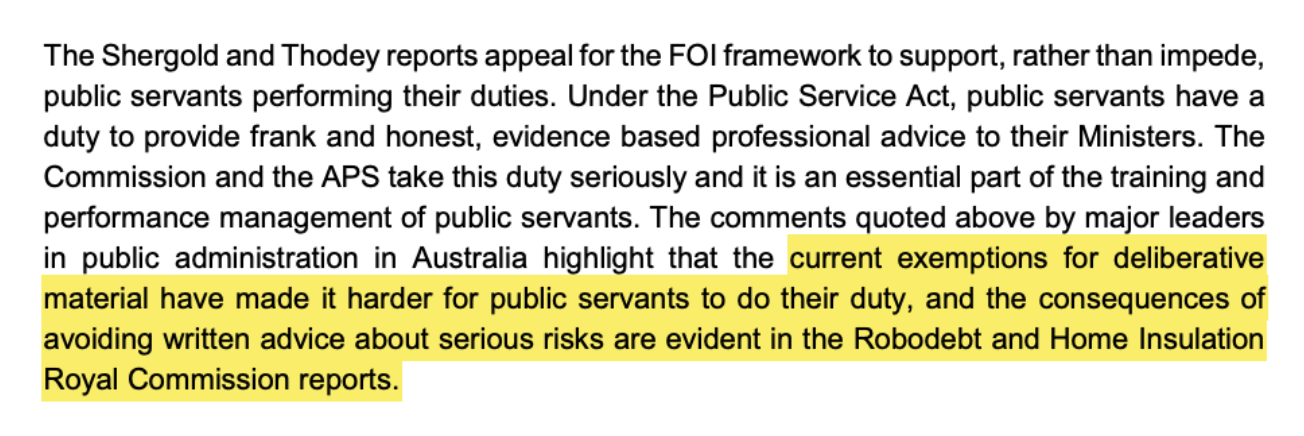
APSC Senate Submission Extract (Source: Senate)
Fat Cats say what? Too much transparency caused Robodebt scandal
We endorse public servants breaking the law
Undeterred by this outrageous claim the APSC has gone one step further, arguing under oath, that
public servants can break the law if they are confronted with a transparency requirement.
In a submission to the Administrative Review Tribunal as they argued to keep the Pezzullo report secret, an APSC Deputy Commissioner, Joanne Talbot, argued confidentiality was essential to the conduct of an inquiry into a Secretary of a Department.
Failure of the Commission to take steps to protect the confidentiality of the inquiry process to the maximum extent permitted by law (including by maintaining exemptions that apply under the FOI Act where applicable) could reasonably be expected to lead to a decrease in the willingness of APS officers (including the person the subject of the inquiry) and members of the public to report relevant conduct and cooperate fulsomely in any inquiry.
The only problem with Talbot’s position is that it is inconsistent with the law.
Section 10 of the Public Service Act requires personnel to be professional in achieving the best possible results (in meeting their roles and responsibilities) for the Australian community and the Government. Section 13 of the Act requires public servants to behave honestly and with integrity, comply with all applicable Australian laws and comply with any lawful and reasonable direction given by someone in the employee’s Agency who has authority to give the direction.
What makes matters worse is that Section 12 of the Public Service Act requires the Australian Public Service Commissioner and Commission to uphold and promote the above values and employment principles. But the Commission clearly prefers secrecy over it guiding public servant to abide by the law.
Making stuff up
Ms Talbot gave evidence that she had been involved in more than 100 workplace investigations and gave the following evidence;
If information provided in inquiries is publicly disclosed, future investigations are likely to be negatively impacted in circumstances where individuals would likely be less candid and frank by reason of a concern that the information they provided would be disclosed.
Again, the chilling effect that Ms Talbot claimed could happen, is unlawful. Chilling is not allowed.
That aside, and to properly test the claim, under cross examination Ms Talbot was asked how many of the more than 100 workplace investigations in which she had participated had involved public disclosure. “None”, was her answer. The cat was out of the bag – Ms Talbot had never seen the effect that she purported would happen. She had no experience to back her claim.
Compelling evidence
When a Secretary of a Department is being investigated by the Commissioner, he or she has the power to compel a witness to give evidence. In relation to that Ms Talbot stated:
Witnesses who cooperate fully, openly and frankly are likely to be of significantly greater assistance to the conduct of inquiry than witnesses who may adopt a more minimalist approach to providing only such information as they are legally compelled to do.
But again, under cross examination, Ms Talbot had to concede that she had only used compulsion powers once; to get documents for the Pezzullo investigation. She had no experience in the use of compulsion powers.
And Ms Talbot was just wrong. As pointed out by Deputy President Britton-Jones in the Tribunal,
compulsion often makes people more comfortable giving evidence.
Compulsion offers a protection to a witness – the opportunity to say that their testimony wasn’t by way of grace, rather it was mandatory.
MWM has requested summonses in past proceedings for protective reasons. The witness does not have to appear to be a willing participant.
Getting bizarre
Another bizarre statement on the topic of compulsion made by Ms Talbot was as follows:
In addition, exercising the compulsory powers of the Commission invariably involves time, expense and resources.
When asked to explain what was involved in compelling a witness, Ms Talbot did not know.
Again, MWM having compelled witnesses in Tribunal proceedings, knows that it is not resource intensive.
It is not clear why Ms Talbot decided to give testimony over a matter that she was not familiar with; maybe the APSC’s addiction to secrecy helps to explain her conduct.
Fear of blowing the whistle
Ms Talbot also made a plea to the Tribunal that fear of reprisal is an inhibitor to public servants coming forward to report a breach of the APS Code of Conduct.
I believe that APS employees and members of the public would likely be more reluctant to report such information to the Commission if they anticipated that the fact of their report of an Agency Head or the information that they provided would become widely or publicly known. In particular, such APS employees could be concerned, rightly or not, about the risk of potential negative impacts on their public service career, such as an adverse affect on their working relationship or the perception of how others see them.
How’s that for confidence of the APSC in public service whistleblower protections?
A breach of the APS code of conduct is disclosable conduct under the Public Interest Disclosure Act, for which there is a protection under that Act. The only way in which reprisal can occur in respect of a public servant reporting on the breach of the APS Code of conduct is if whistleblower protection inside the public service is not working.
Perhaps this was the most truthful evidence Ms Talbot gave. Perhaps she’s aware of the effect that the prosecution of Afghanistan whistleblower David McBride and Tax Office whistleblower Richard Boyle has had on other public servants.
No conviction for whistleblower Boyle. Reform urged after ordeal
Failure. Public servants muzzled
Putting aside the poor decision of the APSC to keep the Pezzullo report secret, the APSC’s submissions, and particularly the evidence of Ms Talbot, in the Administrative Review Tribunal proceedings paints a damning picture of the environment in which Australian public servants work – an environment where officials cannot assist in an inquiry openly, even when obliged by the law to do so,
because they have no faith that their leadership will protect them.
The submissions and evidence were all the more shameful noting the APSC is directly responsible for the environment in which public servants found themselves working.
Their submission in the Pezzullo proceedings was an assessment of their own performance. And they gave themselves an ‘F’.
The mandarin who got caught. Mike Pezzullo inquiry details revealed