

The Iran War has brought another round of Middle East death and destruction, and with it, profits for weapons companies supported by our superannuation money. Andrew Gardiner reports.
All three combatants in the American-Israeli assault on Iran may not have much to show for it, but the same cannot be said of companies like Elbit Systems, Israel Chemicals (ICL) and Caterpillar Inc., as they reap the rewards of ruination.
Many Australian superfunds are invested in the success of these companies.
Following the February 28 attack on Iran, Israel alone added a whopping $US2.9B to its defence budget, with contractors lining up to cash in. “I currently expect around 30% of that budget boost ($US870m) could reasonably go to Elbit Systems”, analyst Dhierin Bechai wrote.
Elbit Systems might ring a bell with members of 10 Australian unions (see table below) whose super money is tied up there. From a hip pocket point of view, they should be happy: shares in Elbit are expected to reach $US1,200 per share, “reflecting elevated wartime demand”.
The bonanza doesn’t end there. With the attack on Iran came Israel’s March invasion of southern Lebanon, which displaced 1.2 million people in just over a month and killed more than 2,000, among them 16-year-old Jude Suleiman, in what appears to have been a targeted drone strike on a clearly identified relief vehicle as the young man delivered food.
Such attacks rely heavily on Elbit’s Hermes 900, a drone that can stay in the air for 30 hours and carries precision-guided bombs. With 900s costing up to $30m each and Iran claiming to have shot down at least four of them in the space of one April week, there’s plenty of scope for repeat business.
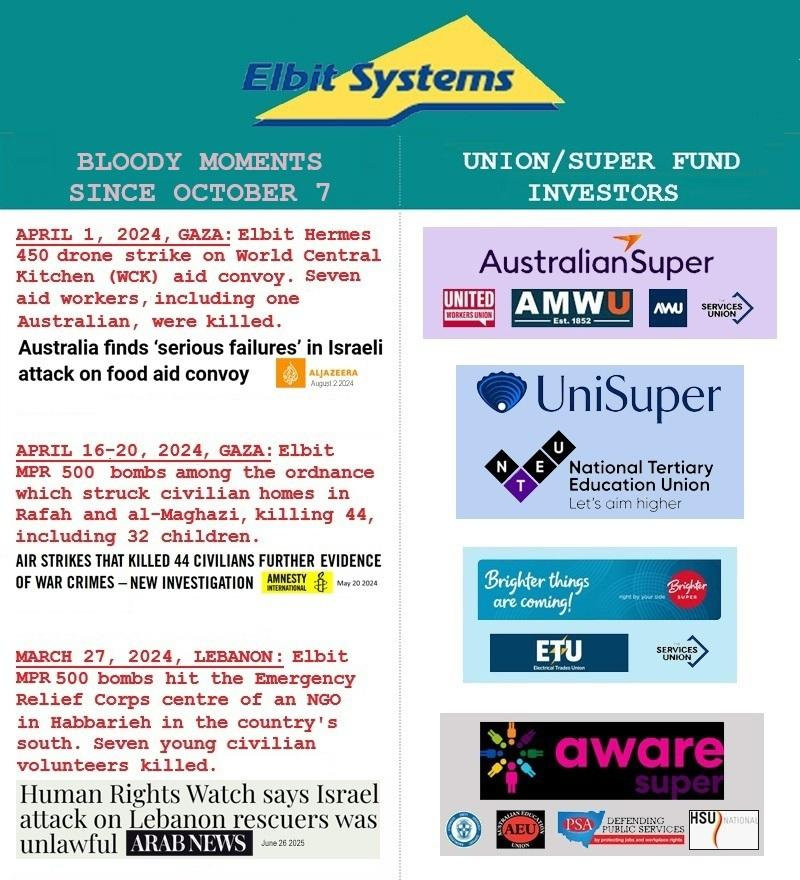
Image: Andrew Gardiner
Phosphorous munition use
In the early stages of this invasion, Human Rights Watch reported white phosphorus munitions literally burning holes in civilian residents of the southern Lebanese town of Yohmor. Banned for use as an incendiary weapon, white phosphorus burns to the bone at over 800°C, inflicting organ damage, “lifelong suffering” and at times outright death.
During earlier conflicts in Gaza, a UN fact-finding mission concluded,
“Israeli armed forces were systematically reckless in (using white phosphorus) in built-up areas”,
and that incidents of its use against hospitals violated the Geneva Convention. Neither these findings nor Israel’s reneging on a pledge to cease and desist have deterred funds like Australian Super, HostPlus and CBUS from investing in ICL, which manufactures white phosphorus at plants in the Negev Desert and St Louis, USA.
Bulldozers as weapons of displacement
With headlines focused on the Persian Gulf, Israelis this year also escalated their often-violent campaign to settle Palestinian lands on the West Bank. “What we are witnessing is a man (Israeli PM Netanyahu) wanted for war crimes and crimes against humanity, openly gloating about (his) defiance of international law (while) destroying Palestinian lives and livelihoods,” Amnesty International’s Erika Guevara-Rosas said.
A major corporate beneficiary of this dispossession is Caterpillar Inc, which supplies the armoured bulldozers, excavators and loaders used to demolish the homes of Palestinians who had every right to live there. The company’s most recent windfall came last year with a $US295m sale, rubber-stamped by the Trump Administration, for equipment enabling the next wave of illegal settlements.
Australian Super, UniSuper, HostPlus and HESTA are among the investors in Caterpillar, a canny move in a calamitous “growth area” if financial gain is your only measure. In the big picture, with the Middle East growing more precarious by the day, funding the instability these companies thrive on may yet burn super fund investors.
Elbit the star “performer”
Elbit Systems had a huge hand in buttressing Israel’s share indices amid the tumult following the October 7 attacks. A big player at 10 per cent of the MSCI’s Israeli Index, Elbit’s “growing order book for battle-proven defense systems” led the way as iShares MSCI Israel jumped 14.1 per cent over the past financial year.
The clear co-dependence between Elbit and Israel’s barbarous military is best summed up by the company’s CEO, Bezhalel (Butzi) Machlis, who revealed at a 2025 investor tele-conference how Elbit embeds its personnel alongside the IDF “during combat”.
“Divestment activists see this as an admission of culpability in slaughter by Elbit’s “war criminals and genocidaires”.
“Make Iran like Gaza”: Chilling insider view from Israel weapons expo
Machlis went on to describe how, in 2024, Elbit “scaled up production massively and met (IDF) demands” for the assault on Gaza. Observers point to an alignment of interests between Elbit (which wants the shekels) and Netanyahu (who needs to stay out of prison), with both seeing “permanent wars” as guaranteeing their respective agendas.
Their interests may be aligned, but is the ongoing Middle East mayhem in the longer-term interests of union members and their super? Energy costs are through the roof, supply chains and trade are unsettled, and global growth is down.
The global MSCI dropped accordingly, down 3.2 per cent for the quarter ending March 31. Yes, the Israel MSCI index is up, but super funds invest the vast bulk of their money elsewhere.
Analysts and academics say a stable Middle East is good for the world’s economy, with flow-on benefits for Australian super funds.
“You can argue that the financial interests of super fund members are undermined by investments that support the Israeli military”, Claire Parfitt, Senior Lecturer in Political Economy at Sydney University, told MWM.
Corruption and war profiteering
Union members whose super funds are in Elbit Systems may not know of the company’s chequered recent past. Just last year, NATO’s procurement arm (NSPA) suspended 13 contracts tied to Elbit or its subsidiary, Orion Advanced Systems, amid a major corruption probe of suspected kickbacks, insider information, and manipulated bids by officials or consultants, which some say gave Elbit a rails run.
If NATO finds Elbit culpable for this malfeasance, don’t expect the four industry super funds with money there to make for the equity exits. Investing in “corrupt” companies isn’t prohibited in Australia, but rather “managed” through a combination of fiduciary duties, prudential standards and ethical disclosure requirements, which activists say you could drive a truck through.
From Vietnam war to Gaza genocide. Where have all the unions gone?
Accusations of war profiteering at companies like Elbit – whose higher ups and major shareholders amass “steamer trunks full of money” as their weapons wreak genocide on Gaza – are indeed comparable to the story of industrialist Oskar Schindler (without the wartime epiphany or ‘list’ of survivors).
A confronting role reversal, to be sure, but that’s what you get when descendants of powerless outcasts in the 1930s and 40s wind up with all the power 90 years on.
“The Nazi genocide cannot be relativised or generalised. It was an unprecedented act of industrial slaughter; a uniquely horrific crime against humanity.” I wrote those words in the Times of London in 2012, while condemning Holocaust denial in the Muslim community. I stand by… pic.twitter.com/jq9q0XidFV
— Mehdi Hasan (@mehdirhasan) October 13, 2025
The genocide in Gaza is just one of the litany of reasons why Australian super funds should divest from Elbit and other companies accused of war profiteering.
But there’s an equally-elongated catalogue of excuses for those funds what have barely lifted a finger to divest from the slaughter, from the legislated primacy of a unionist client’s “best financial interests” (emphasis added) to one the author discovered just last week:
at least we don’t invest in landmines, chemical or biological weapons
How do you define those “best financial interests”? Middle East peace might be a good start, but try convincing brokers with an eye for the quick wartime buck, or a government in Canberra, former foreign minister Bob Carr insists, is captured by Zionist pressure groups.
With only a handful of super funds offering token divestment, and unions often reluctant to act, readers need not despair. They can always take matters into their own hands by switching to one of two super funds that don’t invest in genocide.
Your money, their rules. Super funds support Israel war machine