
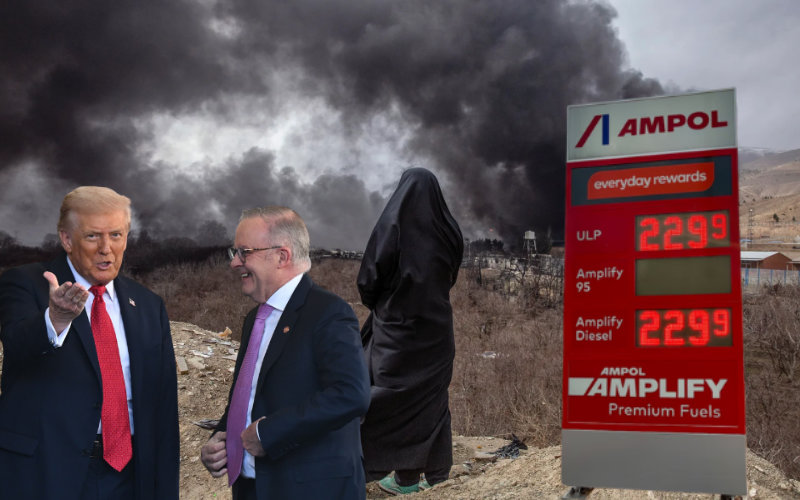
Amid Trump’s delusional speech today and Albanese’s denial of responsibility last night, the Iran war continues at the huge cost of lives and livelihoods. Andrew Brown on the price of Australia’s complicity, first in a series.
Australians know when something is wrong. They feel it every time they pull up at the bowser and watch the numbers run like a poker machine rigged against them.
They feel it at the supermarket, where a bag of groceries now lands with the weight of a small insult. They feel it in the quiet panic of small business, where margins are thinning, freight costs are rising, power bills are biting, and another week of this can mean the difference between staying open and shutting the doors for good.
And yet the story we are told is always the same. Global pressures. Market volatility. Complex conditions. A regrettable tightening. The language is polished, bloodless, designed to anaesthetise. It is the language of people desperate to discuss consequences while keeping their mouths firmly shut about causes.
But causes matter, and one of the great moral and political disgraces of this moment is that Australians are being made to pay for a war they did not choose, an escalation they did not authorise, and
an imperial order they are never allowed to question.
The cost of obedience
Let us speak plainly. Benjamin Netanyahu has dragged the region deeper into catastrophe with a level of impunity that would be unthinkable if the perpetrator were an enemy of the West rather than its favoured client.
Donald Trump, grotesque even by the standards of modern American power, has helped normalise the politics of lawless domination, chest-beating militarism, and unconditional indulgence of Israel’s worst instincts.
And Anthony Albanese, in that uniquely Australian tradition of smiling subservience, has chosen not independence, not courage, not principle, but obedience.
Last night he addressed the nation. It took him three minutes. He told Australians they were paying higher prices because of the war, but could not bring himself to name who started it or who his government has refused to condemn for starting it.
He said “Australia is not an active participant in this war” as though that settles something. As though diplomatic cover is not participation. As though standing in Washington’s corner while Gaza was pulverised, Iran was attacked without provocation, and the Strait of Hormuz became a choke point strangling the global economy is not, in any meaningful sense, participation.
If it were Russia causing this pain, Albanese would say Russia. If it were China, he would say China. But it is Israel and the United States, so he finds no language at all.
He cut the fuel excise, promised loans for businesses, told people to take the bus, told them to enjoy Easter, and closed with an invitation to handle it the Australian way. No anger. No accountability. No naming of the illegal war that caused this, or the governments that launched it.
That is cowardice dressed up as statecraft.
And it comes at a cost not paid in speeches, press releases or diplomatic cables. It is paid in dollars at the pump. It is paid in food inflation. It is paid in disrupted trade, higher shipping costs, market fear, investment uncertainty, and the creeping economic anxiety of a population that knows it is being squeezed but is constantly lied to about why.
Wars in the Middle East do not stay in the Middle East. They ripple through oil markets, shipping routes, insurance premiums, supply chains, business confidence, and currency nerves.
US war on Iran exposes Australia’s frail defence, AUKUS even more
That is not ideology, it’s how the world works.
When the region is set alight, energy prices surge, trade tightens, and every country tied to global supply systems wears the shock. Australia is no exception. We are not floating above history on some lucky island. We are in it. We are exposed to it.
And under Albanese,
we are politically chained to the very forces making it worse.
Fraud upon the people
Because Australians are invited to blame abstractions. Blame inflation. Blame the market. Blame weather events. Blame supermarkets. Blame anyone safely domestic, anyone comfortably local, anyone who keeps the real architecture of power out of frame.
But the truth is uglier.
Australia has a political class that is terrified of offending Washington, petrified of criticising Israel, and structurally incapable of acting as though this country has sovereign interests of its own.
We have leaders who can lecture their own citizens about social cohesion but cannot bring themselves to meaningfully condemn the pulverisation of a captive civilian population. We have a government that speaks endlessly of values while attaching itself to conduct that disgraces the very idea of international law.
At Nuremberg, the launching of a war of aggression was described as the supreme international crime. Those words matter because they remind us that illegality at the top does not remain neatly confined to legal textbooks or foreign rubble. It cascades. It corrupts diplomacy, trade, public morality, and the domestic lives of people far from the battlefield.
That is what Australians are living through now, while paying, materially, for a strategic order built on American arrogance, Israeli impunity, and Australian cowardice.
Albanese’s folly
Anthony Albanese came to power promising something different. A more considered foreign policy. An Australia that could hold its values and its alliances in the same hand without dropping either.
What he delivered instead was a masterclass in managed capitulation. Enough symbolic gestures to placate the progressive base, never enough substance to threaten the alliance managers in Washington or the lobby groups in Sydney. He voted the right way occasionally at the UN when the optics demanded it, then went quiet when the bombs fell on hospitals, on schools, on tent cities of displaced families who had nowhere left to run.
This is not neutrality. This is not complexity. This is a choice. And Australians are footing the bill for it.
The economic pain this country is enduring is not simply the product of bad luck or global bad weather. It is, in measurable part, the downstream cost of a
geopolitical posture that refuses to distinguish between alliance and submission.
Every dollar of oil market volatility is driven by Middle East instability. Every freight surcharge is absorbed by importers and passed to consumers. Every business decision is delayed because the investment environment has turned nervous and unpredictable.
These are not accidents, but consequences.
And they flow, however circuitously, from decisions made in Jerusalem, Washington, and Canberra.
The people bearing those consequences deserve, at minimum, the truth.
They deserve a political class honest enough to say: we tied ourselves to this, we chose this, and here is what it is costing you. They deserve leaders capable of asking whether unconditional alignment with American strategic interests actually serves Australian ones.
They deserve a press that can hold both ideas in its head at once. That it is possible to oppose antisemitism and oppose the conduct of this war. That it is possible to value the American alliance and question the terms on which we have surrendered our independence within it.
Election countdown
What they are getting instead is a government counting down to an election, hoping the anger stays diffuse enough not to crystallise into something directed and specific.
It is already too late for that.
Australians are angry, and they are starting to understand why. Not because they are antisemitic. Not because they are anti-American. But because they are paying a price that their leaders refuse to name, for a war they refuse to question, at the behest of powers they refuse to challenge.
That is not statecraft. That is not an alliance. That is complicity. And complicity, as it turns out, is not free.
The price is being collected at the checkout, at the bowser, and in the quiet ruin of small businesses across this country. Someone should have the decency to say so.