
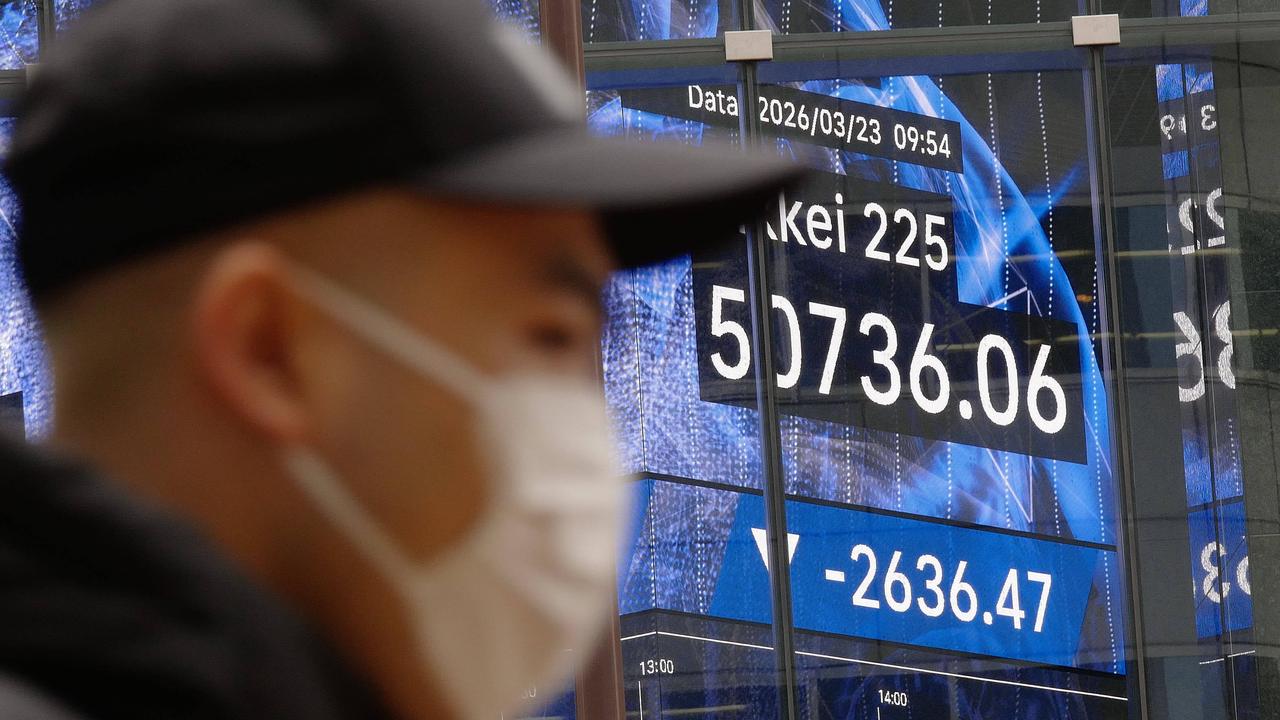
Stocks rose and oil fell on Wednesday on reports the US is seeking a month-long ceasefire in its war on Iran, and had sent a 15-point plan to Iran for discussion, raising hopes for a resumption of oil exports out of the Persian Gulf.
S&P 500 futures rose 0.9 per cent in the Asia morning, European futures lifted 1.2 per cent and Brent crude futures fell about 6.0 per cent to $US98.30 ($A140.47) a barrel.
Equity markets in Australia, South Korea and Japan rose about 2.0 per cent in morning trade and gold, which investors had been selling to take profit after a long rally, rose 1.6 per cent.
“The market is trading the headlines at the moment,” said Kerry Craig, global market strategist at J.P. Morgan Asset Management in Melbourne.
“So there’s a positive tone. The difficulty is now…there are still unknowns about where this actually goes from here and whether there’s anything material in terms of a ceasefire.”
US President Donald Trump on Tuesday said the US was making progress in negotiating an end to the war, including winning an important concession from Tehran, while a source confirmed that Washington had sent Iran a 15-point settlement proposal.
Israel’s Channel 12, quoting three sources, said the US was seeking a month-long ceasefire to discuss the 15-point plan.
Tehran has denied that direct talks have taken place.
Markets have responded well, though cautiously, to rumblings since Monday that the US is looking for an end to hostilities, since it is not really clear if there is much progress on when the Strait of Hormuz can open to oil tankers.
So far this week the dollar is marginally lower – and it was under slight pressure on Wednesday morning – buying 158.8 yen and trading at $US1.1620 ($A1.6605) per euro.
Brent crude prices remain up 35 per cent since the war began and near the $US100 ($A143) a barrel level that’s already causing economic pain for buyers in Asia who are paying up for jet fuel and diesel.
Interest rate markets have also stuck with expectations of fairly extreme responses from central bankers, pricing a series of hikes in Europe, Britain, Japan and Australia in the coming months to tame inflation, and no further US rate cuts.
Benchmark 10-year Treasury yields dropped around five basis points to 4.34 per cent in Tokyo trade and two-year yields fell by a similar margin to 3.875 per cent.
Yields fall when bond prices rise.
“For now, it feels like a market that is reacting rather than anticipating, and until there is clearer alignment from both sides, I would expect price action to remain fragile,” said Marc Velan, head of investments at Lucerne Asset Management in Singapore.
“People are reluctant to chase moves that are entirely headline-driven and can reverse quickly.”
On the ground US, Israeli and Iranian strikes have continued and sources said Washington was preparing to send more troops to the region.
Two people familiar with the matter told Reuters on Tuesday the US was expected to send thousands of soldiers from the Army’s elite 82nd Airborne Division to the Middle East.
The Australian dollar hung around 70 US cents after February inflation data – from before the outbreak of war – was a tad cooler than expected.
War worries have also obscured growing concerns in credit markets where there are signs of stress in private credit and Ares Management on Tuesday became the latest asset manager to cap withdrawals at a private debt fund, spooking investors.
Shares of Ares, which managed around $US623 billion ($A890 billion) in assets at the end of 2025, fell 1.0 per cent on Tuesday. They are down 36 per cent so far this year.