
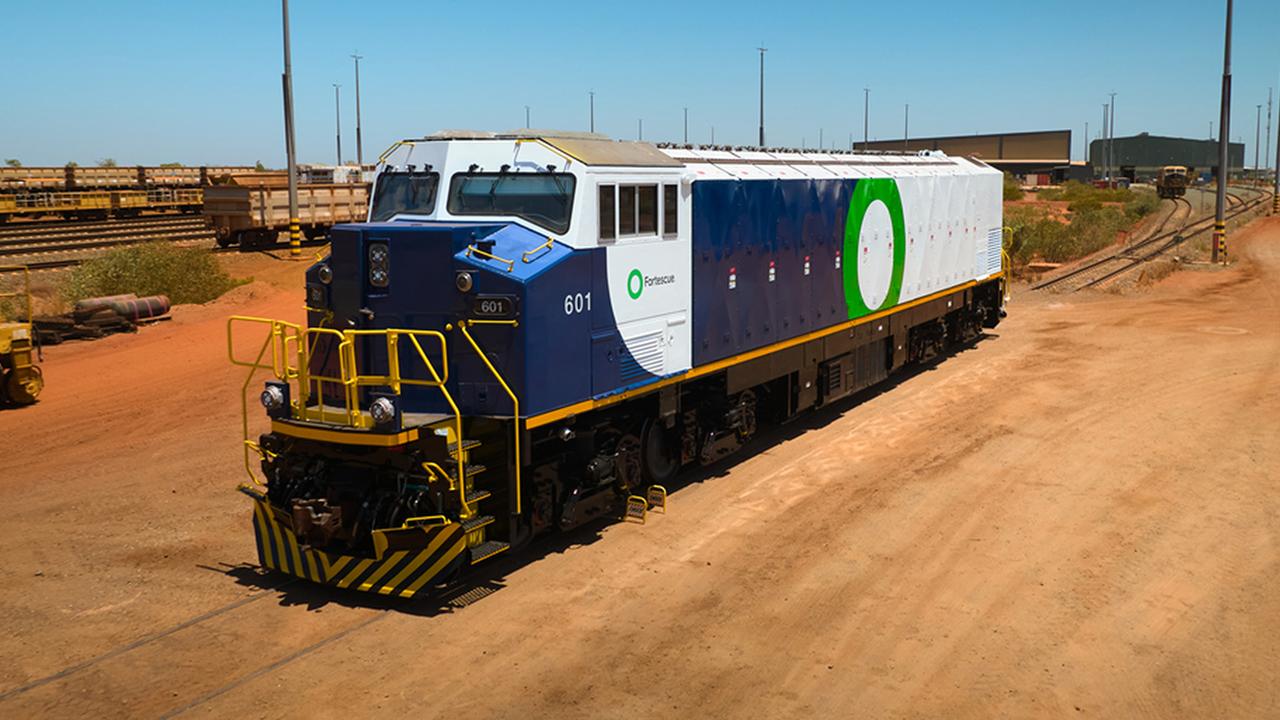
A pair of battery-powered locomotives powered by the world’s largest land-mobile battery are set to help one of Australia’s biggest miners reach its ambitious decarbonisation goals.
Iron ore giant Fortescue estimates the electric train engines will help reduce the company’s diesel use by about one million litres annually.
Fortescue Metals and Operations chief executive Dino Otranto said decarbonising the company’s Pilbara rail network was critical to eliminating fossil fuels from its operations by 2030.
“The commissioning of these battery electric locomotives demonstrates that heavy-haul rail can operate reliably without fossil fuels,” he said.
The locomotives’ batteries, which have a capacity of 14.5MWh, will be powered by renewable energy delivered via Fortescue’s Pilbara Energy Connect program.
“For a mining operation of this scale, decarbonisation only works if renewable energy is firm, reliable and available 24/7,” Mr Otranto said.
“That’s why we’re building an integrated system combining large-scale solar and wind generation, battery storage and transmission infrastructure.”
The plan includes more than 480km of already constructed high-voltage transmission lines to link Fortescue’s energy infrastructure to its operations and rail network.
“This infrastructure enables renewable power to replace diesel and gas, in real time, across the Pilbara,” Mr Otranto said.
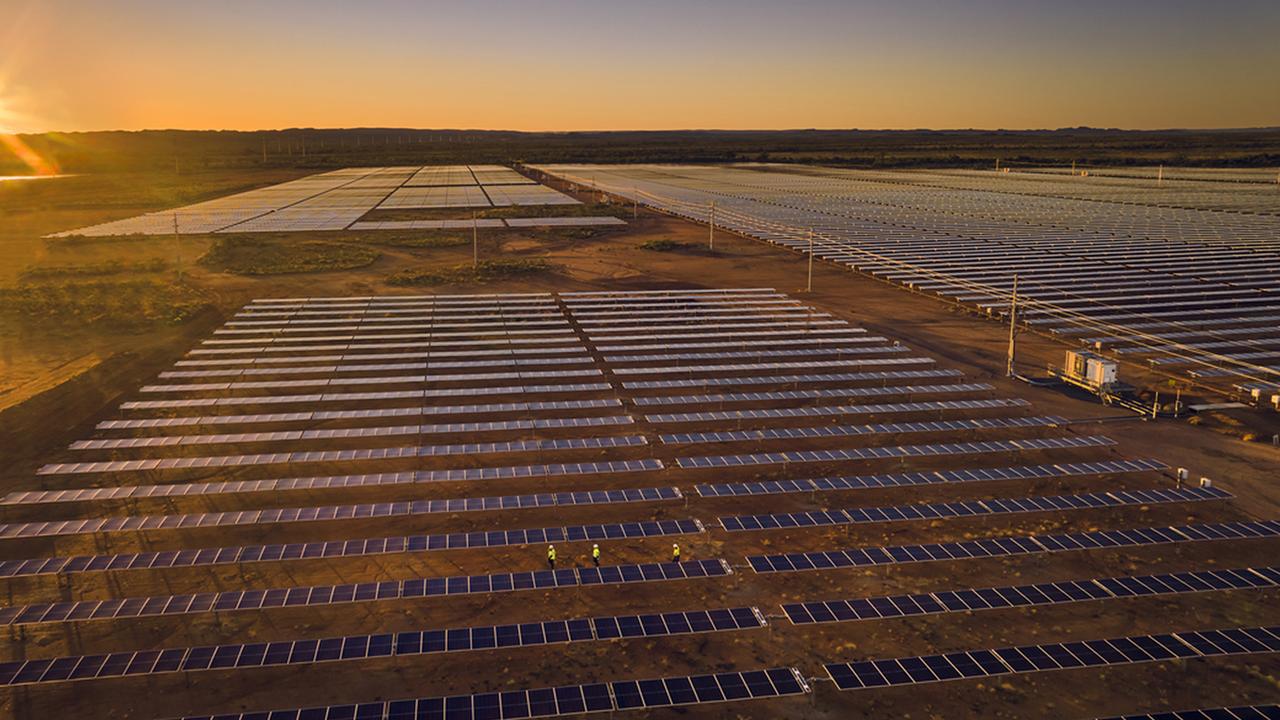
Power for the network will be generated in part by a 100 megawatt solar farm at Fortescue’s North Star Junction site, where a 250MWh battery energy storage system has recently been installed.
The miner has almost finished building a 190 megawatt solar farm at its Cloudbreak operation and has plans to construct two more, potentially boosting energy generation by more than a gigawatt.
Fortescue said its growing portfolio of solar, wind, battery storage and electrified transmission infrastructure will help it reach its 2030 Real Zero Target
It is also the most comprehensive decarbonisation program under construction in the global mining sector.
“Real Zero is about transforming the way we power our assets, move our materials and run our operations, not offsetting emissions but eliminating them,” Mr Otranto said.