
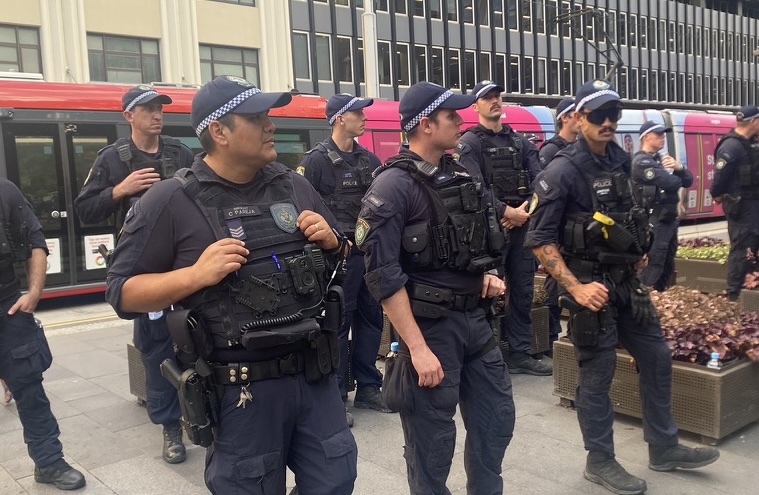
Dunghutti man Paul Silva is calling on supporters to join him in defying NSW’s new protest ban by going ahead with a pre-planned Deaths in Custody march tomorrow. Wendy Bacon reports.
For ten years, the Dungay family have battled unsuccessfully to hold the NSW state government accountable for the killing of Dunghutti man David Dungay in Long Bay prison in December 2015.
Dungay was only 26 and soon to be released when he was killed in Long Bay Prison Hospital on December 29, 2025. A diabetic, he was eating a packet of biscuits when attacked by six guards. They held him face down with force. He repeatedly yelled the words “I can’t breathe” until his heart stopped beating. Resuscitation was delayed and then applied incorrectly.
There have been 618 Indigenous deaths in custody
since the Royal Commission into Deaths in Custody (RCDIC) reported in 1991 on what was then called a ‘national disgrace’. NSW and other governments have failed to act on key recommendations.
At first, NSW Corrective Services found no need for an Inquiry into Dungay’s death. But grieving mother Leetona Dungay and other family members protested outside Long Bay prison. She vowed not to stop until her son’s killers were held to account.
Months ago, Dungay’s nephew Paul Silva and other supporters decided that this year’s rally on January 18 would start with an assembly in Hyde Park followed by a march through the streets of Sydney.
Minns: no protests allowed
But now Dungay’s family and other protesters against deaths in custody have been told they are not allowed their annual march due to the antisemitic massacre in Bondi when two men shot 15 people, nearly all Jewish, on December 14.
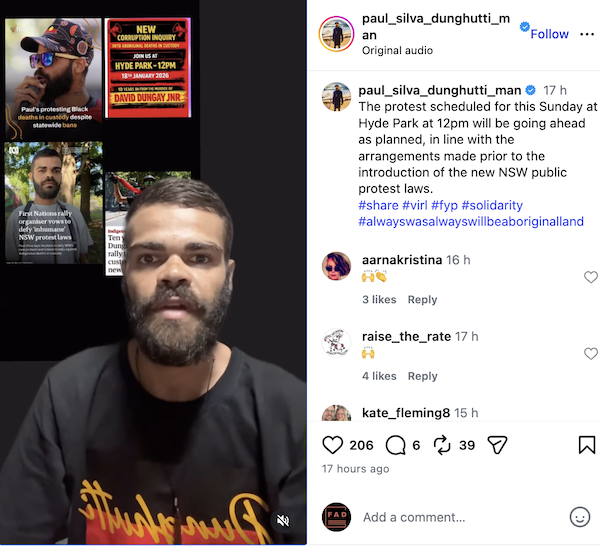
Paul Silva: Instagram
NSW Premier Chris Minns almost immediately linked the horrific Bondi murders with pro-Palestinian protests. He provided no evidence for this claim. Australia’s leading Zionists have long been calling for pro-Palestinian protesters to be silenced. The Minns government recalled parliament to push through new anti-protest laws in the early hours of December 24.
The new laws give police powers to restrict all protests for up to three months “following a terrorism declaration”. Once a declaration is made, no protests on any issue can be authorised in designated areas – in this case, the whole of Sydney.
People can still gather for assemblies but if police decide they are ‘obstructing traffic or causing fear, harassment or intimidation’, they can issue a ‘move on’ order. Refusing the order can lead to arrest.
The effect of the laws is to override the ‘Form One’ system used to authorise protests, which protects people from the arbitrary use of police powers. Organisers of Sunday’s march applied for a Form One approval for their rally and march.
Inhumane laws
On January 6, NSW Police Commissioner Mal Lanyon extended an initial protest ban for another 14 days.
Silva has vowed to march and said he will not be stopped by “inhumane” laws.
The situation is designed to intimidate.
Still, protest assemblies are continuing.
Herzog protest
On Friday evening, hundreds of protesters gathered in Town Hall Square to call for the Federal government to cancel their invitation for the President of Israel Isaac Herzog to visit Australia in coming weeks. More than a hundred police – three deep on the pavement – surrounded them, leaving passers by wondering if there was a safety crisis.
Friday’s protest was stationary and no arrests were made.
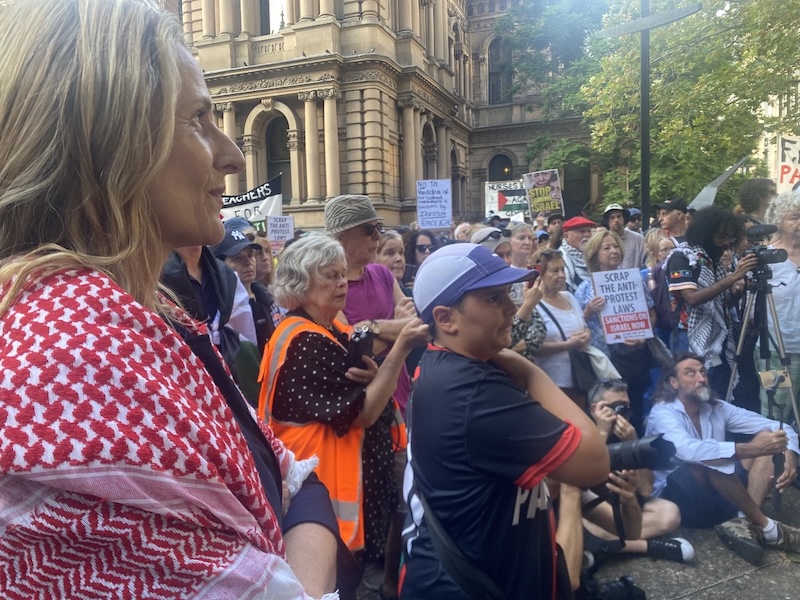
Peace protestors defy Minns ban: Friday
Deaths in custody
Greens Upper House MP Sue Higginson spoke at the protest and called on fellow protesters to join her in solidarity with Deaths in Custody protesters on Sunday. “The best way that we can stand up for the right to protest is to protest,” she said.
To understand why Dungay feels he has an obligation to march, you need to understand his journey with Dungay’s mother and his aunt Leetona through the legal system since 2015.
No one has been held accountable for David’s death.
It took four years before an inquest was completed. Eventually, a coroner found that officers’ conduct was due to poor training, but he did not refer them for consideration for prosecution.
In 2020, prominent criminal barrister (recently appointed as a judge) Phillip Boulten called for guards involved in the deaths to be charged on the grounds that the force used “make a prosecution for manslaughter viable.”
In 2020, then Greens NSW MP David Shoebridge presented a petition signed by 15,000 people to Parliament calling for a further investigation. The NSW government found that it was up to the police to refer the matter for further investigation which they had not done.
Assange lawyer takes the case
In 2021, Leetona Dungay filed a complaint with the United Nations Human Rights Committee arguing that Australia violated David Dungay’s right to life under the International Covenant on Civil and Political Rights (ICCPR). The Australian government is not contesting this case, which is yet to be finalised.
Human rights lawyer Jennifer Robinson is representing Leeton and said the issue of the Australian government’s failure to implement RCDIC recommendations has been raised.
The Dungay campaign has been driven by regular protests which Silva argues are not just ‘political’ but ‘spiritual, cultural and about survival’. He is a member of the Blak Caucus whose campaigns are underpinned by the experience of invasion, apartheid laws and stolen generations and a long tradition of protest going back to the 1930s.
They argue that nearly all wins have been made through protest, including for Aboriginal health and legal services.
Palestinian Action
The Blak Caucus is part of a coalition of groups including the Palestinian Action Group and the Jews Against Occupation which have launched a challenge to the constitutionality of the bans on authorised protests. Their lawyers will argue that the new laws breach the implied right to freedom of communication which is part of Australian democracy.
Researcher at UTS Jumbunna Institute Paddy Gibson has supported the Dungay campaign for justice for many years. He argues that rather than enhancing public safety, the new laws leave everyone who wants to protest less safe, especially Aboriginal people. “‘Move on’ powers are part of the racist system of policing in NSW that we are protesting about.
They are already used against Aboriginal people in NSW at more than 7 times non-indigenous rate,” he said.
Invasion Day, Australia Day
Thousands will usually be expected to attend the annual Invasion Day march on January 26 but this too will be prohibited unless the protest ban is lifted in the coming week.
The Aboriginal Legal Service NSW/ACT is also worried. “Aboriginal people have resisted and protested colonisation for more than 200 years. Since the 1938 Day of Mourning, 26 January has been marked as a day of protest and solidarity against the unjust dispossession of Aboriginal and Torres Strait Islander peoples,” ALS principal legal officer Nadine Miles said.
When justifying the second 14 day ban, Acting NSW Premier Ryan Park said it was “all about keeping the public safe”. Defending the legislation, Premier Chris Minns labelled civil liberties concerns as “overblown”.
But as the Human Rights Law Centre has said, “Anti-protest laws do not prevent racism or keep communities safe, they do the exact opposite. We are now seeing the dangerous consequences of expanded police powers and restricted protest rights.”
Minns’ protest ban: breathtakingly racist, authoritarian, and must be resisted