
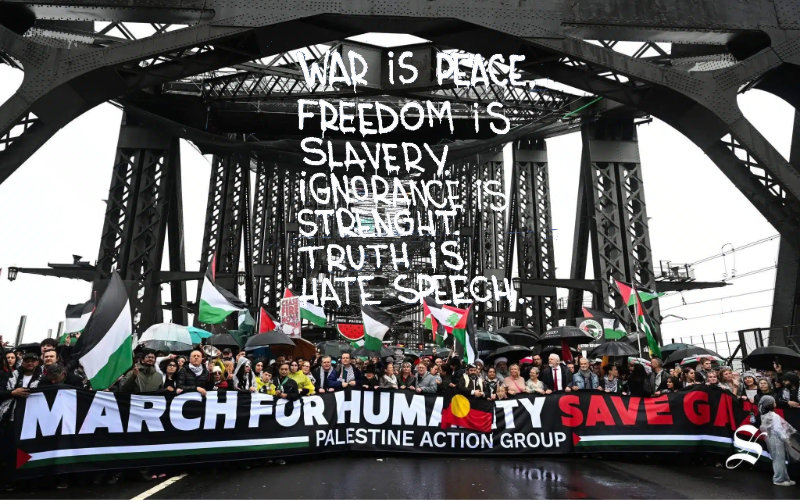
The NSW Government’s plan to criminalise the phrase ‘globalise the intifada’ ignores obvious facts about how language works. Analysis from professional linguist Nick Riemer.
In the wake of December’s antisemitic massacre on Bondi Beach, the orchestrated moral panic over the phrase ‘globalise the intifada’ has itself been globalised. According to the terms of the whistle-stop parliamentary inquiry currently underway, which the government has convened as a fig-leaf over its determination to criminalise Palestine solidarity, this and other slogans are hate speech and incitement to violence.
The phrase ‘globalise the intifada’ has only rarely been used at Sydney Palestine rallies.
This means it could not possibly have played any causal role in the lead-up to Bondi.
That inconvenient fact obviously won’t shake the government’s determination to legislate against it. Nothing can come between the NSW premier and the Zionist bandwagon: not even 70,000 dead Palestinians, and certainly not the truth.
In a world where political power and gratification of the Israel lobby have become indistinguishable, it seems naive to explain that there is a basic error about the nature of language and meaning in the proposition that ‘globalise the intifada’ could inherently constitute hate speech or incitement. The argument should still be made. I do so here as a Palestine solidarity activist currently facing vexatious hate-speech prosecution myself, and as an academic linguist who works on questions of meaning and context.
Zionists v Keane, Riemer, Kostakidis. Australia’s massive test cases for free speech
No phrase ‘inherently’ hateful
The bid to criminalise ‘globalise the intifada’ as inherently hateful or inherently incitement encounters a major problem: no phrase in any language inherently possesses any particular quality or any particular contextual effect. Nothing can be ‘inherently hateful by its nature’ or inherently threaten community safety or ‘cohesion’. The meaning of words is contextual.
The law typically recognises the importance of context in identifying hate speech or incitement. But invocations of context shouldn’t function as a black box that justifies whatever arbitrary interpretation of a phrase suits your political purpose;
if you’re going to claim that a certain meaning arises in a context, you need to make an argument to show how that happens.
Doing this is the job of the branches of linguistics known as semantics and pragmatics. As is standardly accepted in these fields – and as is also commonsensical – the meaning and effect of an expression on a particular occasion is more than a matter of the words used.
The meaning that an expression has in actual use is a joint function of the meaning of the words involved, and of the situation in which they are uttered – who is speaking, to whom, when, in what terms. In linguistics, this difference is captured by the contrast between ‘sentence meaning’ (the conventional literal meanings of the words used) and ‘utterance meaning’ (the contextual meaning of the utterance on a particular occasion of use).
What you see isn’t what you get
In order to properly interpret the contextual meaning of any expression, including ‘globalise the intifada’, it’s important to recognise that sentence meaning and utterance meaning can easily diverge.
When environment protesters use the slogan ‘Kill coal’, the meaning completely overrides the literal sentence meaning: coal is not a living being that can be ‘killed’, so the phrase necessarily takes on the non-literal interpretation of ‘end coal mining’.
No one hearing this slogan could reasonably conclude that it is inciting anyone to violence. These kinds of interactions between sentence and utterance meaning are not a special case: they are what make words meaningful in the first place.
They also have a crucial consequence: even if ‘globalise the intifada’ could be interpreted as literally constituting incitement to violence, which, as we’ll see, it can’t – this would not mean this literal meaning was contextually present every time it was used: as we have just seen,
literal meaning can be altered by contextual factors.
Are you feeling incited yet?
It’s useful to ask what it would take to identify a phrase like ‘globalise the intifada’ as inherently incitement or hate speech. To pull off this feat, it would be necessary to show both that its literal or sentence meaning necessarily constituted incitement, and that this meaning was never altered or overridden by the phrase’s contextual (or ‘utterance’) meaning. As it turns out, doing this is impossible.
If ‘globalise the intifada’ was inherently hateful in its meaning, then this would mean that it has that quality on every occasion that it is expressed. Otherwise, that meaning is not inherent, but context-dependent. But if ‘globalise the intifada’ inherently counts as incitement, then that must also be the case in this very sentence. If ‘globalise the intifada’ is inherently hateful, then my writing about it must count as incitement to violence.
Obviously, that’s absurd. When you read those words, you weren’t incited to anything. And for obvious reasons, I mentioned the phrase ‘globalise the intifada’ in order to discuss its possible status as hate speech. I was engaging in analysis, not incitement.
This point is so obvious that it is embarrassing to even make it.
It is, however, essential, and should be enough to debunk the idea that ‘globalise the intifada’ could inherently constitute hate speech.
What an expression means is a contextual matter – a matter of who says it, when, to whom – and no accurate assessment of its meaning can be made without considering those parameters: exactly the ones that Chris Minns and Sussan Ley want to block their ears to.
‘Intifada’ in NSW
If the relevant context for ‘globalise the intifada’ is pro-Palestine protests, then it might be a nice idea to ask what these protests are actually like. Who attends and speaks at them? What do they want? What do they say? How do they behave? This will provide the best evidence of protesters’ overall beliefs and intentions, and, as a result, of the likely interpretation of their slogans.
As I’ve documented previously on MWM, slogans with the word ‘intifada’ at Palestine demonstrations in Sydney have been used by the same demonstrators holding humanitarian placards calling for peace, justice and equality. In this light,
interpreting people who use ‘intifada’ as wishing violence on anyone is beyond implausible.
And what about intifada’s literal meaning? As is now well understood by everyone except the NSW state cabinet and their counterparts elsewhere, ‘intifada’ means ‘uprising’ or ‘shaking off’. Like ‘uprising’ itself, it is a highly general term. It can refer to a wide array of very different situations: participation in protests and marches, children throwing rocks at soldiers, armed uprisings, civil disobedience, non-violent direct action, and so on.
The principle that any word with a general meaning which might be open to interpretation as incitement should be banned would entail banning vast numbers of political slogans, including the ‘Cancel Russia’ slogan used about Ukraine and the environmental slogan ‘Kill pollution, or it will kill you’.
Neither of those slogans could reasonably be seen as incitement. Interpreting ‘globalise the intifada’ as hate speech is just as far-fetched and just as remote from anything protesters have in mind.
Antisemitism Bill. Same shirt. Different stairs. Years in prison.
What do protesters mean?
Another way of determining the intended meaning of an expression is to ask the people using it what they mean by it.
As representatives of the Palestine solidarity movement have repeatedly explained, calls for an ‘intifada’ in the West are to be understood as
calls for political opposition, in solidarity with the people of Palestine, to Israel’s occupation, apartheid and genocide.
Aspirations for peace, justice and equality for everyone in historic Palestine, regardless of their ethnicity, religion, or background, have regularly been articulated by speakers at demonstrations.
They are always met with enthusiastic applause. When the numerous Jewish participants chant ‘long live the intifada’, they are not calling for violence against themselves and other Jews: they are calling on society to support Palestinians in their struggle against genocide.
Demonstrations vs terrorist attacks
It’s essential to take into account another aspect of the context of any slogan used at a demonstration: the fact that it is, precisely, used at a demonstration. Demonstrations are non-violent, political means of supporting particular points of view. People attend demonstrations in order to ‘demonstrate’ their priorities to others, in the hope that this will lead to political change. This means,
demonstrations are the opposite of direct action and, even more, of terrorism.
If protesters intended ‘intifada’ to refer to a violent uprising here against Jewish people, would it really make sense to chant it at rallies week after week, and then go home and sit on their hands? Obviously not. There is no evidence that the Bondi gunmen attended Palestine protests.
The fact that protesters’ activity was limited to protesting and other forms of non-violent political action is clear evidence that they did not aspire to any – obviously, abhorrent – uprising against Jews.
It is striking that the main criticisms of the Palestine protests come from people who would never attend them on principle, and who therefore have no direct experience of them. In this, Minns and other politicians have, again, magisterially exempted themselves from any responsibility to the facts, and any obligation to make policy about the real, actually existing world.
The disgraceful slanders used against Randa Abdel-Fattah to justify her sacking from Adelaide Writers’ Week are just the most recent example. Whenever it is a matter of Palestine and Palestinians, the fantasy principle has free rein.
Houdini. Apologies bring Adelaide Festival back from death by own hand
December’s murders at Bondi were criminal atrocities. Governments owe it to the victims and their families to objectively and correctly identify the factors responsible for them, not indulge in fly-in-fly-out policy making rubber-stamped by sham inquiries.
Demonstrators against genocide should not be stigmatised and slandered on the basis of prejudice, moral panic or fabrications. Far from benefitting anyone, this just takes us further down the dark road of censorship and authoritarianism onto which the Minns and Albanese governments, with their Pavlovian restrictions on protest and free speech, are already leading us.
Port Arthur via Oslo to Bondi. History repeats, lessons ignored at our peril