
Plan a trip to the NRL in Las Vegas, or the World Cup Soccer? That old social media post bagging Donald Trump could make it the trip from hell. Andrew Gardiner investigates the US tourism nightmare.
Never shy of the odd hyperbolic spiel, the NRL events team stayed true-to-form when it dubbed February’s two game Las Vegas rugby league showcase as “the ultimate bucket list event!”. “Join the excitement as the NRL takes centre stage (and) stay at a central 4-star hotel in the City of Lights” for just $4,499 twin-share, the spruikers went on.
A word of caution before you part with all that hard-earned loot: check every one of your emails, texts or social media posts over the past five-to-10 years for anything deemed “unacceptable” by those currently running things in the Land of the Free.
Chances are you could be sent straight home on the next available flight or, worse, detained in an Immigration and Customs Enforcement (ICE) facility for months if you’ve sent anything deemed critical of Donald Trump or his administration, something ‘antisemitic’ in nature or otherwise proscribed (the latter list varies from month to month in these turbulent times).
Ten years of emails for a tourist visa
The Trump administration has ramped up attempts to pre-screen and monitor sports fans, tourists, students, researchers and business travellers alike, planning a slew of “intrusive” demands for their every last email address over the preceding decade (for those seeking a 90-day visa waiver) and all their phone numbers, family members’ names/contact details, dates of birth, home and IP addresses, together with metadata from submitted photos if they’re applying for the Electronic System for Travel Authorisation (ESTA).
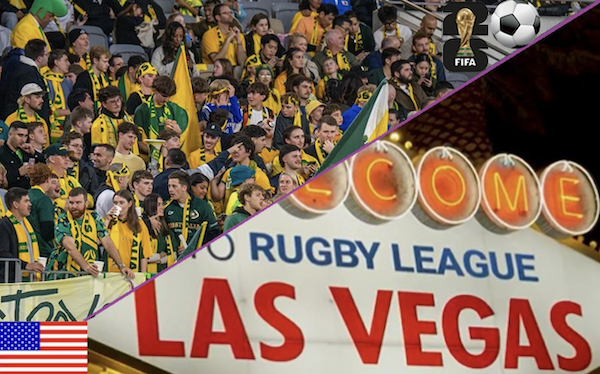
Image: Andrew Gardiner
The Washington-based Electronic Privacy Information Center (EPIC) says the new vetting regime “calls into question how (a visitor’s) information is being used”. “The (Trump) administration has gone after people who espouse views it doesn’t like (so) you can imagine there are some similar problems that you may have with emails that you would find in their social media vetting”, EPIC’s lead counsel, Jeramie Scott, said.
Anyone thinking they can dodge the system via anonymous social media handles or burner email accounts would be well-advised to assume the worst rather than hoping for the best.
Palantir AI to target Israel critics
ICE is using automated artificial intelligence (AI) to target those who speak out on Gaza or other taboos.
Software such as Palantir’s Immigration OS allows for constant mass monitoring, surveillance, and assessment of visitors. Another tool, Babel X, ‘assigns’ opinions to tourists or students – based on social media posts and online behaviour – in an arbitrary and imprecise fashion not dissimilar from Australia’s egregious RoboDebt scheme.
Fans of next year’s Las Vegas NRL combatants – the Dragons, Bulldogs, Knights and Cowboys – may well see a trip to Sinatra’s second home as the trip of a lifetime, but it’s thousands of dollars down the tubes if they’re caught calling Trump a clown way back in 2020.
The same goes for Socceroos fans, whose team qualified for the 2026 World Cup in June-July. Co-hosted by the US, Canada and Mexico, Australia is scheduled to play two of its three group stage fixtures in the American cities of Seattle and Santa Clara.
World Cup Soccer fans face rigorous checks
“This policy represents the ‘thin edge of the wedge’ regarding civil liberties and fan rights,” Football Supporters Association Australia chair, Patrick Clancy, said.”While Australian (soccer) fans face rigorous checks, supporters from nations such as Iran or Haiti have been denied entry entirely”.
Iran has qualified for the 2026b World Cup.
Fans of fellow World Cup qualifiers Senegal and Côte d’Ivoire may also be locked out after Trump imposed partial travel bans on both last week. Along with fans from Haiti and Iran, arrivals from these countries (plus visitors from another 36 mostly third World countries subject to travel bans) are, for the most part, from racial or religious cohorts Amnesty International has accused the Trump administration of actively mistreating.
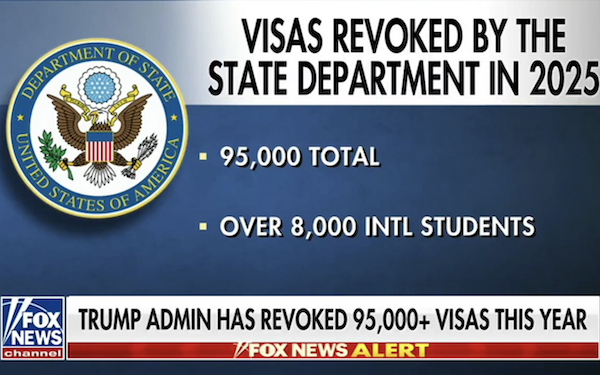
Image: X
Australia’s 5,000-odd students in the US would, likewise, be well advised to watch their ps and qs, especially those with any sympathy for the plight of Palestinians. AI by Palantir and Babel is specifically aimed at expressions of such sympathy, which you’re perhaps more likely to encounter from Australians at Harvard or Cornell than from their rugby league-loving compatriots in Las Vegas.
The curse of Palantir
Washington’s AI-driven “Catch and Revoke” scheme has been central to the deportation of more than 8,000 international students via social media monitoring, visa status tracking, and automated threat assessments of international students.
“These technologies enable authorities to swiftly track and target international students and other marginalised migrant groups at an unprecedented scale and scope … creating a climate of fear for international students across schools and campuses,” Amnesty International’s Erika Guevara-Rosas said.
While the exact number of Australian students deported from the United States is not publicly available, the International Education Association of Australia (IEAA) reports that Australians were definitely among those deported, with others feeling targeted and pondering leaving of their own accord.
“There’s definitely momentum to explore other options away from America,” IEAA chief executive Phil Honeywood told News Corp.
The Trump Factor
“It’s the combination of the Donald Trump factor, the concern about how other nations have been dealt with, and genuine concerns about privacy and information being exposed to people other than their family and friends.”
MWM reached out to the US Embassy in Canberra for its take on “catch and revoke”, but had not heard back by publication time. However, Washington’s defence of the scheme is perhaps most succinctly summarised by Trump’s ambassador-designate to nearby Malaysia, Australian Nick Adams: “If (foreign students) are going to support Hamas, they should not be here. It’s a privilege to study in the United States, not a constitutional right” he wrote, quoting Republican political strategist Shermichael Singleton.
“Exactly right! The American people support deporting pro-Hamas student visa holders”, Adams agreed. Readers might recall Nick Adams as the former Ashfield (Sydney) councillor who rarely attended council meetings and abused a reporter who asked him about it, before turning his hand to a lucrative role as Florida-based, Trump-boosting “alpha male”.
US tourism in freefall
If you’re thinking of a trip to the States and you’re alarmed by any of the above, you’re not alone. Visits to the US dropped again in November the seventh straight month with a year-over-year decline.
Australian visitors dropped 13 per cent year-to-year in November, with just 57.478 venturing across the pond, per the US National Travel and Tourism Office (NTTO). This compares with just a five per cent equivalent drop in visitors from Europe, and marks a trend in which Australians avoided the US in favour of other destinations in greater numbers than visitors from all other continents (with the exception of travel ban-hit Africa).
NTTO doesn’t expect a full recovery to pre-Covid inbound tourism levels until 2029, oddly enough the year Trump’s second term ends. Rugby league fans might want to put their travel plans on the back burner until then.
Wheelies on Boxing Day. Did Barnaby Joyce ruin Christmas for e-bike riders?