
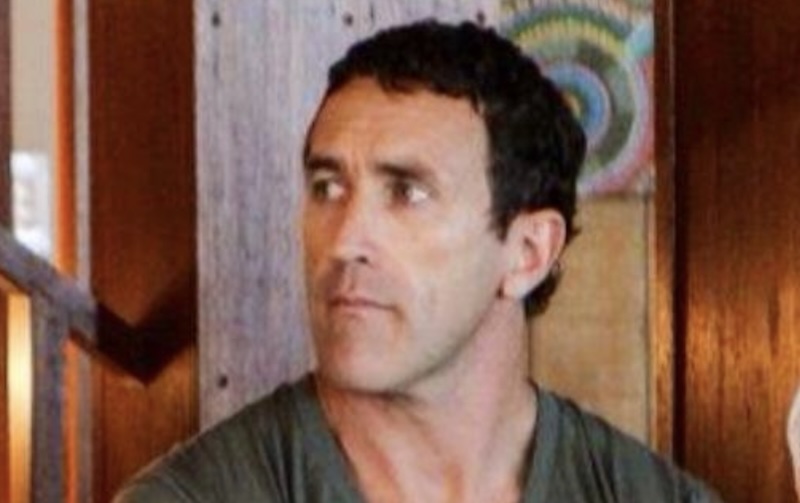
Police have quietly dropped all charges against Andrew Brown, the man arrested for wearing a Fuck Israel tee-shirt. Michael West reports.
Just before Christmas, as a nation grieved and feuded in the truculent aftermath of the Bondi terror attacks, police dropped all three criminal charges against the man who wore a Fuck Israel Fuck Zionism tee-shirt in Sydney’s eastern suburbs.
Andrew Brown, a businessman, Palestinian supporter and former deputy mayor of Mosman, will be seeking costs and a damages claim against NSW Police. He had intended to defend the claims by invoking Australia’s Constitution and its implied protections for political communication. And had the money to do it.
Brown was arrested more than a year ago; in public on Bondi Beach, then he says he was led along the sand, paraded around Bondi “like a prop in a public lesson”. Charges followed. Bail conditions followed. A year of legal struggle ensued. And now, he says, the whole thing has been quietly abandoned.
Condemns Bondi attacks
In an interview with MWM, Brown condemned the Bondi attacks “without qualification”.
“I want to reiterate my deep sympathy for the victims of the Bondi Beach mass shooting, their families, and everyone traumatised by that horrific event. The violence was senseless and devastating. Nothing I have said or done was ever intended to diminish that tragedy or exploit it in any way. I condemn it entirely.”
This story is about power, process, and what happens when the machinery of the state is used in a way that feels less like law enforcement and more like message sending.
Three charges are gone. Two alleged causing offence. One alleged stalking intimidation. Withdrawn and dismissed.
On its face, that is not unusual. Cases are dropped all the time. Evidence collapses. Witnesses vanish. Prosecutors reassess. The system is imperfect and sometimes it corrects itself.
But Brown says this was not a correction. He says the outcome was predicted from the first week, including by those responsible for prosecuting him.
He claims the case was pursued anyway, not to win, but to wear him down, push him out of Sydney’s eastern suburbs amid the rising turmoil in Israel and the occupied Palestinian territories, and serve as a warning to anyone else tempted to bring protest to wealthy, influential streets.
Flawed prosecution a strategy
If that is true, it is not simply a flawed prosecution. It is a strategy.
The pivotal detail, Brown says, rests in a pair of phone calls.
Brown says that early in the matter, the police prosecutor rang his barrister. The prosecutor, according to Brown, said he had reviewed the evidence across the matters and could not see how police could obtain a conviction. The prosecutor said he was recommending the charges be withdrawn.
Two weeks later, Brown says, the prosecutor rang again. This time he said his position had changed, not because the evidence had changed, but because he had received instructions which had come directly from the Commander of Strike Force Pearl. Proceed with all matters regardless of the likely outcome.
There are only a handful of phrases in legal life that make professionals sit up straight. Regardless of the likely outcome is one of them.
If Brown’s account is accurate, it raises a stark question. What is a prosecution for, if not the pursuit of a conviction grounded in evidence? It also raises a second question. Who gets to decide that a case should continue when the prosecutor says it cannot succeed?
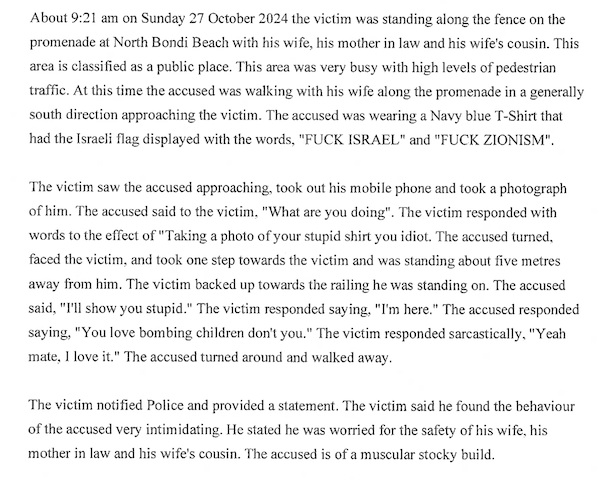
NSW Police Force Contents of Brief of Evidence
The following detail is quieter, and arguably more revealing.
Brown says one of the arresting constables told him at Waverley Police Station that most officers there supported his cause and the T-shirt he was wearing.
The constable, Brown claims, described the case as nonsense.
He said they were told to go and arrest Brown. He doubted it would ever reach Court, and if it did, it would be over in minutes.
In other words, Brown claims, even at station level, the arrest was understood as an instruction, not an evidentiary response.
Then comes the third strand, the one that moves this beyond one man’s clash with the police.
Brown says several former police and the partners of serving and former officers from Waverley Local Area Command have reached out privately. He says these contacts described pressure within that command to do what the local Jewish community demanded in politically sensitive matters.
The media pile-on
He says one former officer told him that when he resisted this pressure, he was moved to desk duties and then shuffled out of the command.
These claims are serious. They are also, at this stage, allegations. But they are not the kind of allegations a functioning institution should wave away with a shrug. They describe a culture where external political pressure is not merely felt but enforced, and where internal dissent is punished.

Daily Tele quick to pounce
While the legal process unfolded, Brown says, another parallel process ran beside it.
He says he was ridiculed and condemned in mainstream media before the facts were tested. He says he was doxed and subjected to attempts to destroy his business relationships. That kind of pressure is hard to measure, but easy to recognise.
It is not only the Court that punishes. Sometimes the community does too, with glee.
Then there was bail, extraordinary bail
Bail is meant to manage risk, not to manage politics. Brown says the bail and bond conditions imposed through Waverley Local Court were extraordinary, effectively excluding him from the eastern suburbs for close to a year. He says the practical effect was banishment, achieved without a conviction.
If that is true, the case becomes a familiar modern pattern. Not jail, just constraint. Not a sentence, just exhaustion.
The process becomes the penalty.
Brown says he did not retreat. He says he publicly welcomed the matter being heard, and that he would fight it. Then, once it became clear he would not fold, the case collapsed. Charges were withdrawn.
There is a final dimension that drags this out of local policing and into constitutional terrain.
Brown says he lodged a challenge to the constitutionality of the charges, arguing they offended the implied freedom of political communication and the practical freedom of political participation that flows from Australia’s constitutional system. He says the NSW Attorney General joined the proceedings to defend the charges.
If that is accurate, it raises questions that a responsible government should answer in daylight. Why commit the resources of the state to defend charges that, on Brown’s account, prosecutors had already assessed as not capable of success. Why insert the executive into a prosecution now withdrawn, in a context where fundamental political freedoms were being argued.
And then, after all of that, silence.
There was no explanation, Brown says. No apology. No public accounting of why the case was continued. No statement about whether command instructions were issued. No clarity about what Strike Force Pearl did, and why.
When the state brings charges, it borrows the public’s authority. When it withdraws them, it owes the public an explanation, particularly when there are credible claims that the case was pursued as deterrence rather than justice.
So the questions now are not rhetorical. They are investigative.
Who authorised this, and why?
Who authorised the instruction, if it exists, to proceed regardless of the likely outcome? What was the basis? Who documented it? What did the prosecutor record after the first call, and after the second? What role did Strike Force Pearl play, and under what mandate?
Were NSW Police resources expended on a prosecution understood internally to be unsustainable? Were there internal concerns raised and, if so, by whom? And are there officers who can corroborate a culture of political pressure within Waverley Local Area Command?
The Attorney General’s involvement raises another set of questions. Who authorised the intervention? On what basis? What advice was received? And why was it considered appropriate for the state to defend charges that were later withdrawn?

Andrew Brown on the Sydney Harbour Bridge March for Humanity
NSW Police should now be asked for a detailed public statement addressing these questions. Not a line about operational matters. Not a shrug. A statement that explains decision making, oversight, and safeguards. If the institution believes the allegations are wrong, it should say so, and it should explain why. If it believes mistakes were made, it should say that too, and explain what changes.
This is not about one man’s hurt pride. It is about whether the criminal process can be used to silence political protest through attrition and exclusion, especially when powerful local interests want the noise to stop.
Because if this can be done once, in plain sight, and then quietly abandoned, it will not be an aberration.
It will be a template.